The Darkness We Live With

- Update Time : Saturday, April 25, 2026
- 71 Time
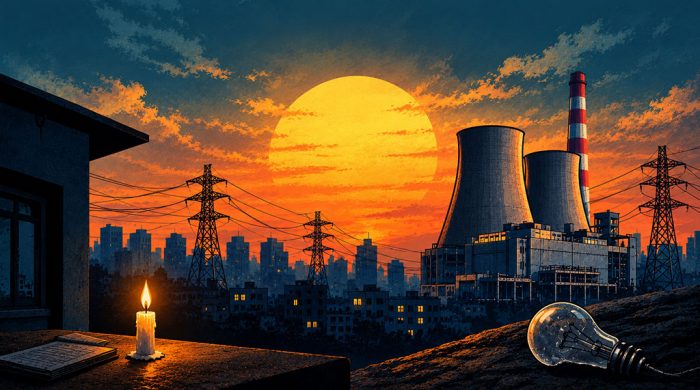
The nights in rural Bangladesh no longer belong to rest. They stretch, heavy and airless, as electricity disappears without warning. A fan slows, then stops. The heat stays. In many villages, power now vanishes for five to six hours each day, and in some places, far longer. Reports from different districts suggest that outages often extend deep into the night, sometimes covering most of the day during peak shortages. These are not just figures. There are nights when sleep breaks into fragments, when children sit with open books they cannot see, when the body refuses to cool. Bangladesh once spoke with pride about electrification reaching nearly every home. That promise still exists in numbers. Yet the lived reality tells a different story. The connection is there, but the light is not. What remains is a quiet endurance that rarely finds its way into national conversation.
Behind this darkness lies a system under strain. The country is facing a power shortfall that has recently exceeded 2,000 megawatts, with concerns that it may rise further during periods of high demand. Peak demand continues to hover between 15,000 and 16,000 megawatts, placing constant pressure on supply. Fuel shortages have pushed a large number of power plants into partial or complete inactivity, limiting their ability to respond to rising demand. Gas supply, which supports much of the electricity generation, remains significantly below requirement, creating a persistent gap that cannot be quickly closed. At the same time, disruptions in imported electricity have added further pressure, exposing the vulnerability of relying on external sources. Rising temperatures intensify the crisis, as demand increases across both urban and rural areas. These are structural pressures that build slowly, yet their effects are felt instantly by those who rely on a stable flow of power for everyday survival.

That human impact appears most clearly in the divide between city and village. In urban centres, electricity may fluctuate, but prolonged darkness remains relatively rare. In rural areas, the situation unfolds differently. Load shedding follows a pattern that tends to protect high-demand commercial zones, while village grids experience longer, more frequent outages. Even a moderate national shortage can translate into extended blackouts in these regions. This pattern reflects more than technical necessity. It reveals a structure that quietly ranks whose comfort matters more. A city continues its rhythm. A village pauses. The contrast is not always visible in official narratives, yet it is deeply felt in daily life. Electricity begins to reveal something deeper than infrastructure. It exposes a hierarchy that shapes experience, opportunity, and even the sense of belonging within a shared national space.
The consequences move far beyond inconvenience. Reports from regions such as Khulna indicate that shrimp farmers face serious risks when aeration systems fail during outages, putting entire stocks at risk. In agricultural districts, irregular power supply disrupts irrigation cycles, affecting crop growth and seasonal planning. In northern areas, small businesses often operate at reduced capacity, while the cost of running generators cuts into already limited earnings. A shop that once stayed open now closes early. A workshop slows its pace. Students preparing for examinations try to read under candles or the dim light of a phone, their focus breaking under heat and fatigue. Even communication begins to collapse. Mobile network towers rely on electricity, and their backup systems generally last only a few hours. When outages extend beyond that, signals weaken or disappear entirely. Entire communities become disconnected. A call cannot be made. A message cannot be sent. The darkness deepens into silence.
This is a crisis that unfolds without spectacle. It does not arrive with a single dramatic moment. It settles into daily life, repeating itself until it begins to feel ordinary. Yet its impact grows with each passing day. When one part of the country remains illuminated while another waits in heat and stillness, a quiet message takes shape. Some lives move forward. Others are forced to pause. A child who studies in darkness carries that experience into the future. A farmer who loses income carries it into the next season. These are not isolated disruptions. They accumulate, shaping opportunity and reinforcing inequality in ways that are difficult to reverse. Electricity, in this context, becomes more than a service. It becomes a measure of presence, a reflection of priorities, and a silent indicator of whose lives are allowed to remain visible.
There is also a deeper layer to this crisis that often remains unspoken. Energy is closely tied to dignity, yet dignity rarely enters discussions about power supply. When a household cannot keep a light on, it loses more than comfort. It loses a sense of control over daily life. Women working inside homes face longer hours of physical strain without basic appliances. Elderly people endure heat without relief, their health quietly at risk. Young people begin to associate rural life with limitations, feeding a steady migration toward cities already under pressure. The imbalance grows stronger with each season. What appears as a temporary shortage slowly reshapes social patterns, economic choices, and even personal aspirations. If this condition continues, it will leave marks that extend far beyond electricity itself. It will redefine who gets to imagine a future with ease and who must continue to struggle within the boundaries of darkness.
_____________________________________
The writer is an Assistant Professor in the Department of Philosophy at IUBAT and is currently on study leave, residing in Oslo, Norway