Quader, Arafat, 5 others to die for July atrocities

- Update Time : Tuesday, September 15, 2026
- 36 Time

The International Crimes Tribunal-2 on Tuesday sentenced Awami League general secretary Obaidul Quader, former state minister Mohammad Ali Arafat and five others to death for crimes against humanity committed during the July 2024 uprising.
The other recipients of death sentence are Awami League joint general secretary AFM Bahauddin Nasim, Juba League chairman Sheikh Fazle Shams Parash, its general secretary Mainul Hossain Khan Nikhil, and Chhatra League leaders Saddam Hossain and Sheikh Wali Asif Inan.
The three-member tribunal, headed by Justice Md Nozrul Islam Chowdhury, delivered the verdict in the case against the seven absconding leaders over their alleged superior roles roles as senior leaders in atrocities committed during the uprising.
All seven accused were tried in absentia as they remain in hiding.
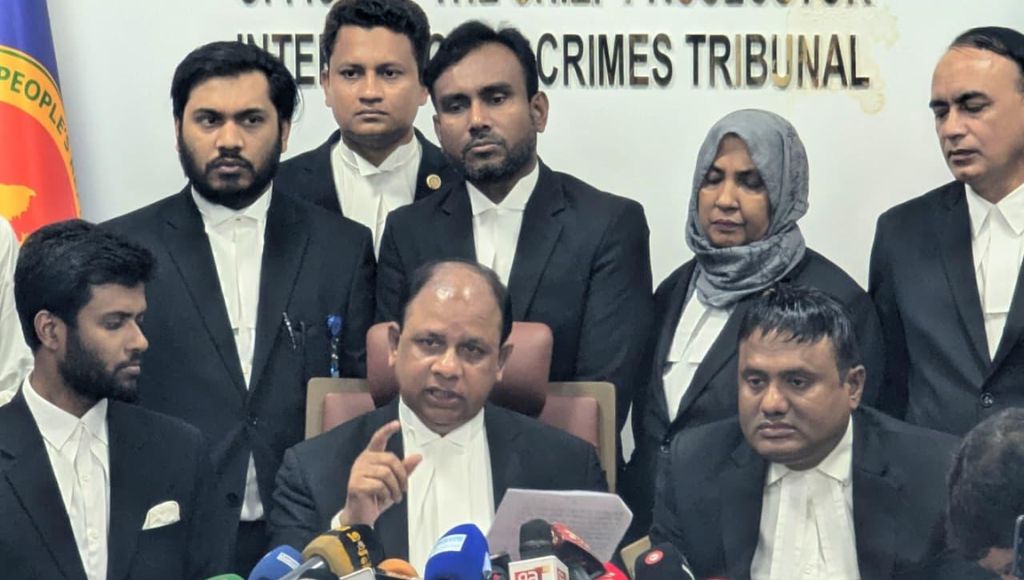
Earlier, during the trial of the case, prosecution argued that the accused were responsible for the killings and injuries during the mass uprising under the doctrine of civilian superior command responsibility.
It argued that the accused exercised authority over party leaders and activists who allegedly carried out orders to suppress protesters.
The prosecution contended that the Awami League, Juba League and Chhatra League played major roles in attacks on protesters.
It said that Quader, Parash and Nikhil used speeches, statements and organisational communications to incite their activists to attack protesters.
The prosecution cited forensic-verified recordings of conversations involving Quader and Parash and between Quader and the then Chhatra League president Saddam Hossain.
The prosecutor of the case argued that the recordings showed political instructions that were passed through party networks.
The prosecution linked these orders to the July 15 attack on protesters at Dhaka University, in which more than 300 people were reportedly injured.
Citing witness testimony, official records and UN findings, the prosecution said that the police fired more than 300,000 bullets during the uprising, including more than 95,000 in Dhaka.
It said that lethal weapons were used in 40 districts and clashes occurred in 50 districts.
The prosecution also referred to evidence involving 7.62mm ammunition, the killing of children, helicopter shootings, the burning and disposal of bodies, the alleged killing of Yamin after he was thrown from an APC, and attacks on hospitals.
The prosecution argued that the scale, geographical spread and coordination of the violence established a widespread and systematic attack on civilians, a key element of the crimes against humanity charges.
The state-appointed defence lawyers for the accused persons acknowledged that many people were killed and injured during the uprising but argued that the prosecution failed to prove that their clients were present at the scenes.
The state defence lawyers claimed that prosecution witnesses could not identify who killed the protesters.
According to the charges, Quader, acting with law enforcement agencies and leaders and activists of the Awami League, Juba League and Chhatra League, ordered, instigated, aided and facilitated widespread and systematic attacks on unarmed student protesters between July 1, 2024 and August 5, 2024.
The prosecution alleged that after a 14-party alliance meeting at Ganabhaban on July 19, Quader told journalists that a curfew had been imposed with a ‘shoot at sight’ order.
It further alleged that on July 17, Sheikh Hasina spoke with Chhatra League general secretary Sheikh Walid Asif Enan, who later instigated and supervised attacks on protesters at Dhaka University and other educational institutions.
According to the charges, coordinated attacks by law enforcement agencies and party activists on July 18 left at least 23 people dead and about 2,500 injured.
The prosecution also cited a July 13 phone conversation in which Quader allegedly urged Saddam to crack down on protesters.
The violence continued across the country until the Awami League regime was ousted from power on August 5, 2024.
The prosecution submitted the formal charge in the case in December 2025.
The tribunal framed charges against the seven on January 23.
The prosecution produced 27 witnesses to prove its case.