A platform gives Bangladesh’s hidden child abuse a voice

- Update Time : Wednesday, September 9, 2026
- 61 Time
The children were often too young to understand what was happening to them.
Some were approached by teachers. Others were targeted by older students or relatives. Some were abused at home, in madrassah boarding houses or in places where they were supposed to be safe.
For many, the abuse ended years ago. The trauma did not.
A newly launched online platform, Awaz Uthao (Raise Your Voice), is now bringing some of these experiences into the open, offering an early and disturbing glimpse into the forms and settings of sexual abuse faced by children in Bangladesh.
The platform, awaz.bd, launched on September 7 and had received at least 66 anonymous accounts of sexual abuse by 2:00pm on Wednesday. The submissions continue to grow with every hour.
About 30 per cent of the submissions were from victims aged between 10 and 12, while children aged seven to nine formed the second-largest age group.
Of the 20 reports submitted by victims aged 10 to 12, 80 per cent were from boys and 20 percent from girls.
The platform’s initial data shows that 52 per cent of the reported incidents took place in homes, while 33 per cent occurred in religious or educational institutions. Another 11 per cent took place in open places and 5 per cent in commercial places or on transport.
Among the reports involving religious and educational institutions, 68 per cent were from Qawmi madrassahs and 14 per cent from schools.
Behind these numbers are people carrying memories of abuse for years, often without telling anyone.
A childhood that never really ended
One survivor said his ordeal began when he was studying at a madrassah.
‘It started at a very young age, with the lodging teacher enticing me with early release from morning studies,’ he said.
The teachers changed, he recalled, but the vulnerability remained.
‘In the madrassah boarding house, senior students also kept me on their target list.’
He later experienced another form of sexual abuse involving a married cousin when he was around 21 or 22.
Now about 35 and married, he said the experiences of his childhood still intrude into his married life.
‘That ugly past from my childhood flashes before my eyes,’ he said, describing how memories return during intimacy with his wife.
He has sought help from a psychotherapist. After five sessions, he said, he has not yet recovered and was told that he might need more than 10 sessions.
He believes he was able to speak more openly about his experience while abroad because he felt more confident about confidentiality.
In Bangladesh, he said, concerns about privacy might have prevented him from seeking help.
‘Can you erase that trauma?’
Another account, written by a woman, described abuse suffered by her elder sisters in Dhaka in the 1980s.
At the time, the children were being taught the Qur’an at home by an imam from a nearby mosque.
‘My mother would set them down to study in one room and attend to household chores,’ she wrote.
According to the account, the imam sexually abused her eldest sister while teaching her Qur’an. Later, another religious teacher behaved inappropriately towards her second-eldest sister.
Her mother, she said, was deeply devoted to the imam and the children were unable to tell her what was happening.
The consequences lasted long after the incidents ended.
‘These events did not only breed lifelong disgust in my sisters’ minds,’ she wrote.
‘I myself view people of this kind with hatred, though not everyone is the same.’
Then came the question that appears to haunt the family: ‘But can you erase that trauma and hatred from a child’s mind with that logic?’
Another survivor recalled an incident when he was in class three or four.
Some classmates were older because they had failed several times and remained in the same class. One day, they talked about a movie scene in which villains sexually assaulted a heroine.
The boys then laid the younger child down and imitated what they had seen.
‘I screamed softly as they replicated a movie scene,’ he recalled.
They eventually let him go.
‘I was never able to share this incident with anyone,’ he said.
He later spent 15 to 16 years studying at a Qawmi madrassah and said he did not experience further abuse from teachers or students.
Why Awaz Uthao was created
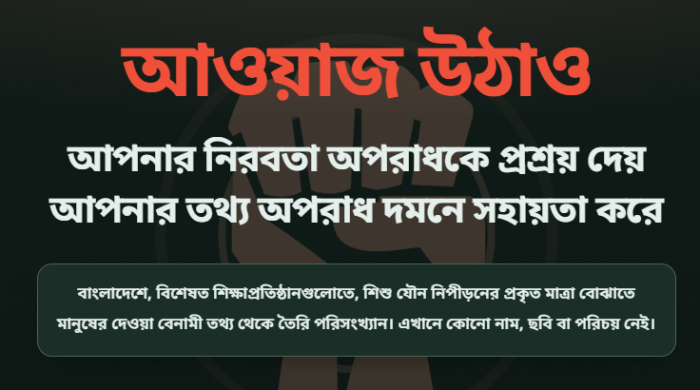
The platform carries the slogan ‘Raise Your Voice’, followed by a message: ‘Your silence tolerates crime, your information helps curb crime.’
Its goal is to collect anonymous accounts and allow people to share the stories of those abused, particularly child sexual abuse in educational institutions. It does not collect names, photographs, tracking cookies or other personal information.
Rakibul Hasan, 27, an International Relations graduate of Dhaka University and an online entrepreneur, said he and Salahuddin Jahangir, 42, an MPhil researcher at Islamic University in Kushtia, are the two founding members, with several of their friends also supporting the initiative.
‘I have a Qawmi madrassah background. But in recent times, there have been series of reports of sexual abuse in madrassahs. I thought it was a serious form of exploitation and also a matter of concern for the reputation of madrassah education,’ Rakibul told New Age on Wednesday.
He said the idea was also influenced by the public response to the Ghush website, which sought to expose bribery and encourage government action.
Awaz Uthao, he said, is not intended to be a legal aid service or helpline.
Rather, it seeks to make the problem visible, generate public awareness and put pressure on authorities and madrassah boards to act against child sexual abuse.
‘We can now see that sexual exploitation is happening not only in madrassahs but also in households, schools and public places. We want an end to it,’ Rakibul said.