One day we too will play in the World Cup

- Update Time : Monday, July 20, 2026
- 1 Time
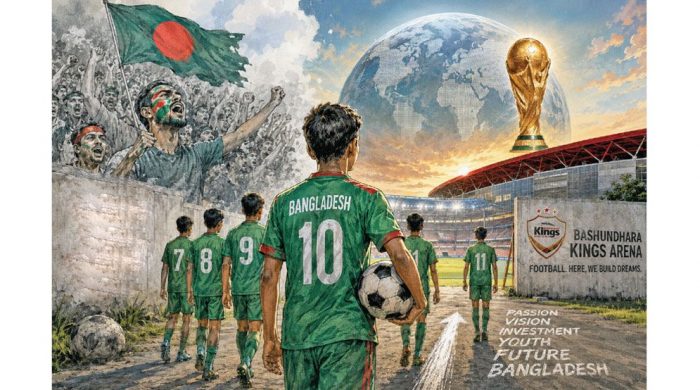
Five weeks of football frenzy have finally come to an end. The entire world was spellbound by the magic of the game. In this 48-team football festival, nations ranging from the world’s most powerful superpowers to some of its most oppressed populations, and from highly developed countries to tiny island states, came together in an unparalleled celebration of global unity. Differences were set aside as billions fell under the spell of football’s biggest stars, from Lionel Messi to Lamine Yamal and Kylian Mbappé.
This is the FIFA World Cup. This is why it is called the “Greatest Show on Earth”.
The World Cup is not merely a battle for a trophy; it embodies the emotions, passion, love and euphoria of billions of people across the globe.
Bangladesh may only be a spectator at the World Cup, but its football-loving supporters are undoubtedly among the most passionate in the world. From the opening day of the tournament, the country embraced a festive atmosphere. From the affluent neighbourhoods of Dhaka to its slums, and from bustling cities to remote villages, streets were adorned with the flags of competing nations. Festoons and banners celebrating favourite teams appeared everywhere, while some enthusiasts even painted their houses in the colours of Argentina or Brazil.
For a month and a half, devoted supporters spent their days and nights wearing the jerseys of their favourite teams. Giant screens were set up in many places for public viewing, while hotels and restaurants arranged special areas for fans to watch the matches together. Football became the dominant topic of conversation in tea stalls, offices, neighbourhoods and homes alike. In a nation of more than 200 million people, almost everyone seemed to become a football analyst overnight. Endless debates raged over tactical decisions, individual mistakes and coaching errors. For a few precious weeks, people set aside the hardships of everyday life and immersed themselves in the joy of football.
The passion of Bangladeshi fans also drew international attention. Argentina and Brazil acknowledged the extraordinary support they receive from Bangladesh, while social media buzzed with friendly banter and fierce arguments between rival supporters.
Watching all this, one question has lingered in my mind throughout the tournament: why does a country with such immense passion for football remain so far behind in the sport? Are we destined to remain mere spectators? Will we forever celebrate the triumphs of Brazil, Argentina, Spain or France instead of our own?
Throughout this World Cup, I often imagined Bangladesh competing on football’s biggest stage. If a small nation can rise to challenge the world’s best, why can’t Bangladesh?
I believe we can. We have individuals like Ahmed Akbar Sobhan, whose commitment to sport, particularly football, has played a transformative role in the game’s revival in Bangladesh. Under his leadership and vision, a sport that had almost faded into irrelevance has steadily regained momentum. His efforts have helped lay the foundations for Bangladeshi football to rebuild itself and aspire to a place on the international stage.
Bashundhara Group is not only one of Bangladesh’s leading industrial conglomerates; it has also become one of the country’s strongest supporters of sport. Its investment has made a significant contribution to many of Bangladesh’s recent sporting achievements.
When Bangladeshi football was struggling, Bashundhara Group stepped forward with long-term investment. Within the Bashundhara Residential Area, it built the Bashundhara Kings Arena – a modern stadium recognised by both FIFA and the Asian Football Confederation (AFC) – as part of a state-of-the-art multi-sports complex, along with several high-quality training grounds. Few private clubs in South Asia have invested in football infrastructure on such a scale.
From the outset, Bashundhara Group sought not only to strengthen its own club, Bashundhara Kings, but also to help revive the country’s football culture, restore the game’s lost glory and bring supporters back to the stadiums.
When inaugurating the Bashundhara Kings Arena on 17 February 2022, Ahmed Akbar Sobhan said: “Our dream is to have a large residential academy for the club, where one thousand boys will learn to play football.”
That vision reflected a commitment not only to the present but also to the future. By investing in youth development, he sought to nurture the next generation of footballers, and Bangladesh is already beginning to reap the rewards.
The country’s youth teams have enjoyed remarkable success in recent years. Bangladesh retained the SAFF U-20 Men’s Championship by defeating India, while the women’s U-20 team qualified for the final round of the AFC U-20 Women’s Asian Cup for the first time. Although the girls lost their opening two matches on their debut appearance, the performances of players such as Sagarika and Arpita won widespread admiration. These achievements have given football supporters fresh reason to dream.
More recently, Bashundhara Kings received another major boost after being invited to participate in the Men’s U-16 Huari Cup in China this October. The club has accepted the invitation. Since last year, the Kings have also overhauled their academy with a renewed focus on developing young talent, becoming the first club in Bangladesh to undertake such an ambitious youth programme.
The initiative, launched under the guidance of Bashundhara Group Chairman Ahmed Akbar Sobhan, aims to revive Bangladeshi football by addressing the long-standing shortage of quality players. It has attracted praise not only at home but also across South Asian football.
The invitation to the prestigious Huari Cup is perhaps the strongest recognition of those efforts. Bashundhara Kings will be the only club from South Asia competing in the tournament, which will be held in Zhangzhou, China, from 1 to 8 October.
The competition will feature youth teams from some of the world’s most renowned clubs, including Borussia Dortmund of Germany, PSV Eindhoven and Feyenoord of the Netherlands, Sporting CP of Portugal, São Paulo of Brazil and River Plate of Argentina, alongside leading Chinese clubs. Bashundhara Kings will be the only participating team representing South Asia.
These clubs have long-established youth academies dedicated to identifying and developing talent from the grassroots. It was the strength of Bashundhara Kings’ youth programme that earned the club this historic invitation.
Many of the world’s greatest footballers began their journeys in similar youth tournaments. Now, young players from Bashundhara Kings will have the opportunity to test themselves against some of the finest youth talent in world football. The experience will not only inspire them personally but will also contribute to the long-term development of football in Bangladesh.
Although the Huari Cup is an age-group competition, the quality of the participating teams is exceptionally high. For Bangladesh’s young footballers, the tournament represents a priceless learning opportunity. Facing clubs such as Borussia Dortmund, PSV Eindhoven, São Paulo and River Plate at any level is a remarkable achievement. The confidence, exposure and experience they gain could prove invaluable in shaping the country’s next generation of footballers.
This is how vision becomes reality – through patience, planning and investment in the future. When others see limitations, true visionaries see possibilities. Perhaps one day, thanks to such efforts, Bangladesh will no longer watch the World Cup from afar. One day, we too will be there.
Audite Karim is a writer and playwright. Email: [email protected]