CJP leaders, govt say no breakthrough in talks

- Update Time : Saturday, July 25, 2026
- 42 Time
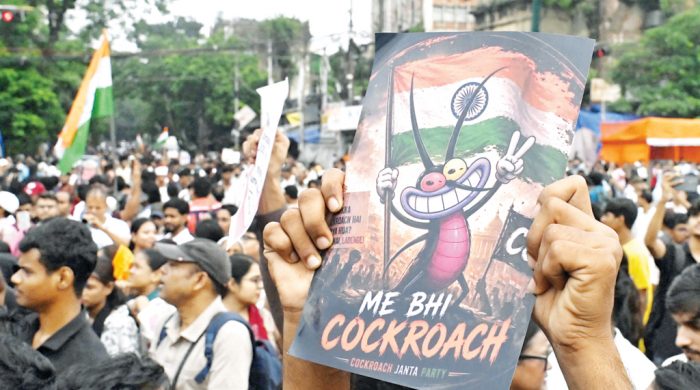
Talks between the Indian government and leaders of the youth-led ‘Cockroach’ movement failed to make headway Friday, as protesters gathered in the nation’s capital to push for an overhaul of the education system.
Senior ministers JP Nadda and Jitendra Singh met with leaders of the Cockroach Janta Party for two hours of talks on the group’s demands, which include a call for the resignation of the education minister, Dharmendra Pradhan.
Both sides said the talks would resume on Saturday.
‘We conveyed in very clear terms that nothing short of Dharmendra Pradhan’s resignation or his removal from the Union Cabinet would be acceptable,’ CJP spokesman Ashutosh Ranka told reporters after the meeting in New Delhi.
Nadda, who also met with protesters on Monday, said the government had ‘heard their points’ and was expected to respond in follow up talks.
The Jantar Mantar protest site in New Delhi has seen bouts of unrest and violence during the week that snowballed after police fired tear gas and baton-charged demonstrators as they tried to march to parliament.
A series of irregularities has stoked public anger, including the leak of a medical entrance exam paper — forcing millions to retake the exam — and a failure in an online marking system for high school students.
The movement has evolved to include concerns over unemployment, opportunities for young people and what critics brand as Modi’s increasingly authoritarian style of governance — in one of the biggest challenges to the Hindu-nationalist’s administration since his 2024 re-election.
Modi has so far pledged legal reforms and swift punishment for those involved in the exam paper leaks.
At Delhi’s Jantar Mantar protest site, student Sushmita, 20 said she felt the government dragged its feet on the issue for too long.
‘Why did it take the government this long to announce the steps?’ she said.
‘I don’t know how Modi and this government can come back to us for support during the next elections.’
India’s opposition parties, who have thrown their weight behind the protesters, disrupted proceedings in the lower house of parliament Friday, saying they would not allow any debate until Pradhan steps down.
Rahul Gandhi of the opposition Congress Party accused police of using pellet guns on some protesters on Monday, after meeting an injured demonstrator in hospital.
‘Thousands of youth were baton-charged, beaten, and pellet guns were used against them,’ he told reporters.
Modi said in a social media post on Thursday his cabinet would discuss measures to speed up court proceedings against those involved in examination leaks.
After ‘incorporating the suggestions of my cabinet colleagues’, draft legislation would be given ‘its final shape’, he said.
‘We will make every effort to have the bill introduced and passed by the House at the earliest,’ Modi added.
Prominent activist Sonam Wangchuk, who ended a 26-day hunger strike in support of the movement late Thursday, said the government had assured him that no action would be taken against peaceful demonstrators.
‘They also assured us that parliament would hold a full debate on the issue and on improving accountability in the education and examination system,’ he said.
India’s ministry of home affairs issued an order suspending mobile internet services for eight hours on Thursday within 1.5 kilometres of the protest site.
The action was needed ‘in the interest of public order and for preventing incitement to the commission of any offence’, said the document, published on the ministry’s website.
Some students simply switched to Bitchat — a peer-to-peer messaging system that relies on Bluetooth to link people who are nearby into an ad-hoc network without using the internet.
‘Many people are using Bitchat,’ Kumar Shalabh, 21, said of the open source app developed by American tech entrepreneur Jack Dorsey.
Shalabh is among the many protesters demanding change, and the resignation of the education minister, Dharmendra Pradhan.
He used artificial intelligence services Claude and ChatGPT to seek out new ways to communicate.
‘They think we are just part of the internet. Yeah, we know the internet — we also know how to communicate without the internet,’ he said.
‘They think we are dumb, we are foolish, but actually we are quite smart.’