Bangladesh weighs promise of China trade corridor

- Update Time : Saturday, July 18, 2026
- 0 Time
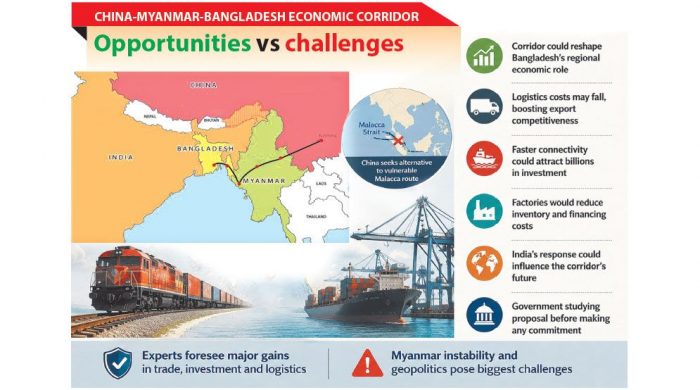
A proposal to establish a China-Myanmar-Bangladesh Economic Corridor (CBMEC) has reignited debate over Bangladesh’s place in Asia’s changing economic landscape, with economists, diplomats and business leaders arguing that the initiative could transform the country’s trade and investment prospects if managed with strategic caution.
Still at an exploratory stage, the proposed corridor promises far more than another transport link. If realised, it could reduce logistics costs, strengthen regional supply chains, attract fresh investment and position Bangladesh as a key gateway between South Asia, Southeast Asia and southwestern China.
Yet it also places Dhaka at the centre of an increasingly complex geopolitical landscape, requiring policymakers to balance economic gains against security concerns, Myanmar’s instability and regional strategic rivalries.
The proposal gathered momentum during Prime Minister Tarique Rahman’s visit to China in June 2026, when both governments agreed in a joint communiqué to explore new avenues of regional connectivity.
Although Bangladesh has made no formal commitment, officials say the proposal is being assessed through economic, strategic and diplomatic lenses before any decision is taken.
Many analysts argue that the debate should begin not with geopolitics but with Bangladesh’s own development priorities.
Former Bangladesh Ambassador to China Mahbub Uz Zaman believes the proposal deserves consideration primarily on economic grounds.
“The proposed corridor offers Bangladesh an opportunity to reduce logistics costs, improve international competitiveness and deepen regional economic integration,” he told the Daily Sun.
“Once we visualise it in purely economic terms rather than strategic competition, it can become a win-win arrangement for every participating country.”
His view reflects a growing consensus among economists that connectivity is neither inherently political nor ideological. Its success depends on governance, sound regulation and the ability to convert improved infrastructure into higher productivity and investment.
More than a transport project
The proposal revives, in a modified form, the Bangladesh-China-India-Myanmar (BCIM) Economic Corridor, which failed to progress largely because of India’s reservations.
By excluding India, the proposed CBMEC could prove more politically manageable while preserving much of the earlier initiative’s economic rationale.
For China, the corridor would help address the so-called “Malacca Dilemma”.
Nearly 80% of its imported energy passes through the Strait of Malacca, one of the world’s busiest maritime chokepoints. A direct overland route linking Kunming in Yunnan Province with the Bay of Bengal would shorten transport routes and diversify supply lines.
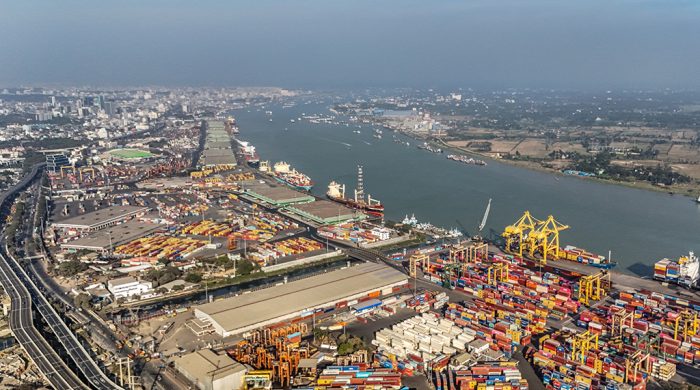
Bangladesh’s strategic interest is different. Analysts say the country could become a regional logistics hub connecting South Asia, Southeast Asia and southwestern China, lowering freight costs, shortening delivery times and strengthening its role in regional supply chains.
Mahbub Uz Zaman noted that Bangladesh has long featured in regional connectivity plans under the SAARC Regional Multimodal Transport Study supported by the Asian Development Bank.
“The corridor is not an isolated idea,” he said, adding, “It complements broader regional connectivity initiatives already discussed under SAARC, SASEC and UN-ESCAP transport frameworks.”
According to him, successful implementation could help Bangladesh integrate more deeply into regional production networks while advancing its long-term ambition of joining the Regional Comprehensive Economic Partnership (RCEP).
He added that multilateral lenders, including the Asian Development Bank, could emerge as financing partners if participating countries reach a formal agreement.
Competitiveness, not simply connectivity
For investment policymakers, the corridor’s greatest value lies in improving Bangladesh’s competitiveness.
Nahian Rahman Rochi, executive member of the Bangladesh Investment Development Authority (BIDA), said Bangladesh’s logistics costs remain among the highest in the region, amounting to nearly 16% of GDP.
“Any initiative capable of reducing transport time, logistics costs and uncertainty deserves serious consideration because competitiveness today depends heavily on efficient connectivity,” he said.
Drawing on experiences from Europe and ASEAN, Rochi said transport corridors typically generate investment far beyond roads and railways by encouraging industrial zones, logistics services, warehousing, port-based industries and integrated supply chains.
He identified logistics, port infrastructure, cold-chain services, transport, agro-processing, textiles, light engineering, electronics assembly and packaging among the sectors likely to benefit most.
However, he cautioned against premature projections.
“The level of investment will depend on the corridor’s financing model, customs procedures, trade facilitation measures, security arrangements and the overall policy framework. What matters most is lowering logistics costs, strengthening export competitiveness and attracting quality long-term investment.”
According to Bangladesh Bank and BIDA, cumulative Chinese investment, including Hong Kong, reached about $3.19 billion by the end of 2025, while nearly $400 million in additional investment proposals are awaiting implementation across advanced textiles, pharmaceuticals, renewable energy, the digital economy and automotive manufacturing.
Improved connectivity, analysts say, could accelerate investment further, particularly in the Chinese Economic and Industrial Zone under development in Anwara, Chattogram.
Faster supply chains, stronger exports
Business leaders argue that the corridor’s biggest impact would be felt inside Bangladesh’s factories.
Mohammad Khorshed Alam, president of the Bangladesh China Chamber of Commerce and Industry (BCCCI), said manufacturers currently wait almost two months for many raw materials imported from China, forcing factories to maintain expensive inventories and tying up working capital.
“Many manufacturers wait nearly two months for raw materials to arrive by sea. If rail or road connectivity through Myanmar reduces that transit time to only a few days, factories will no longer need to hold large inventories.”
Bangladesh imports nearly $20 billion worth of goods annually from China. According to Alam, even modest reductions in transport and inventory costs could save businesses hundreds of millions of dollars each year while easing pressure on bank financing.
He also believes the corridor could broaden Bangladesh’s export basket.
“Fresh agricultural products, fisheries, processed food and other time-sensitive goods could reach Chinese consumers within days instead of weeks, allowing Bangladesh to diversify exports beyond garments.”
Former FBCCI senior vice-president Mostofa Azad Chowdhury Babu likewise sees significant commercial advantages.
“If the objective is purely economic, Bangladesh stands to benefit,” he said, noting that faster overland transport would lower freight costs, improve port utilisation and create new income from logistics and transit services.
Yet he stressed that economic benefits alone cannot determine such a strategic decision.
“Bangladesh must carefully evaluate financing arrangements, national security implications and the reactions of major regional and global powers before making any final decision.”
Geopolitics cannot be ignored
Despite the economic promise, analysts agree that the project’s viability will depend as much on politics as on infrastructure.
Former Bangladesh Bank chief economist Dr Mustafa K Mujeri, now executive director of the Institute for Inclusive Finance and Development (InM), said direct land connectivity with China could significantly improve Bangladesh’s export competitiveness while integrating the country more closely into East and Southeast Asian production networks.
“Our transport costs would decline substantially, and Bangladesh would gain direct access not only to China’s vast consumer market but also to wider regional production networks.”
However, he identified Myanmar’s political instability and the unresolved Rohingya crisis as the corridor’s greatest obstacles.
“Unless peace and stability return to Myanmar and meaningful progress is achieved on Rohingya repatriation, the corridor’s full economic potential will remain difficult to realise.”
Professor Dr Md Shahabul Haque of Shahjalal University of Science and Technology, who also serves as General Secretary of the Association of Bangladesh-China Alumni (ABCA), believes India’s reaction will be another critical variable.
“The first major challenge is India’s likely reaction. New Delhi is already closely observing developments and may again express concerns, as it did under the previous BCIM proposal,” he said.
He also pointed to Myanmar’s continuing civil conflict.
“Even if the corridor is agreed upon, implementation will be difficult unless security conditions improve.”
At the same time, Dr Shahabul believes the initiative could strengthen China’s incentives to support progress on Rohingya repatriation.
Former Press Minister at the Bangladesh High Commission in London Akbar Hossain described the proposal as a strategic “double-edged sword”.
While China would gain a shorter and more secure route to the Bay of Bengal, Bangladesh could also acquire additional diplomatic leverage.
“China is one of the few countries with significant influence over Myanmar. If Bangladesh eventually agrees to participate in the corridor, Beijing may have stronger incentives to facilitate meaningful progress towards Rohingya repatriation,” he said.
Mahbub Uz Zaman likewise cautioned that Myanmar’s fragile security environment remains the corridor’s weakest link, creating risks for infrastructure development, investment protection and commercial operations.
(This is the first instalment of a two-part series.)