Dengue surge raises alarm

- Update Time : Monday, September 7, 2026
- 49 Time
Dengue situation across the country is worsening rapidly, with infections and deaths rising sharply, as experts warn that the situation could take a dangerous turn unless Aedes mosquito control and preventive measures are intensified immediately.
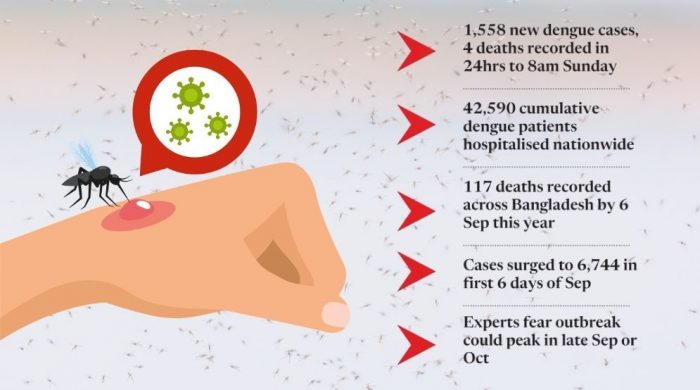
The latest figures took the cumulative number of hospitalised dengue patients to 42,590, with 117 deaths recorded nationwide by 6 September.
Dengue has now spread to all 64 districts, with the situation particularly severe in the Khulna, Chattogram, Barishal and Dhaka divisions.
Of the total patients, 62.1% are male and 37.9% female. However, women account for 55.6% of dengue deaths, compared with 44.4% among men.
Professor Dr Md Halimur Rashid, director (Disease Control) at the DGHS, told the Daily Sun on Sunday that the number of dengue patients was increasing, although the situation remained under control for now.
“It is difficult to say in what direction the situation will turn if Aedes mosquitoes are not controlled,” he said.
Halimur said health authorities had made the necessary preparations to deal with the outbreak, including adequate stocks of saline and dengue test kits.
He added that dedicated dengue units had been opened at all public hospitals across the country to ensure proper treatment.
The DGHS data show that dengue cases have increased sharply in recent months. The country recorded 1,081 cases in January, 409 in February, 353 in March, 640 in April, 714 in May, 2,907 in June, 9,206 in July and 20,536 in August. A further 6,744 cases were recorded in just the first six days of September.
Deaths have followed a similar upward trend, rising from13 in June to 36 in July and 43 in August. Another 20 deaths were recorded in the first six days of September.
Khulna division has recorded the highest number of cases at 6,821, followed by Barishal with 6,516, Chattogram 6,347 and Dhaka division, excluding city corporations, 6,333.

Dhaka North City Corporation has reported 5,088 cases and Dhaka South City Corporation 5,548. Mymensingh recorded 2,341 cases, Rajshahi 2,342, Rangpur 1,061 and Sylhet 193.
Dhaka South also recorded the highest number of deaths at 42, followed by Khulna with 19, Dhaka North 16, Mymensingh 12, Barishal 10 and Chattogram eight.
At Kurmitola Multicare Specialised Hospital, more than 70 dengue patients were undergoing treatment on Sunday.
Brig Gen Md Saydur Rahman, director of the hospital, said around 500 patients with fever were visiting its outpatient department every day, of whom 70%-80% were found to have dengue.
He said special arrangements had been made for dengue treatment, with separate units opened in different departments and no shortage of necessary logistics.
Doctors have advised people to undergo dengue tests and seek medical evaluation as soon as they develop fever instead of waiting for complications.
Public health expert Mushtaq Hossain, a former principal scientific officer at the Institute of Epidemiology, Disease Control and Research, described the current dengue situation as alarming.
He said many patients remained undetected because they avoided hospitals or doctors’ chambers and relied on over-the-counter medicines.
“The government has to ensure maximum dengue testing to identify patients and bring them under treatment to keep the situation under control and prevent deaths,” he said, suggesting mobile testing facilities to reach people at their homes.
All government hospitals across Bangladesh are currently offering free Non-Structural Protein 1 (NS1) tests for dengue, with the facility available until 31 December.
Health experts said intermittent rain was creating favourable conditions for Aedes mosquitoes, which transmit dengue and chikungunya.
Prof Kabirul Bashar of Jahangirnagar University’s Department of Zoology warned that the dengue situation could worsen further in September and October before declining in winter as rainfall decreases.
He attributed the worsening situation to rising Aedes populations, favourable temperature and humidity, and the growing number of dengue patients.
He called for intensified efforts to identify and destroy Aedes hotspots, improve dengue hotspot management, conduct larviciding and adulticiding, and ensure proper patient management.
Govt steps up prevention
Prime Minister Tarique Rahman on Sunday directed authorities to intensify cleanliness and public awareness campaigns nationwide, stressing that dengue prevention could not depend solely on government agencies.
At an urgent meeting on the dengue situation at the Secretariat, he called for greater public participation in keeping homes and their surroundings clean, removing stagnant water, clearing rubbish and preventing mosquito breeding grounds.
He also ordered the involvement of disaster management volunteers, BNCC, Rover Scouts and Red Crescent personnel in local cleanliness and awareness drives.
The meeting also discussed strengthening treatment facilities and patient-management capacity at upazila-level hospitals.
Supplying mosquito nets to hospitalised dengue patients was also discussed to reduce the risk of transmission bymosquitoes biting infected patients.
“There must be visible results on the ground,” the prime minister said, stressing prevention, coordinated action and extensive awareness campaigns.
Peak feared in late September
State Minister for Health Dr M A Muhit warned on Sunday that the dengue outbreak could reach a dangerous peak in the last week of September or the first week of October.
Briefing journalists at the Jatiya Sangsad, he said data and epidemiological analysis from the past three to four years showed that dengue typically peaks during this period, driven by rainfall, warm temperatures and climate change.
“Unless preventive measures are intensified immediately, the number of infections and deaths could rise at an alarming rate next month,” he said.
Muhit said a coordinated social movement involving the Red Crescent, Scouts, Girl Guides and socio-cultural organisations would be launched within the next day or two.
He urged apartment associations and residents, particularly in Dhaka, to remain vigilant, noting that access restrictions at apartment complexes could hamper mosquito-control efforts.
To prepare for a possible surge, instructions will be issued to all civil surgeons at a Zoom meeting on Monday to keep additional beds ready and ensure adequate stocks of saline and test kits. Around 300 doctors have also received training.
Bangladesh recorded 102,861 dengue cases and 413 deaths in 2025, while 2024 saw 101,214 infections and 575 deaths.
The country’s worst dengue outbreak on record occurred in 2023, when 321,179 people were hospitalised and 1,705 died.