Dhaleshwari replaces Buriganga as leather pollution hotspot: IMED

- Update Time : Monday, July 20, 2026
- 41 Time
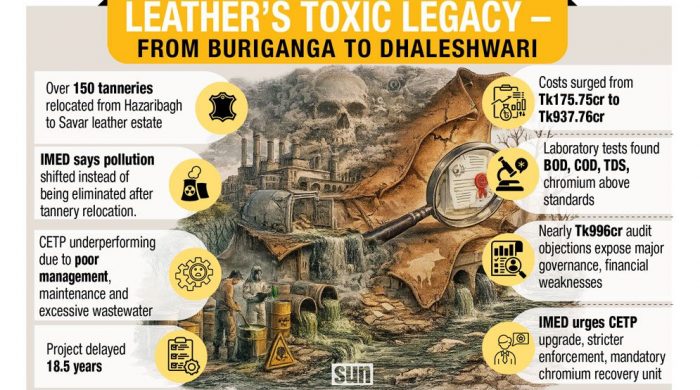
The River Dhaleshwari has become the country’s new leather pollution hotspot, with untreated industrial waste from the Savar Leather Industrial Estate severely damaging the river’s ecosystem and the livelihoods of surrounding communities, according to an impact assessment by the Implementation Monitoring and Evaluation Division (IMED).
The report concludes that although relocating more than 150 tanneries from Hazaribagh has reduced pollution in the Buriganga River, the environmental burden has largely been shifted rather than eliminated.
For 52-year-old fisherman Aslam Uddin, the findings mirror his daily reality.
Standing on the banks of the Dhaleshwari in Savar’s Harindhara area, he recalls when the river was rich with fish and a few hours of casting his net earned him Tk800 to Tk1,000. Today, he often returns with barely Tk100 worth of fish, if any.
“The fish that are caught carry a strong chemical smell. Nobody wants to buy them, and even we cannot eat them,” he said, blaming untreated industrial waste discharged into the river since the leather estate became operational.
The collapse of his livelihood has forced his eldest son to leave school and take a factory job.
Pollution transferred, not solved
The IMED assessment describes the relocation of the tanneries as a major industrial and environmental initiative aimed at modernising Bangladesh’s leather sector while protecting rivers from untreated waste. However, it says the project’s core environmental objective has only been partially achieved.
Residents living around the leather estate told researchers that the Dhaleshwari has turned dark, foul-smelling and increasingly unfit for aquatic life. Fish populations have declined sharply, while air pollution and unpleasant odours have intensified.
Laboratory tests conducted during the assessment found that several key pollution indicators, including Biochemical Oxygen Demand (BOD), Chemical Oxygen Demand (COD), Total Dissolved Solids (TDS) and chromium, exceeded national environmental standards in many instances.
IMED attributes the continuing pollution largely to the poor performance of the Central Effluent Treatment Plant (CETP).
Although the CETP was installed to treat industrial wastewater before it enters the river, the report says it is operating well below expectations because of excessive wastewater inflows, heavy chemical use by factories, inadequate maintenance, power shortages, weak operational management and a shortage of skilled personnel.
The assessment also highlights inadequate management of sludge and chromium-containing waste, warning that the absence of a long-term environmentally safe disposal system could lead to further contamination.
Delays, rising costs and weak compliance
Originally approved in 2003 with a budget of Tk175.75 crore, the project was scheduled for completion within three years. Instead, it took nearly 18 and a half years, finishing in June 2021.
During that period, the project cost rose to about Tk937.76 crore, while the revised allocation exceeded Tk1,015.56 crore because of repeated design revisions, additional infrastructure requirements and prolonged implementation delays.
IMED says several essential components, including the CETP, sewage treatment facilities, waste management systems and emergency infrastructure, were not adequately incorporated in the original project design, resulting in repeated revisions and escalating costs.
Despite the environmental shortcomings, the relocation has improved industrial infrastructure. Tanneries now operate within a planned industrial zone with better roads, utilities and production facilities. Many factories have expanded production by installing modern machinery, while employment and business activity have increased.
However, the report says these gains have not translated into stronger international competitiveness. Most tannery owners believe the relocation has done little to improve buyers’ confidence or help them secure internationally recognised environmental certifications.
Many factories still fall short of Leather Working Group (LWG) standards because of inadequate environmental compliance, limited chromium recovery, weak occupational safety practices and deficiencies in waste treatment.
Governance failures
Beyond environmental concerns, IMED identifies major governance and financial management weaknesses, including unresolved audit objections involving nearly Tk996 crore, delays in revenue collection, financial irregularities, administrative inefficiency and weak project oversight. Frequent changes in project leadership and poor long-term planning also contributed to delays and cost overruns.
The report recommends upgrading the CETP with modern technology, making chromium recovery units mandatory, strengthening sludge and solid waste management, introducing real-time digital environmental monitoring and enforcing stricter pollution controls.
It also calls for improved governance, faster one-stop services, better worker health facilities and a time-bound roadmap for achieving international environmental certification.
Environmental scientist Dr Shafi Mohammad Tareq, Professor of Environmental Sciences, said the crisis stemmed from poor management rather than the relocation itself.
“The problem lies in management, not in relocating the leather industry,” he told the Daily Sun. “If the CETP had been operated properly and industrial wastewater treated effectively before discharge, pollution would have been significantly reduced.”
He said relocating the tanneries could not be considered a success if pollution had merely been transferred from one river to another.
“We wanted to protect one river, but if another river becomes polluted instead, then the main objective has not been fulfilled.”
Dr Tareq added that while leather factories were a major source of pollution, untreated municipal sewage also continued to contaminate rivers around Dhaka.
He urged strict enforcement of the Environmental Conservation Rules 2023 and greater cooperation from factory owners to prevent further degradation of the Dhaleshwari.
The reporter can be reached at: [email protected]