Spiking commodity prices strain consumers

- Update Time : Saturday, April 25, 2026
- 31 Time
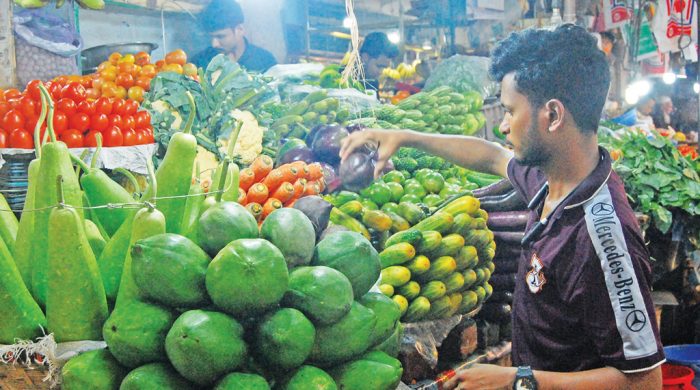
Prices of chicken, eggs, sugar and vegetables remained high on Friday, alongside a persistent shortage of edible oils, leaving consumers under continued pressure.
Traders said that during the Russia-Ukraine war in 2022, the country witnessed simultaneous price surges across commodities, triggering prolonged high inflation.
They said that a recent fuel shortage linked to the Middle East conflict, along with subsequent fuel price hikes, had pushed up the cost of essentials, further increasing pressure on consumers.
However, they said, the full impact of higher fuel prices is yet to be fully reflected on the market, largely due to ongoing supply disruptions that have overshadowed the immediate effect.
A visit to kitchen markets, including Kallyanpur Natun Bazar, Agargaon Taltola Bazar and Karwan Bazar wholesale market, showed that Sonali chicken was selling at Tk 360-380 a kilogram, while Sonali hybrid was Tk 340-350 a kilogram.
Broiler chicken prices declined slightly to Tk 180-190 a kilogram from Tk 200-210 two weeks earlier, thanks to increased supply this week.
Two months ago, Sonali chicken was selling at Tk 270-280 a kilogram, while broiler chicken was Tk 160-170 a kilogram.
Sohel Rana, a trader at Karwan Bazar, said that prices increased due to supply disruptions, reduced Sonali chicken farming and disease outbreaks.
‘Fuel shortages have been disrupting the supply chain over the past month. The recent fuel price hike might further increase transport costs,’ he said.
A shortage of soya bean oil, particularly bottled variants, has also persisted on the market.
Unpackaged soya bean oil was selling at Tk 195-200 a litre on Friday, against the government-fixed rate of Tk 176. Palm oil was selling at Tk 180-185 a litre, above the fixed rate of Tk 164.
Tofayel Ahmed, a trader at Karwan Bazar, said that the bottled soya bean oil supply had not improved.
‘If we order 10 cartons, companies supply only 2-4 cartons, often at higher prices. A five-litre bottle is supplied at Tk 947.50 against a retail price of Tk 955, leaving almost no profit margin,’ he said.
Due to shortages of one- and two-litre bottles, low- and middle-income consumers are increasingly switching to unpackaged oil, pushing up demand and prices.
Refiners have repeatedly urged the government to raise prices, but approval has been pending.
Representatives of the Bangladesh Vegetable Oil Refiners and Vanaspati Manufacturers Association met commerce minister Khandaker Abdul Muktadir on April 12, following a letter sent on March 25.
Prices of other essentials, including eggs, sugar and rice, also increased over the past week.
Eggs were selling at Tk 120-130 per dozen, up from Tk 110-120 a week earlier. Sugar rose to Tk 110 a kilogram from Tk 105.
Aromatic rice (unpackaged) was selling at Tk 120-160 a kilogram and packaged varieties at Tk 175-180, while coarse rice rose to Tk 55-60 a kilogram from Tk 50-55 a month earlier.
On April 19, the Bangladesh Energy Regulatory Commission raised the price of a 12-kg LPG cylinder by Tk 212 to Tk 1,940, citing global oil market trends.
Earlier, the government increased diesel price to Tk 115 a litre from Tk 100, octane to Tk 140 from Tk 120, petrol to Tk 135 from Tk 116 and kerosene to Tk 130 from Tk 112.
These increases have pushed up agricultural production and transportation costs, which are gradually being reflected in retail prices.
Md Imran Master, president of the Bangladesh Kachamal Arat Malik Samity, told New Age that fuel shortages had been affecting kitchen markets since the outbreak of the conflict in the Middle East, severely disrupting supply chains.
‘Transportation and irrigation have been affected, contributing to price increases. The recent fuel price hike might also have an immediate impact on commodity prices,’ he said.
He said that until fuel supply normalised, it would be difficult to determine whether current volatility was driven more by shortages or rising costs.
With improved supply, prices of summer vegetables declined slightly, although they remain largely beyond the reach of many consumers.
Spiny gourd was selling at Tk 100 a kilogram, ridge gourd, sponge gourd and snake gourd at Tk 60-70 a kilogram and pointed gourd at Tk 80–100 a kilogram.
Bitter gourd sold at Tk 60-70 a kilogram, yardlong beans at Tk 60-80, okra at Tk 40-50 and drumstick at Tk 80-100 a kilogram.
Cucumber was selling at Tk 80-100 a kilogram, aubergine at Tk 100 and green chilli at Tk 60.
Onions were priced at Tk 40 a kilogram, potatoes at Tk 20-25 a kilogram and garlic at Tk 120 a kilogram for local varieties and Tk 180-200 a kilogram for imported varieties.
Beans sold at Tk 100 a kilogram, papaya at Tk 40-50, tomatoes at Tk 60 and both taro root and taro stems at Tk 100 a kilogram.
Abbas Ali, a trader at Karwan Bazar, said that vegetable supply had increased, which would normally ease prices.
‘However, higher transport costs due to fuel shortages are preventing significant price drops,’ he said.
Among pulses, fine lentils were selling at Tk 150 a kilogram, medium at Tk 120 a kilogram and coarse at Tk 105 a kilogram. Moong dal ranged from Tk 120 to Tk 180 a kilogram, while anchor pulse sold for Tk 65-75 a kilogram.
Rice prices remained elevated, with fine varieties at Tk 70-85 a kilogram, medium at Tk 55-68 and coarse at Tk 50-55.
Atta was priced at Tk 46-60 a kilogram depending on packaging, while flour ranged from Tk 60 to Tk 75 a kilogram.
Beef was selling at Tk 800-850 a kilogram and mutton at Tk 1,100-1,200 a kilogram.
Bangladesh has experienced high inflation for nearly three years, typically between 8.5 and 9 per cent, pushing up commodity prices and increasing pressure on consumers.
Consumer rights groups, however, alleged that opportunistic practices by market syndicates were further fuelling the price spiral.
Consumers Association of Bangladesh president AHM Shafiquzzaman said that the simultaneous rise in commodity prices had placed significant pressure on low-income households.
wHowever, he alleged that some traders were exploiting the situation to further increase prices, worsening consumer hardship.