15th constitution amendment made state autocratic: counsel

- Update Time : Tuesday, July 7, 2026
- 3 Time
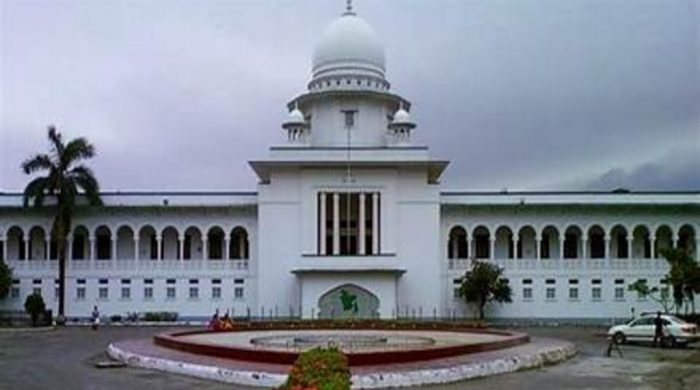
A lawyer on Monday told the Appellate Division of the Supreme Court that the 15th amendment to the constitution transformed Bangladesh from a democratic republic into an ‘authoritarian system’ and was enacted to prolong the Awami League government’s power.
Senior lawyer Sharif Bhuiyan made the submission before a four-member Appellate Division bench, led by chief justice Zubayer Rahman Chowdhury, while arguing on behalf of Sushashoner Jonno Nagorik, one of the appellants challenging the amendment.
The other members of the bench were Justice Md Ashfaqul Islam, Justice Md Rezaul Haque, and Justice SM Emdadul Hoque.
The bench adjourned the hearing until 9:30am today.
During the hearing, the chief justice told the lawyer that the Appellate Division wanted to dispose of the appeals by July 14 as Justice Md Ashfaqul Islam was scheduled to retire on that day.
Additional attorney general Aneek R Haque told the court that if it wanted to conclude the hearing on the important constitutional matter before Justice Md Ashfaqul Islam’s retirement, the proceedings would need to be completed within the remaining five working days.
In November 2025, the Appellate Division, chaired by chief justice Syed Refaat Ahmed during the interim government, scrapped its 2011 verdict that had cancelled the caretaker government system.
The Appellate Division in its verdict, which followed Shujan’s another appeal petition, had said that the caretaker government provisions stood automatically restored in the constitution but would remain dormant for the time being.
It had observed that the caretaker government mechanism could be activated only after the dissolution of a sitting parliament, as required under articles 58B to 58E of the constitution.
Sharif argued on Monday that the High Court, while declaring parts of the 15th amendment unconstitutional, did not address several key constitutional questions arising out of the abolition of the non-party caretaker government system.
Before the 15th amendment, he pointed out, article 58B(1) provided for a non-party caretaker government to administer the country when the Jatiya Sangsad was dissolved until a newly elected prime minister assumed office.
After the 15th amendment, however, article 123(3) requires JS elections to be held within 90 days before the expiry of the JS term, or within 90 days after the JS is dissolved in other circumstances.
Sharif argued that these constitutional provisions created inconsistencies, asking the Appellate Division to clarify how the election-time administration should function.
The High Court, he also submitted, did not resolve another important issue — who would administer the oath to the chief adviser in a caretaker government if such a system were restored.
Before the 15th amendment, the chief justice administered the oath to the president, but the amendment changed the procedure by authorising the JS speaker to administer the president’s oath, he said.
Sharif further argued that the High Court erred by invalidating only selected provisions of the 15th amendment instead of examining whether the amendment should be struck down in its entirety.
Confirming these submissions before the court, Sharif told New Age that he would explain during today’s hearing the constitutional complications that could arise if the entire 15th amendment were declared void.
Sharif said that he would request the Appellate Division to allow a transitional period to address any legal vacuum that might arise until the JS enacted necessary legislation.
According to Sharif, the AL government rewrote the constitution and cheated on the constitution by changing the republic structure of the constitution into the ‘authoritarian necrocracy’.
He said that necrocracy (derived from the Greek words nekros meaning ‘dead person’ and kratos meaning ‘power’) is a form of government where a deceased individual is formally recognised as the supreme head of state.
The government continues to operate under the directives and ideology of the dead leader, with living successors acting in their name, according to the meaning of necrocracy.
The 139-page High Court ruling, delivered on December 17, 2024 by Justice Farah Mahbub, who is now in the Appellate Division, and Justice Debasish Roy Chowdhury, declared several key provisions of the Constitution (Fifteenth Amendment) Act, 2011 unconstitutional.
The verdict said that it was up to the next Jatiya Sangsad to review and decide on the legality of other parts of the 15th amendment.
These include changes to the constitution’s preamble and various articles made through additions, deletions, and modifications.
Among the unresolved issues are matters related to nationality, secularism, and the mandatory display of the portrait of the country’s founding president Sheikh Mujibur Rahman in all government offices and Bangladesh missions abroad.
The HC verdict said that the removal of the caretaker system through sections 20 and 21 of the 15th amendment violated the basic structure of the constitution — particularly democracy, electoral fairness, and public trust. It struck down the abolition of article 58A and chapter IIA, which had mandated a neutral interim government during elections.
However, according to the HC verdict, the restoration of the caretaker system will apply only in future elections, not retroactively.
The 15th amendment, passed in 2011 by the Awami League-led Jatiya Sangsad, abolished the caretaker government provision without debating it in the JS and defying the recommendations of the parliamentary special committee on the constitution amendment and the protests by major political parties, including the Bangladesh Nationalist Party, the then opposition in the Jatiya Sangsad.
The HC judgement followed two public interest writ petitions filed in 2024 — 13 years after the amendment was passed — following the August 5, 2024 student-led uprising that toppled the Sheikh Hasina government, forcing her to flee to India.
The petitioners, including prominent civil society figures like Shujan’s secretary Badiul Alam Majumder, argued that the 15th amendment undermined democratic accountability and judicial oversight.
They were supported by the BNP, Bangladesh Jamaat-e-Islami, Gono Forum, and other opposition groups.
The national demand for caretaker government emerged in the 1990s for credible elections and was later introduced through the 13th amendment after a broad political consensus.
Senior lawyer Mohammad Shishir Manir appeared for the Jamaat during the Monday hearing.