That 18 months of unrelenting pressure

- Update Time : Tuesday, March 17, 2026
- 73 Time

During the 18 months of the interim government, we were under severe pressure due to government actions. We became victims of mobs led by some unruly individuals claiming to be anti-discrimination activists. We also faced various forms of political pressure. Lists began arriving from political parties and representatives of these so-called anti-discrimination groups—each one extensive.
The 18 months of the interim government were extremely difficult for Bangladesh Pratidin. During this time, we were unable to fulfil many expectations of our valued readers. This was not intentional; rather, it was due to the overall circumstances. In short, Bangladesh Pratidin struggled to survive amid numerous adversities. We were subjected to mob attacks, deprived of our allocated quota of newsprint, and even faced a declared halt in advertising—the lifeblood of any newspaper. In essence, we were like someone barely keeping their nose above deep water to stay alive. By the grace of Almighty Allah and with the guidance, inspiration, and support of Bashundhara Group Chairman Ahmed Akbar Sobhan, we managed to survive. We consider it essential to inform our readers in detail about the severe pressure we faced over the 18 months from the government, political actors, and various pressure groups, and the many distressing experiences of that difficult period.
I would like to begin with two incidents from the final phase of those 18 months. After nearly 16 years without an election, voting was held in a festive atmosphere. The Bangladesh Nationalist Party (BNP), led by Tarique Rahman, secured a landslide victory. The new government was sworn in on 17 February 2026 in a unique open-air ceremony at the South Plaza of the Jatiya Sangsad on Manik Mia Avenue, attended by around 1,200 guests from home and abroad.
A total of 23 invitations were sent to leading editors of print and electronic media, as well as heads of news agencies and journalists’ organisations. The list was finalised by the Cabinet Division’s government formation and protocol wing in coordination with the Ministry of Information. Despite Bangladesh Pratidin holding the top position in circulation for the past 14 years—and remaining number one in government records over the last 18 months—it was regrettably not invited to the swearing-in ceremony. Even as the leading newspaper, its name was excluded from the list by the Information Ministry.
The second issue concerns the exclusion from the special supplement for 21 February 2026. Although the day was observed under the new government, responsibility lies entirely with the previous administration and its Information Ministry. The government took oath on Tuesday, 17 February, and before the new minister, Zahir Uddin Swapan, formally assumed office on Wednesday and Thursday, the ministry had already finalised the supplement list. Friday was a holiday, and Saturday was 21 February. Information Secretary Mahbuba Farzana prepared and distributed the list at her discretion, which did not include Bangladesh Pratidin. When the matter was brought to the minister’s attention, he expressed clear surprise.
Mahbuba Farzana, who was promoted to the position of Information Secretary during the interim government, placed the new minister in an awkward position at the very outset of the administration. She joined the Ministry of Information and Broadcasting on 23 October 2024 and has since worked under advisers Nahid Islam, Mahfuz Alam, and Syeda Rizwana Hasan. In practice, her role largely involved handling protocol duties for these advisers, rather than carrying out the responsibilities of a secretary with due authority. This may be attributed to her lack of prior experience in senior roles within any ministry. She had served as a Deputy Secretary in the Health Ministry in 2019 but had no significant experience as a Joint Secretary or Additional Secretary in key positions thereafter. As a result, she had little option but to focus on protocol duties.
From the outset, these advisers and the secretary effectively placed Bangladesh Pratidin on a “red list”. Consequently, over the past 18 months, the newspaper was deprived of its rightful entitlements and had to endure an extremely difficult period.
During the 18 months of the interim government, no government supplements were allocated to us. On 5 August, marking the July Uprising Day, special supplements were distributed to 170 daily newspapers across the country, yet Bangladesh Pratidin was excluded. Similarly, we did not receive any supplements published on 16 December or those issued by various ministries.
Not only were we denied special supplements, but some officials of the government’s Department of Films and Publications, along with many field administration officials, also showed reluctance to place advertisements in Bangladesh Pratidin on their own initiative. In one instance, a police officer from a district placed an advertisement in our newspaper, but after its publication, he was reprimanded by his range DIG for doing so.
Some individuals and institutions also withheld outstanding advertisement payments. We were even deprived of rights that should be guaranteed to all institutions and citizens on the basis of fairness. Our correspondents across the country also faced obstacle in carrying out their professional duties.
Despite all this, we endured and made every effort to survive. At the same time, we have prepared a list of those who, at various levels of the administration, created obstacles to the normal functioning of Bangladesh Pratidin.
To find out why Bangladesh Pratidin was being deprived of advertisements and other rightful benefits, I assigned our senior reporter, Manik Muntasir, to arrange a meeting with adviser Nahid Islam. As instructed, Manik contacted the adviser’s personal secretary, R H M Alaul Kabir, who informed him that a written application would be required to secure an appointment. He added that around 40 such requests were already pending, and a meeting could be scheduled only after those were addressed—though he could not say how many months that might take.
I was genuinely astonished to hear this. The information adviser’s work is centred on the media, and it is entirely natural for journalists to meet him. Yet, the executive editor of a leading daily newspaper would have to submit a formal application just to seek an appointment, with no certainty about when it might be granted. This was the kind of absurd situation we lived through for 18 months. Knowing that even to meet an adviser—who had attained ministerial status through a movement—one had to submit a written application, I chose not to lower myself to that extent and did not pursue the meeting.
That adviser stepped down from his position after forming a political party, and another student representative, Mahfuz Alam, was assigned responsibility for the Ministry of Information. We had hoped the new adviser would not follow in his predecessor’s footsteps and would instead ensure fairness for all. However, he proved to be even more uncompromising in our case. We received no support from him either.
Eventually, we took the initiative to meet the Chief Adviser’s Press Secretary, Shafiqul Alam, to brief him in detail. As soon as we expressed our interest, he gave us time and invited us to his residence—courtesy one would expect from a journalist. Accompanied by two colleagues, I visited his official residence. He welcomed us warmly and listened attentively as we explained how Bangladesh Pratidin had been affected during the interim government period.
He expressed sympathy and assured us that he would try to ensure such issues did not recur in the future. However, I am unsure how much effort he ultimately made, as the situation did not improve; in fact, it worsened.
Later, we learned that Azad Mazumder, Deputy Press Secretary at the Chief Adviser’s press wing, would reportedly react negatively whenever Bangladesh Pratidin was mentioned. He maintained a close relationship with Adviser Mahfuz. We do not know why he was so intolerant of Bangladesh Pratidin. He had been a journalist, though perhaps only a small circle in the profession recognised him, as he had worked as a sports reporter for an English daily. I have no recollection of ever meeting him or knowing him personally—perhaps that is my misfortune. Seeing his name in the press wing, I even asked my colleagues, “Who is this person?”
Then came prominent environmental lawyer Syeda Rizwana Hasan. After she assumed the role of Adviser for Information and Broadcasting, our difficulties intensified further. She began to place us under various forms of pressure. The two incidents I mentioned earlier were also a result of her actions.
During the 18 months of the interim government, we endured significant mental pressure as well. We operate a state-of-the-art printing press for Bangladesh Pratidin, Kaler Kantho, and Daily Sun. Located within the Bashundhara Residential Area, the press spans a vast area and can be considered a standalone industrial unit. It is equipped with eight modern machines, along with numerous other printing machines and tools.
After the interim government took office, officials from the Department of Films and Publications (DFP) and the Ministry of Information visited our office. We received them with due respect, including DFP Director General Khaleda Begum. They held discussions with us, toured various departments, and inquired whether we implement the Wage Board. We responded to all their questions with proper documentation.
From their speeches, it seemed they had perhaps never visited our office before. They appeared genuinely surprised to see such a large media house. Our single complex accommodates Bangladesh Pratidin, Kaler Kantho, Daily Sun, News24 Television, T Sports, and Radio Capital, along with their online and multimedia units. We also operate the online news portal Banglanews24. Over the years, participants of the National Defence Course of the Bangladesh Army have visited and expressed similar surprise. Khaleda Begum also shared comparable impressions that day.
Despite this, we sensed a degree of unease among them. Eventually, they expressed a desire to inspect our printing press. We gladly took them there, confident that no other media house in Bangladesh possesses such a large facility. They were again impressed upon seeing it. Yet, it seemed they were searching for something.
One official asked how many copies we print daily. Although this information had already been provided earlier, they continued to verify it by questioning machine operators and other technical staff. They asked to see the print order and even checked the number of paper rolls in stock. Their conduct suggested they were attempting to catch us in some irregularity. However, they found none. As they left, it appeared they were disappointed—their mission had not succeeded.
Later, when Mahfuz Alam became an adviser, a team from the Department of Films and Publications (DFP) and the Ministry of Information suddenly arrived at our press at 2am! They had come on a surprise inspection to verify the actual number of copies we print. Upon hearing the news, I went to the press that night to ask why they had come unannounced at such a late hour.
One member of the team, whom I knew, took me aside and said, “Brother, don’t take this the wrong way, and please don’t tell anyone what I’m about to say. We have been instructed by the ministry to check whether the circulation numbers reported in the ABC report are actually being printed. You have been number one in circulation for a long time. Certain advisers and a few newspaper owners/editors are putting pressure on us to lower your position—especially one editor, who has now positioned himself as a guardian of the anti-discrimination movement. I won’t mention the name, but you’ll understand. We had no choice but to come under this pressure. We cannot act without verifying the actual figures, so we had to come. Please don’t take offence.”
Hearing this, I felt great sympathy for him. He also seemed very helpless. Poor man had come with a team at 2am just to protect his job by catching us in the act. I instructed those responsible at the press to cooperate with them, and then went home. The next morning, I learned that they had stayed at the press until printing was completed—but they were unable to find any irregularities. In the end, they reported only the truth. However, certain quarters were not pleased with that report.
Government officials carried out similar surprise inspections at our press on three more occasions during the night. Later, we learned that in the past 18 months, no officials from the DFP or the Ministry of Information had conducted inspections at any other newspaper office or press in Bangladesh. Not only in Dhaka, but our press in Bogura was also inspected unexpectedly by representatives from the ministry and DFP. There too, they asked many questions of the press staff, including how many copies are printed in Bogura and how many in Dhaka. Various forms of pressure were applied in this manner to suppress the truth about our operations.
We were not only under mental stress; we also faced economic pressure and oppression. During the 18 months of the interim government, no allocation was made for our entitled newsprint quota. None of the newspapers of the Bashundhara Group, including Bangladesh Pratidin, were able to secure LCs for newsprint. As a result, Bashundhara Paper Mill had to produce additional newsprint to keep the newspapers running, which required significant subsidies. Nevertheless, despite all pressures from the government, no salaries or benefits were left unpaid in any of the Bashundhara Group media outlets, including Bangladesh Pratidin. In fact, nearly 400 new jobs were created during these 18 months, and the multimedia departments in each unit were strengthened.
During these 18 months, we were under severe pressure from the government. We became targets of mobs led by certain unruly individuals claiming to be anti-discrimination activists. We also faced political pressure in various forms. Lists began arriving from political parties and representatives of these so-called anti-discrimination groups—each one extensive. Some listed 50 names, others 72. Some lists specified which journalists from Bangladesh Pratidin were to be dismissed, while others outlined which journalists were to be employed in which positions and at what salary. Some lists classified journalists as supporters of the previous regime, BNP, Jamaat, or anti-discrimination activists.
However, our position was very clear: we did not dismiss a single journalist from Bangladesh Pratidin. During this period, three district correspondents were replaced, but these changes were purely for institutional reasons.
Now, the BNP, one of the main bastions of nationalist strength, is in power. The party’s founder, the late President Ziaur Rahman, believed in the freedom of the press. That is why, during the Bakshal regime, he lifted the restrictions on all media outlets that had been closed. His widow, three-time Prime Minister Begum Khaleda Zia, ensured the unrestricted flow of information and media across Bangladesh. Their son, Tarique Rahman, is now the country’s Prime Minister, and the once-dynamic student leader Zahir Uddin Swapan serves as Information Minister.
Bangladesh’s media and journalistic community expect from them a reasonable degree of press freedom and fair recognition of their rights. We, too, seek fairness. We do not demand any undue or unjust special privileges. Bangladesh Pratidin is a newspaper of the people and has always stood with the people.
On this special day, we express our heartfelt gratitude to all our readers, subscribers, hawkers, advertising agencies, advertisers, and well-wishers. [Source: Bangladesh Pratidin]
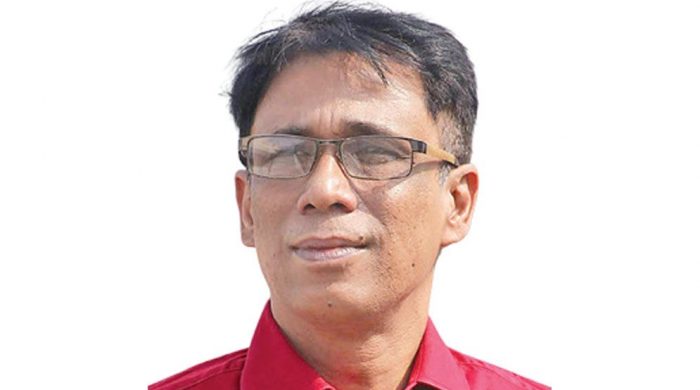
Author: Executive Editor, Bangladesh Pratidin