In recent years, Bangladeshi cinema has undergone a powerful revival. From box office blockbusters to viral OTT hits, films like Tandob, Poran, Toofan, Surongo, and Daagi are captivating diverse audiences across the country. This resurgence has brought local stories into the mainstream, spotlighting crime, romance, ambition, and betrayal in glossy, gripping narratives.
But amid this cinematic glow lies a critical issue: how are women being portrayed in these stories? Despite strong visuals and emotional depth, female characters remain largely marginalized—either romanticized, punished, or forgotten. Their portrayal is often shaped more by how men see them than by who they really are.
This reflects what British feminist film theorist Laura Mulvey called the “Male Gaze”—where women are presented on screen not as autonomous beings, but as objects of male desire, judgment, or vengeance. Bangladeshi commercial cinema, unfortunately, still conforms to this outdated lens.
Familiar Roles, Recycled Tropes
Across recent popular films, a pattern emerges: women serve as plot devices to further male characters’ growth. They are betrayed lovers, emotional triggers, tragic muses—but rarely agents of their own destiny.
In Poran, the central female character Ananya drives the story but is framed as manipulative and irrational—falling into the trope of the “dangerous woman.” In Surongo, the woman is a tool of betrayal, motivating the hero’s transformation but receiving little character development herself. And in Daagi, a disturbing attempted rape is erased from the film’s moral landscape, treated as a regrettable moment for the male character rather than a crime against the woman.

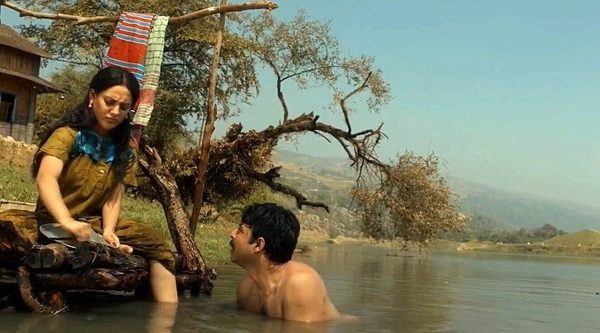
Photo: A still cut of Nazifa Tushi from blockbuster movie ‘Hawa’
While ‘Hawa’ is visually powerful and symbolically layered, it lacks a feminist lens. The film presents the lone female character as a mysterious, eroticized symbol rather than a fully developed person. Her silence, sexualization, and lack of agency reinforce the male gaze, turning her into an object of male desire, fear, and violence.
Though the film invites metaphorical interpretations, it ultimately reflects deep-rooted misogyny rather than challenging it—making women passive symbols instead of active voices
These films repeatedly deny female characters emotional complexity, reducing them to accessories in the emotional evolution of men. It’s not just poor storytelling—it’s a reflection of deeper societal inequalities.
From Screen to Facebook: Misogyny Amplified
What’s more alarming is how these portrayals are echoed and amplified in audience reactions—especially on social media platforms like Facebook.
After Poran, Surongo and Daagi were released, comment sections exploded with anger toward female characters. Ananya from Poran was called “treacherous” and “evil,” while viewers justified or even glorified the violent male character. In Daagi, despite a clear depiction of attempted rape, male fans defended the aggressor and vilified the victim.
Such reactions reflect how cinema does not exist in a vacuum. It shapes and is shaped by public perception. When films demonize women for complex behavior but redeem violent or manipulative men, audiences—particularly men—internalize and reproduce these narratives.
This is what feminist scholar Susan Faludi describes as “backlash”—a cultural resistance that punishes women who step outside traditional roles. And the male gaze doesn’t end at the camera—it continues through the eyes of the audience.
The Real-World Impact of Fiction
When films ignore, downplay, or romanticize violence against women, they normalize it. When female characters are punished for autonomy while male characters are rewarded for aggression, cinema reinforces harmful gender norms.
Women are denied agency. Their trauma is a plot twist. Their voices are silenced, while male emotions take center stage.
This cinematic inequality mirrors what many Bangladeshi women face in reality: a culture that demands silence, obedience, and sacrifice—and punishes deviation.
A Cinema of Resistance, Not Reinforcement
Laura Mulvey urged that cinema must disrupt patriarchal pleasure—not by removing joy, but by creating space for real, complex female subjectivity. That includes giving women agency, flaws, contradictions, and control over their stories.
Despite these challenges, hope is not lost. Films like ‘No Dorai’, ‘Rehana Maryam Noor’ and ‘Made in Bangladesh’ have shown that it is possible to craft compelling stories centered on women’s lives, voices, and struggles—without reducing them to stereotypes.
Bangladeshi filmmakers now have a unique opportunity: to not only entertain but to influence, reshape, and challenge cultural norms.
Because what we see on screen matters. And when women continue to be seen but not heard, desired but not understood, fiction becomes a mirror that distorts reality—for half the population.