Memories, resistance take centre stage

- Update Time : Saturday, October 24, 2026
- 11 Time
Documentaries will pivot round the memories of war, personal loss and resistance to injustice at the 13th edition of the Liberation DocFest Bangladesh to start from October 29.
The three-day international documentary film festival, themed around ‘Presence in Absence’ will begin at the Liberation War Museum in the capital’s Agargaon.
188 submissions, 18 films for screening
The event this year has 188 submissions from which an eight-member preview committee of young filmmakers has selected 18 films for screening from which 10 films have been nominated to compete in the categories of national competition and the international competition.
Selection committee members are Zihan Karim, Biplob Sarker, Mehedi Mostafa, Partha Sarathi, Sharmin Doza, Chaitali Samaddar, Kamrul Ahsan Lenin and Kazi Arefin Ahmed.
The screenings are arranged along thematic categories of ‘bodies and belonging’, ‘gender equality and resistance’, ‘resistance and reform’, ‘generational memory’, ‘displacement and statelessness’, ‘1971: living archives’, ‘ecology in crisis’, and ‘ancestral roots and livelihoods’.
1971 in memories
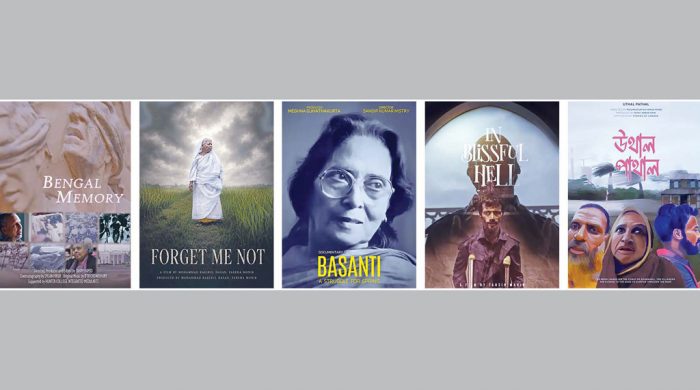
Several of the five nominated films in the national competition revisit the War of Independence and its aftermath.
‘Bengal Memory’, directed by Fahim Hamid, follows a Bangladeshi American who travels to Bangladesh to learn about the war and his family’s immigration to the United States.
The film uses interviews, archival materials and declassified recordings to examine the genocide of 1971 and the role played by the United States.
‘Forget-Me-Not’, directed by Mohammad Rakibul Hasan and Fabeha Monir, revisits the Sohagpur genocide, perpetrated by the Pakistani army in Sohagpur village which was then under Mymensingh and now in Sherpur district on July 25, 1971.
The film follows Hafiza Bewa, who lost her husband and other relatives in the massacre committed by the Pakistani army who were led to the village by local collaborators.
‘Basanti: A Struggle for Spring’, directed by Sandip Kumar Mistry, portrays educationist and writer Basanti Guhathakurta who worked to spread women’s education.
The film also documents the martyrdom of her husband Jyotirmoy Guhathakurta in 1971 and her desperate effort to protect her daughter Meghna.
The other two films in the category focus on survival in the face of adversity.
‘In Blissful Hell’, directed by Tahsin Mahin, recounts the story of a man who is left disabled after an accident and finds strength in his family and faith as he embarks on a journey from despair to resilience.
‘Uthal Pathal’ (topsy-turvy), directed by Mashrukur Rahman Khan, narrates the struggle of the coastal villagers in Patuakhali to survive Cyclone Remal.
Resistance and loss
The selected five international documentaries are about protest, democratic struggle and separation from home.
‘A Move’, directed by Elahe Esmaili of Iran, follows the filmmaker as she helps her parents relocate in Mashhad while reflecting on the Woman-Life-Freedom movement.
‘K Family Affairs’, directed by Arum Nam of South Korea, examines her parents’ roles in the country’s journey to achieve democracy.
‘Locus Cordis’, directed by Syrian filmmaker Alhasan Yousef, explores the divided Syrian Golan.
‘Piblokto’, directed by Anastasia Shubina and Timofey Glinin of the United States, portrays life on the Arctic coast of Chukotka.
‘Only if the Baby Cries…’, directed by Shadab Farooq of India, is set in a village where villagers are deaf and mute and records a childbirth in silence.
New voices in special screening and other events
Nine films made at a workshop on ‘Sultana’s Dream’, organised by the Liberation War Museum, will be screened in a special section.
The films are ‘A Pony’, ‘Dear R2π’, ‘Eksha’, ‘Equity’, ‘Last Ray of Light Before Dusk’, ‘Rahir Ma’, ‘The River Under Skin’, ‘Untitled’ and ‘Where Have All the Women Gone?’.
On October 30, a seminar titled ‘Connecting with the Memory of 1971 in the Classroom through Documentary Film’ will also be held alongside the screenings at the museum.
Awards and jury
One film each from the national and international categories will be awarded with Tk 1,00,000 prize money for each.
Two separate three-member juries will evaluate the films, organisers said.
The jury for the national competition category comprises filmmaker Shabnam Ferdousi, visual artist and filmmaker Dilara Begum Jolly and Sajjad Hossain of the University of Liberal Arts Bangladesh.
The jury for the international competition category comprises cultural personality M Hamid, filmmaker Shamim Akhtar and human rights activist Asif Munier.
A separate nine-member youth jury will select the best film from the perspective of young people to be awarded with certificate.
Liberation DocFest Bangladesh, previously known as the ‘International Festival of Docufilms on Liberation and Human Rights’, began in 2006.
The 13th edition of the festival will conclude with an award ceremony on October 31.