Laundering thru crypto leaves Bangladesh chasing shadows

- Update Time : Saturday, May 23, 2026
- 31 Time
In a country like Bangladesh, from where assets travel abroad in many crooked ways and hardly come back, cryptocurrency is another headache as money is being laundered through this dimly-lit alleyway, investigators have found.
But inadequate logistics and lack of technical know-hows have been the stumbling blocks to tracing the chainanalysis, mainly blockchain data and digital layering.
According to the Criminal Investigation Department, online-based fraudulent investment platform Metaverse Foreign Exchange in 2023 smuggled out $136 million in crypto currency – an amount bigger than the Bangladesh Bank reserve heist of $101 million in 2016.
Of the amount laundered through Metaverse Foreign Exchange, CID has been able to recover only $3.6 million or Tk 44.14 crore towards the end of March this year, which is the first-ever Bangladesh success in recovering smuggled out money through crypto currency.
CID officials say that they have found that the cryptocurrency crime suspects earn through many other crimes like online fraudulence, cyber harassment and online gambling.
But they cannot trace the digital footprints as they do not have any memorandum of understanding with the crypto platforms like Binance, Bybit, OKX, KuCoin and Bitget.
Nurul Islam Hridoy, a Bangladeshi expatriate living in Saudi Arabia, filed a complaint with the Cyber Police Centre of the CID, alleging that Md Masum Bhuiyan, a fraudster living in Bangladesh, had taken $98.42 through online and blocked him.
‘I have already talked to the Binance security team and they have started official investigation into the issue,’ he said in the complaint filed online.
The victim said that Binance would extend all-out support to the CID in this regard.
On May 17, the CID arrested eight members of an organised online gambling syndicate, including its alleged mastermind, on charges of running illegal betting platforms and laundering crores of taka abroad through cryptocurrency and digital hundi.
The syndicate transacted around Tk 2 crore daily over the past six months using different international and local gambling platforms, and later the illegally earned money was smuggled out by cryptocurrency and digital hundi.
Another impediment in the way of tracing money laundering and other crimes through cryptocurrency is that a large number of victims who have lost money investing in crypto do not file complaints with the law enforcers as the Bangladesh central bank considers crypto currency illegal.
The United States-based non-profit business Crypto Council for Innovation (CCI) reported on January 8, 2026 that Bangladesh ranked 13th on the global crypto adoption index with 4.3 million people owning crypto despite the Bangladesh Bank considering crypto trading illegal.
The CCI, a global alliance working to advance innovation and inclusive regulation, says in the report that remittance payments are important to Bangladeshis, registering an all-time high of more than $30 billion in 2024-2025.
‘Making these payments using P2P networks is faster and typically cheaper. It also bypasses the country’s traditional banking, which is bureaucratic, slow, and still excludes large parts of the population,’ the CCI adds.
The term crypto comes from Greek word ‘kryptos,’ meaning ‘hidden’ or ‘secret’. Prefixed to currency, it emphasises the cryptographic techniques used to secure transactions and control the creation of new units.
Crypto platforms like Binance, Bybit, OKX, KuCoin, Bitget commonly used in Bangladesh are not fraudulent but often used in laundering chain, according to Criminal Investigation Department officials.
They also say that the money is converted to crypto from local currency through P2P conversion, then kept at the temporary storage and finally sent abroad. The fraudsters mostly use Telegram, WhatsApp and Facebook for communication.
Masrur Ahmed, a crypto currency victim, who bought dollars spending Tk 5.7 lakh on August, 2025 and bought three bit coin mining devices from Bit Harvest by giving the local currency to a person living in Bangladesh at that time, now living in Malaysia and the United Arab Emirates.
‘I used to get $15 daily from three devices in my account opened in Bit Harvest. I had been receiving the money in my account for three months and then the third party person living in Malaysia told me that bit coin could not be mined through these devices,’ said Masrur, adding that they asked him buy new devices in another organisation of the same Bit Harvest company.
He said that USDT 5,000 showed in his account but he could not withdraw the amount.
‘The most attractive part of the cryptocurrency is that it is traceless but has value. It remains out of scanner of the central bank, law enforcers and taxation, and moves through computer system and is cashed out as USD,’ said Daffodil International University associate professor of software engineering Tanvir Hasan Zoha.
Tanvir, also an International Crimes Tribunal prosecutor, says that crypto currency is being used as a form of digital hundi or informal cross border value transfer in many cases. ‘Payments over criminal activities and dark web transactions are conducted in a way where both sender and receiver remain traceless,’ he adds.
The challenges become even more difficult in tracing the cryptocurrency when the amount is related to extremist financing, child exploitation, ransomware, organised crime and online extremism, according to investigators and experts.
Tanvir Hasan Zoha suggests that the Bangladesh government should formulate a policy to contain cross-border money transfer through crypto, and investigators are required to have three things – Mutual Legal Assistance Treaty (MLAT) to seek services in diplomatic channels, software and forensic – to arrest the criminals in the dark web.
‘It is good to know that the CID has finally made some success in cryptocurrency tracing. But, it is not enough to solve a case partially in five to ten years as over a thousand of such incidents involving the laundering of tens of thousands of crore taka remain traceless,’ he adds.
CID officials say that they had to take help from US intelligence agencies to trace the digital footprints as they have no logistics for chainanalysis of blockchain.
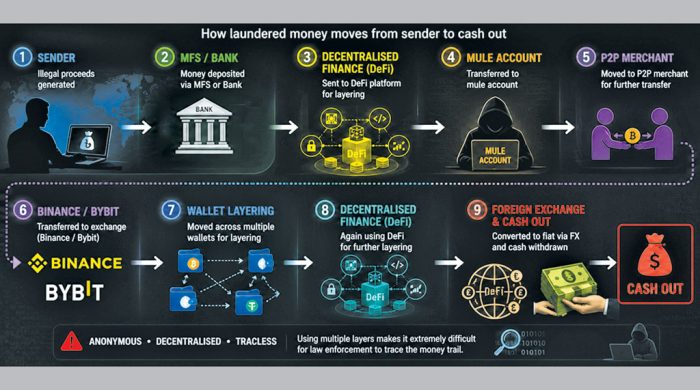
In laundering money through crypto, the amount flows from the sender to MFS/Bank to decentralised finance for a layering to a Mule Account, to P2P merchant to Binance/ Bybit, Wallet Layering, another decentralised financing to foreign exchange and finally cash out, a CID official seeking anonymity details.
CID chief Mosleh Uddin Ahmed, now the Dhaka Metropolitan Police commissioner, told New Age on May 5 that they were aware of the incidents of smuggling through crypto currency and recently held meetings with the officials of the Bangladesh Financial Intelligence Unit.
‘We are working on how to strengthen our capacity to deal with crypto currency issues. We are trying our best to contain laundering through crypto currency,’ Mosleh Uddin said.
CID officials say the Bangladeshi agencies can reach only the sender or victim while the rest trail of money remains traceless.
They say that mobile financial services like Bkash and Nagad are widely used for crypto transactions.
They say that the Bangladesh Bank and its intelligence agencies should find out such mule accounts and bring the agent and merchant accounts in Bkash and Nagad under its surveillance.
Bangladesh Bank Executive Director Arief Hossain Khan says cryptocurrency is banned in Bangladesh and law enforcers are to oversee this.
‘Bangladesh Bank payment system department is overseeing the transactions on MFS. If any agent or merchant is involved in such activities, the company may not be aware of it,’ he added.
Asked about the BB’s action against mule accounts and others MFS agents and merchant who help buy crypto currency, he said that the head of the Bangladesh Financial Intelligence Unit could tell better in this regard as the BFIU is working on it.
BFIU head Iqtiaruddin Md Mamun’s phone was found switched off when this reporter tried to reach him for comment.