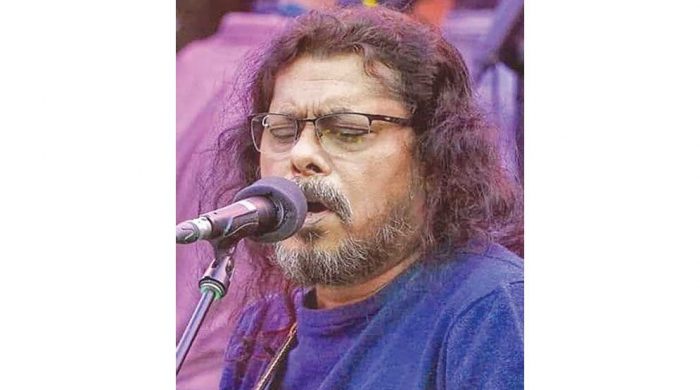
For decades, Hyder Husyn has stood as one of Bangladesh’s most distinctive musical voices, a man equally admired for his art and his authenticity. With his signature afro, beard, and calm presence, he carries the humble assurance of someone who has made peace with both applause and the silence that follows.
But to call Hyder Husyn merely a musician would be an understatement. He is a lyricist, philosopher, father, and a visionary: a man who, by his own measure, lives by rhythm. In a world that prizes speed, he exists at a slower frequency, one where sound, thought, and faith move in a melange of harmony.
“First, you have to understand what music really is,” he says early in the conversation. “It’s vibration, a frequency that touches your inner mind and body, something invisible yet deeply felt.”
To him, music is not just a performance, but a form of inner exploration. His celebrated songs, such as “Faisha Gechi,” are quirky and playful, evoking laughter and lightheartedness, while others, like “Gonotontro,” are heavy and probing, questioning society and stirring deep contemplation. He remarks, “When you explore through music, it pushes you toward the hidden things inside you, the files your brain doesn’t usually open,” he explains. “A melody can unlock what you’ve forgotten. Sometimes it’s painful, sometimes joyful, but it always takes you closer to yourself.”
His relationship with music has never been about fame or recognition. His eyes soften when he speaks of it. “I play because it soothes me,” he says. “When I make music, I don’t even realize who’s in front of me. If people listen and find joy in it, that’s beautiful,” he says. “But even if they don’t, it doesn’t change anything for me. I create music for my own peace.”
This detachment does not come from indifference but from integrity. His songs, often described as meditative and philosophical, reflect a deep belief in truth as a form of beauty. “Truth was always open,” he says quietly. “It’s humans who keep covering it. We pretend to be more than we are, but the more we cover ourselves, the more the truth reveals itself. Truth is your beauty. The more you live it, the more radiant you become.”
Solitude, too, plays a vital role in his creative process. “Solitude means concentrating at level zero,” he says. “No one around, no distractions, just you, searching for yourself. That’s when real focus begins.” He compares it to meditation, adding with a wry smile, “When I write lyrics, I ask myself, what am I trying to say? Many writers lose meaning trying to rhyme. But sense must come first, and rhyme later.”
In an era when the music industry is saturated with commercial pursuits, Hyder Husyn’s refusal to conform stands out. “When creativity is made for selling, it loses its soul,” he says firmly. “Anyone who creates only for money stops being creative. The purpose of art is to seek, not to sell.” For him, to create means to align with something ancient, a frequency which is older than memory.
When asked what success means to him, he pauses, as if searching for a word that feels right. “I’m successful when I see someone searching for their truth,” he says finally. “Whoever finds it, that’s my success.”
In Hyder Husyn’s world, music is neither a career nor a calling. It is a mirror that reflects the essence of being. His melodies do not ask for applause; they require reflection. In a time when noise deluges meaning, Hyder Husyn reminds us that silence and sincerity might just be the truest sounds of all.