Energy crisis pushes production costs up by 20pc: BKMEA

- Update Time : Sunday, April 26, 2026
- 33 Time
Industry leaders of the country’s readymade garment sector said that the production costs in this sector have increased by at least 20 per cent, along with a fall in export orders, due to mounting pressure of energy shortage.
They also said that persistent load shedding and financial sector bottlenecks have affected the sector over the past months, forcing many factories to limit production or even shut down operations.
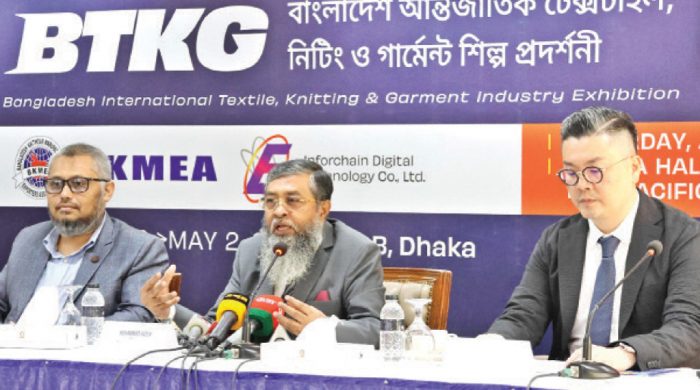
They were speaking at a press conference on Saturday on the upcoming Bangladesh International Textile, Knitting and Garment Industry Exhibition (BTKG Expo 2026), scheduled to begin on April 29.
The four-day expo, jointly organised by BKMEA and Inforchain Digital Technology Co Ltd, would be held at the International Convention City Bashundhara in the capital till May 2.
Organisers said more than 1,000 exhibitors from around 30 countries are expected to participate.
Mohammad Hatem, president of the Bangladesh Knitwear Manufacturers and Exporters Association, said that the overall business environment had become ‘severely challenging’.
He also said that despite official claims of adequate fuel reserves, industrialists were struggling to obtain diesel and other fuels from filling stations.
In many cases, fuel supply in containers has been restricted, creating operational difficulties for factories reliant on generators.
‘Is it practically possible to take factory generators to filling stations to fill fuel? This is simply not workable,’ he added.
He also said that load-shedding across industrial zones averaged two to three hours, but in some areas it extended to six to eight hours.
Such disruptions were significantly affecting production schedules, leading to missed export deadlines and additional costs, including air shipments and penalties.
‘The combined impact of higher fuel prices, transport costs, power disruptions and supply chain constraints had pushed production costs up by at least 20 per cent,’ he added, saying that, however, exporters were unable to pass on the increased costs due to pre-agreed contract prices in international markets.
The buyers have begun scaling down new orders, placing further pressure on exporters, he said.
‘Delays in receiving payments due to banking inefficiencies had resulted in shipment postponements of up to two months, ultimately causing significant financial losses when orders were canceled or partially settled,’ he added.
He also said that constraints in the banking sector, including delays in opening letters of credit, limited credit access, and slow document processing, were disrupting import and export operations.
BKMEA executive president Fazlee Shamim Ehsan said that although fuel cards have been introduced, supply has not yet stabilised across all regions.
He said that global economic slowdown, declining consumer spending in key markets such as Europe, and rising energy costs have led to a reduction in orders not only for Bangladesh but also for competing exporting countries.
The industry leaders said that the sector is operating at only 50 to 60 per cent of its capacity currently.
Industry leaders warned that unless the energy, banking, and customs-related bottlenecks are addressed urgently, Bangladesh’s apparel sector risks losing further competitiveness in the global market.
Responding to a question on the expo, Hatem said the exhibition had previously been organised by another association, but it did not take place this year.
In that context, industry stakeholders felt that, regardless of the current business situation, failing to keep pace with modern technologies would result in Bangladesh losing its market share and export orders shifting elsewhere.
He also said that the global fashion industry is rapidly moving towards fast fashion, recycling, and circularity, making technological advancement essential.
The primary objective of the exhibition is to familiarise entrepreneurs in the sector with such technologies, he added.
According to the organisers, companies from Bangladesh as well as Canada, China, Taiwan, Belgium, France, Hong Kong, India, Indonesia, Japan, Vietnam, Malaysia, Turkey, and the United Arab Emirates will showcase their products and technologies at the exhibition.
The event would feature modern textile machinery, dyes and chemicals, knitting and weaving technologies, embroidery, cutting and sewing equipment, and washing and dry-cleaning technologies.
The exhibition will remain open to visitors daily from 11:00am to 7:00pm.
Among others, Inforchain Digital Technology Co Ltd executive director Spencer Lin and Alliant Ltd CEO Rubaiyat Ahsan were present at the press conference.