Hidden climate bank beneath soil

- Update Time : Tuesday, June 2, 2026
- 36 Time
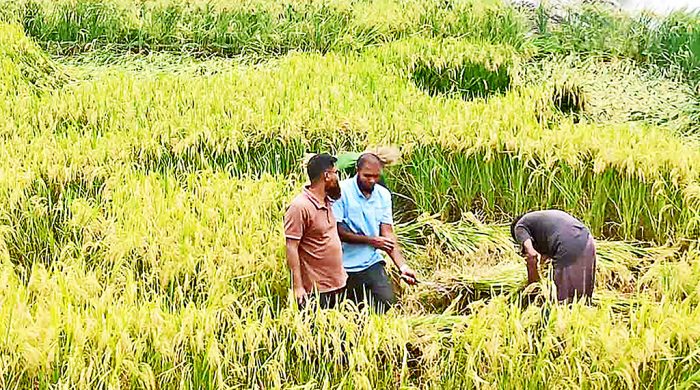
CLIMATE change is usually discussed through cyclones, river erosion, salinity intrusion, floods and heat stress. Far less attention is given to the quiet climate story beneath the soil. Yet, the farmland may become one of its most practical allies in strengthening food security and climate resilience. Healthy soil stores organic carbon drawn from the atmosphere through crops, roots, residues and microorganisms. When managed properly, it can retain more moisture, improve nutrient efficiency, reduce fertiliser dependence and support more stable crop production. In a densely cultivated country such as Bangladesh, this is not merely an environmental concern; it is increasingly becoming an agricultural necessity.
Soils have been under continuous pressure for decades. Multiple cropping, intensive tillage, declining use of organic manure, removal of crop residues and imbalanced fertiliser application have gradually reduced soil organic matter in many farming regions. According to the Soil Fertility Atlas Bangladesh 2020 prepared by the Soil Resource Development Institute, more than one-third of the country’s arable land falls within very low to low organic matter status, while only a small fraction remains high or very high. This decline carries implications beyond soil fertility alone. Agriculture continues to support rural livelihoods, employment and national food systems despite its declining share in gross domestic product. Weakening soil health therefore threatens both productivity and long-term resilience.
Soil carbon sequestration refers to increasing the amount of organic carbon stored in soil over time. This can be strengthened through relatively familiar farming practices such as returning crop residues to fields, applying compost and decomposed cow dung, using green manure, reducing unnecessary tillage, integrating trees into farmland and introducing cover crops or biochar where feasible. Many farmers already practise some of these methods, though they are rarely framed as part of climate mitigation. The growing importance of soil carbon lies in recognising these practices not only as soil management tools, but also as measurable climate actions capable of improving agricultural sustainability while lowering environmental stress.
The global scientific community increasingly recognises soil organic carbon as a cost-effective nature-based solution to climate change. The Food and Agriculture Organisation has emphasised the importance of monitoring topsoil carbon stocks, particularly within the upper soil layer, to understand how management practices influence sequestration potential. For Bangladesh, this highlights the need for caution against exaggerated carbon claims. A project cannot credibly claim climate benefits merely because compost has been applied or because one isolated soil test shows improvement. Reliable sequestration assessment requires repeated soil sampling, laboratory analysis, bulk density measurement and comparison over time. Without rigorous measurement, climate promises risk becoming symbolic rather than scientifically defensible.
This is where the country requires a stronger bridge between scientific research and field-level implementation. Laboratories under the Soil Resource Development Institute, agricultural universities, research institutes and development agencies could jointly establish a national soil carbon monitoring culture. A practical approach would involve collecting baseline samples from GPS-marked plots, measuring soil organic carbon and bulk density and repeating the process after several years to identify measurable change. Expressing results as tonnes of carbon per hectare and where necessary converting them into carbon dioxide equivalents, would make soil health more visible not only to scientists but also to policymakers, financiers and farmers themselves.
Rice cultivation deserves particular attention within this discussion. Paddy farming remains central to Bangladesh’s food security, yet continuously flooded rice systems are also linked with methane emissions. Soil carbon strategies within rice agriculture therefore require careful balancing between productivity and emission reduction. Alternate wetting and drying, promoted by the International Rice Research Institute and its partners, offers one possible pathway. Research has shown that alternative wetting and drying can reduce methane emissions while lowering water use and maintaining productivity under suitable conditions. Experiences from the Barind region have also demonstrated potential gains in water efficiency and emission reduction, although widespread farmer adoption remains limited because of awareness gaps, irrigation practices and risk perceptions.
The broader policy environment is gradually becoming more supportive. Bangladesh’s climate commitments under its Third Nationally Determined Contribution identify agriculture, forestry and land use as priority mitigation sectors, with targets for reducing emissions by 2035. Proposed measures include wider adoption of alternative wetting and drying, precision fertiliser application, improved manure management, short-duration rice varieties and increased use of biochar, vermicompost and biogas solutions. Taken together, these initiatives point towards a more integrated climate-smart agricultural system where soil, crops, livestock, water and trees are managed within a connected ecological framework rather than through isolated interventions.
The economic argument for restoring soil health is equally significant. Climate change is already increasing farming costs through irregular rainfall, heat stress, salinity intrusion, pest outbreaks and water scarcity. Soil rich in organic matter functions much like a natural sponge. It retains moisture during dry periods, drains more effectively during heavy rainfall, supports microbial activity and improves nutrient retention. For smallholders, this may reduce production risks and stabilise yields. For the state, healthier soils could improve returns from fertiliser subsidies, irrigation investments and adaptation programmes. Soil carbon therefore should not be viewed merely as an abstract carbon-market discussion, but as part of Bangladesh’s broader agricultural resilience strategy.
At the same time, the country must avoid two policy extremes. One is to neglect soil carbon because it appears technically complex and largely invisible. The other is to overstate climate gains without transparent scientific evidence. Carbon projects promising rapid benefits without proper monitoring may ultimately undermine farmer trust and institutional credibility. A more balanced approach would focus on farmer-friendly soil health cards, local composting systems, residue management incentives, demonstration farms and digital soil databases linked with existing national information systems. Climate-smart agriculture programmes and donor-funded projects should incorporate soil carbon indicators, but with realistic timelines and credible methodologies.
Bangladesh’s climate future will not depend solely on embankments, cyclone shelters, solar panels or early warning systems. It will also depend on the biological strength of millions of small agricultural plots stretching from Rangpur to Barishal and from the Barind highlands to the coastal belt. Soil carbon sequestration offers a rare convergence of benefits: improved soil fertility, greater climate resilience, lower emissions and more sustainable rural livelihoods. The challenge now is to move beyond scattered initiatives towards measurable national action. Beneath crowded fields lies a hidden climate bank that the country can no longer afford to neglect.
Dr Makhan Lal Dutta is an irrigation engineer and the chief executive officer of Harvesting Knowledge Consultancy.