657 deaths, yet guidelines for measles management absent

- Update Time : Wednesday, June 17, 2026
- 21 Time
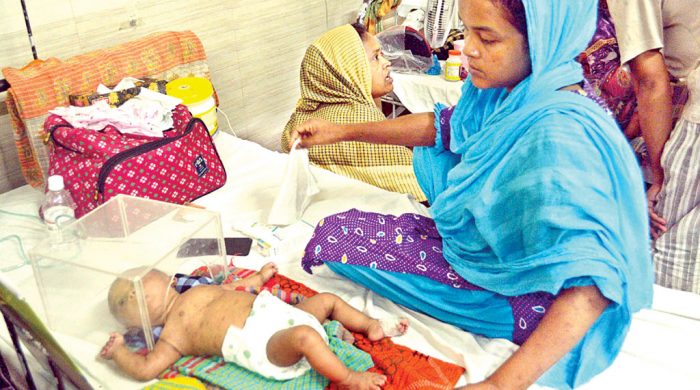
Three months into an unprecedented measles outbreak sweeping across Bangladesh — infecting nearly 1 lakh people and claiming 657 lives, the country is yet to develop a national medical protocol for doctors to deal with the viral disease.
The lack of a protocol for the highly infectious disease currently infecting hundreds of children daily could mean the difference between life and death, especially within Bangladesh’s fragile healthcare system.
The country’s healthcare system lacks adequate critical, life-saving facilities like reliable oxygen supplies and intensive care units, health experts observed.
Unaccustomed to dealing with measles cases, physicians are issuing unnecessary referrals, sending large number of patients to specialised hospitals, as they are reluctant to take risks in treating a disease that has emerged almost out of nowhere.
Meanwhile, an unprecedented scene has unfolded across the country’s healthcare landscape: local hospitals are lying empty while city facilities are struggling to cope with the sheer number of patients, even though only 10 per cent of measles cases are practically critical.
‘A national protocol could have minimised the number of referrals to specialised hospitals and saved more lives,’ said professor Be-Nazir Ahmed, a public health expert.
A group of paediatricians, medicine specialists, and public health experts is enough to prepare a national measles guideline in just a week, he also observed.
He warned that without a protocol, doctors are left in a tight spot, hesitant to treat even the mildest cases of infection.
For instance, a measles patient with nothing more than some rashes can easily be treated at home, but such routine cases are currently overwhelming specialised hospitals.
Measles patients who develop encephalitis — an inflammation that occurs when the infection spreads to the brain and threatens to cause permanent damage —require immediate, specialised hospital care.
The protocol, with descriptions of symptoms to look for, enables a physician to separate severe cases from simple ones without wasting time, even before laboratory test results arrive.
A simple count of breathing rate could indicate how severe a measles patient’s condition is, experts said, adding that increased breathing suggests lung infection.
A treatment protocol, he said, helps clinicians in determining which tests are necessary when, what treatment should be provided, and when referrals are required, thereby reducing unnecessary investigations and healthcare costs.
Dr Md Khairul Islam, executive committee member of the Bangladesh Health Watch, a non-government health research body, noted that physicians were unprepared to tackle measles cases due to its historical low prevalence in Bangladesh setting, which reversed during the past interim government.
He recalled the death of a physician from internal haemorrhage caused by dengue infection before the treatment protocol for the mosquito-borne disease was developed.
‘The unfortunate doctor was taken to the operating table to stop his bleeding, while in an ideal situation any procedure that could trigger bleeding in such patients is prohibited,’ he said.
In haemorrhage cases, patients are not even allowed to brush their teeth to avoid even minimal risk of gum injury from toothbrush bristles, experts said.
On Tuesday, privately run Holy Family Red Crescent Medical College Hospital launched what it described as the country’s first comprehensive institutional ‘Measles Treatment Guideline’.
The Bangladesh Society for Infectious and Tropical Diseases said that it also drafted a protocol for its members to treat measles cases and it is being followed.
Health minister Sardar Md Sakhawat Husain attended the launch of Holy Family’s measles guideline on Tuesday.
‘A private hospital has developed its measles protocol, which is good, but the government is yet to do the job,’ he said.
‘We will do it soon,’ he told reporters.
Several physicians working at district and upazila hospitals told New Age that they were reluctant to deal with measles cases due to the absence of the guideline.
They walk the easy path of sending patients to specialised health facilities in the capital.
But travelling to capital could be taxing for the patients and their guardians, both economically and physically.
Emergency service providers such as ambulance operators often charge exorbitant rates.
The Infectious Diseases Hospital, DNCC Dedicated Hospital and the Bangladesh Shishu Hospital and Institute in Dhaka have seen their spaces flooded with measles patients.
Doctors working at referral hospitals said that some patients arrived after protracted delays following transfers from distant districts, reducing their chances of recovery.
‘If patients receive proper treatment in time at local facilities, many lives could be saved,’ said a physician involved in treating measles patients.
According to data from the Directorate General of Health Services, around 40 per cent of hospitalised children suffering from measles and measles symptoms die within two days of admission.
The World Health Organisation has an extensive guideline on measles prevention, surveillance, and clinical management.
Experts, however, say that countries often adapt international recommendations to local realities, considering available resources, disease patterns, and healthcare capacity.
According to former DGHS director-general and medicine specialist professor Mohammad Abul Faiz, localisation of international guidelines is essential.
Bangladesh has developed national management guidelines for many diseases, including Covid-19, dengue, malaria, tuberculosis, snakebite, Nipah virus infection, asthma, and hypertension.
Whenever an unusual outbreak occurs, experts said, the government should immediately form a technical committee to develop and regularly update a clinical management protocol.
They also stressed that developing a guideline alone would not be enough.
The government would also need to officially endorse it, circulate it nationwide, and provide training to physicians, nurses, and other health professionals to ensure its effective implementation.
Questions also remain about the approval process for clinical guidelines.
Experts suggested that the government establish a high-powered technical committee to review, endorse, and authorise national treatment protocols for emerging public health threats.
Health secretary Quamruzzaman Chowdhury acknowledged the need for a measles guideline, saying that the DGHS has been asked to prepare one.
DGHS director general professor Dr Pravath Chandra Biswas did not respond to repeated phone calls and text messages seeking comment.
The DGHS on Tuesday reported that one more died of measles and 1,142 were infected, totalling number of infections 98,452 and deaths 657.