When mountains melt, deltas pay

- Update Time : Saturday, August 29, 2026
- 1 Time
THE most frightening lesson from Nepal’s recent flash flood is not simply that mountains can collapse. It is that a disaster beginning thousands of metres above sea level can rapidly become a crisis for people living far downstream. In the Himalayas, snow and ice are disappearing, slopes are becoming increasingly unstable, rainfall patterns are changing, and rivers are carrying more water and sediment with greater force. For countries such as Bangladesh, which sits at the receiving end of the Himalayan river system, Nepal’s tragedy should therefore be read not as a distant mountain disaster, but as an early warning from a landscape on which our own future is deeply dependent.
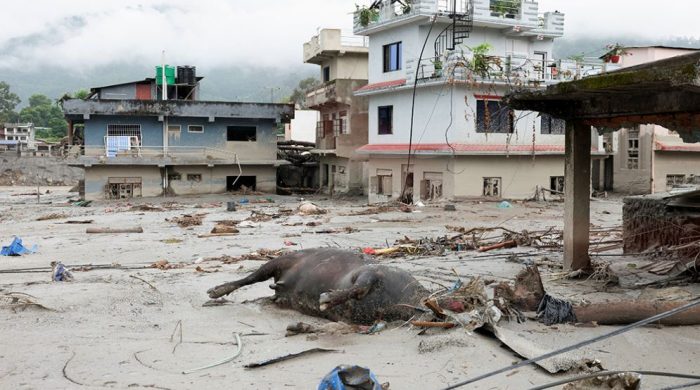
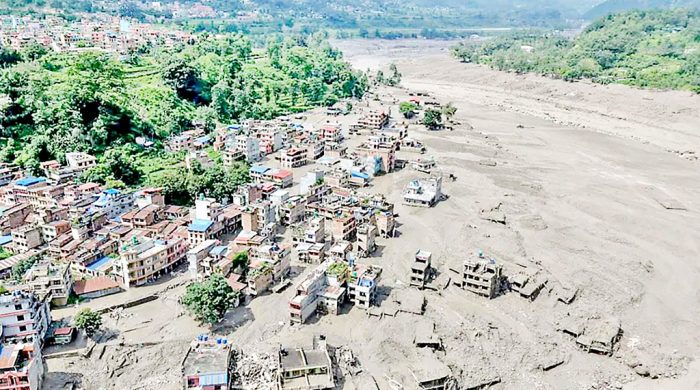
The disaster along the Nepal-Tibet border initially appeared to be an earthquake. The United States Geological Survey later determined that the seismic signal was generated by a massive landslide and debris flow rather than by an earthquake. Satellite imagery indicated that the lower part of a glacier may have collapsed from an altitude of roughly 5,200 metres, plunging towards a valley floor about 1,200 metres below. The resulting torrent swept away people, houses, roads, bridges and infrastructure. In Nepal alone, the death toll reached at least 162 so far, while hundreds remained missing. On the Tibetan side, hundreds more were reported missing.
Yet it would be scientifically premature to declare that climate change directly caused this particular disaster. Scientists are still examining the roles of rainfall, glacier conditions, slope instability, construction and possible changes in glacial lakes. That distinction matters. Climate science does not require us to attribute every landslide or flood to global warming. The more important question is whether climate change is altering the conditions under which such disasters become more likely, more intense and more difficult to predict. The evidence increasingly suggests that it is.
The Himalayas are changing at a speed that should concern every government downstream. According to the United Nations, Nepal’s snow-covered mountains lost nearly one-third of their ice in just over three decades. Nepal’s glaciers were also reported to be melting 65 per cent faster in the last decade than in the previous one. These figures describe something much larger than disappearing scenery. Glaciers are natural reservoirs. They store water as ice and release it gradually. When that system changes, the timing, volume and behaviour of water flowing through entire river basins can change with it.
This is where Nepal’s disaster becomes Bangladesh’s problem.
Bangladesh has historically understood floods as a seasonal reality. The monsoon brings water, rivers overflow, and communities adapt. But the climate crisis is transforming the meaning of flooding. A flood is no longer necessarily just an excess of seasonal rain. It can be the product of multiple forces arriving simultaneously: intense rainfall, upstream landslides, accelerated snow and ice melt, sediment accumulation, riverbank erosion, sudden changes in river flow and inadequate drainage downstream.
Bangladesh is geographically positioned to receive the consequences of these changes. The Ganges, Brahmaputra and Meghna river systems connect the Himalayan region with the world’s largest delta. Water does not respect national borders. A landslide in Nepal may be a Nepalese disaster, but the broader changes taking place in the Himalayan watershed are part of a transboundary environmental system. What happens in the mountains eventually travels through rivers towards the plains.
This geographical reality exposes a weakness in the way climate risk is often discussed in south Asia. Countries tend to prepare for disasters within their own borders, while the forces producing those disasters frequently operate across borders. Nepal cannot manage Himalayan glacier risks alone. Bangladesh cannot protect its river communities through embankments alone. India, China, Nepal, Bhutan and Bangladesh share interconnected mountains, rivers, weather systems and ecological vulnerabilities. Yet climate governance remains largely organised around national boundaries.
That contradiction is becoming increasingly dangerous.
Bangladesh has invested heavily in disaster preparedness and has earned international recognition for reducing deaths from cyclones and floods. Early warning systems, shelters, embankments and community-level preparedness have saved countless lives. But the nature of risk is changing faster than infrastructure and institutions can sometimes adapt. A river that rises gradually gives communities time to respond. A sudden wall of water carrying rocks, mud, ice and debris is a fundamentally different threat.
Nepal’s disaster also raises another uncomfortable question about development. The Himalayan region is increasingly dependent on roads, hydropower, tourism and other infrastructure projects. These are essential for economic development, but construction in fragile mountain environments can interact with natural instability. Roads cut into slopes, poorly planned infrastructure and other forms of disturbance can increase vulnerability. Climate change does not eliminate the responsibility to examine human decisions. In fact, it makes that responsibility more urgent.
The irony is that the people most exposed to these risks often have the least responsibility for creating the problem. Nepal contributes only a tiny fraction of global greenhouse gas emissions, yet its mountains are warming and changing rapidly. Bangladesh is similarly vulnerable despite being a relatively small contributor to historical global emissions. Meanwhile, much of the world’s economic power and emissions remain concentrated in richer and more industrialised countries.
This is the uncomfortable moral arithmetic of climate change. Those who contributed least may be forced to spend the most simply trying to survive the consequences.
For Bangladesh, the response cannot be limited to demanding climate finance after every catastrophe. Adaptation must become a permanent national security priority. That means investing not only in embankments and shelters but also in river monitoring, hydrological forecasting, sediment management, resilient infrastructure and basin-wide data sharing. Bangladesh needs stronger cooperation with upstream countries so that extreme changes in river conditions are detected and communicated before they become downstream disasters.
The country also needs to rethink what it means to build beside rivers. As climate volatility increases, settlements and infrastructure designed according to yesterday’s flood patterns may become dangerously inadequate tomorrow. Bridges, roads, power plants, industrial zones and housing cannot be planned solely around historical averages when the climate itself is moving beyond those averages.
Perhaps the greatest warning from Nepal is therefore not about one catastrophic flash flood. It is about a chain reaction. A warmer atmosphere alters snow and ice. Changing glaciers affect mountain stability and water systems. Heavy rainfall interacts with unstable slopes. Landslides generate debris flows. Rivers carry the consequences downstream. And eventually, millions of people living in distant lowlands inherit risks they had little role in creating.
Bangladesh has spent decades learning how to live with water. The next challenge may be learning how to live with water that behaves differently from the past.
The mountains are sending a warning. We should not wait for that warning to arrive at our doorstep.
HM Nazmul Alam is an academic, journalist and political analyst based in Dhaka, Bangladesh. Currently he teaches at IUBAT.