Pressure mounts on RMG exports to the EU

- Update Time : Sunday, January 18, 2026
- 51 Time
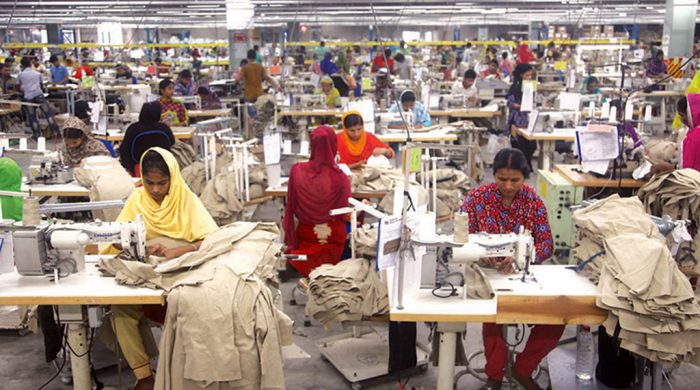
Bangladesh’s ready-made garment exports to the European Union came under notable pressure in November 2025, posting a sharp year-on-year decline amid weak consumer demand and intense competition from rival sourcing countries.
According to Eurostat data, Bangladesh’s RMG exports to the EU fell to 1.37 billion euros in November 2025, down from 1.54 billion euros in November 2024, marking a sharp 10.87 per cent decline.
Moreover, the downturn was not limited to Bangladesh, as major garment-supplying countries experienced negative growth in November, including China, India, Turkey, and Vietnam, due to weak demand.
Meanwhile, the scale of Bangladesh’s decline remains alarming due to its heavy dependence on the EU market, exporters said.
Mohammad Hatem, president of the Bangladesh Knitwear Manufacturers and Exporters Association, said that due to higher reciprocal tariffs in the United States, China and India have shifted aggressively towards the EU.
Supported by strong access to locally sourced raw materials, these countries have been able to export at lower prices and capture market share in the EU, he added, saying that this aggressive pricing and competition have led to a decline in Bangladesh’s exports to the EU.
However, despite the weak November performance, Bangladesh’s overall RMG exports to the EU showed resilience over the longer term.
The broader EU import scenario also underscored the challenging market conditions, as in November 2025, the EU’s total RMG imports from the global sources declined by 4.09 per cent to 6.95 billion euros, down from 7.25 billion euros a year earlier.
Mohiuddin Rubel, former director of the Bangladesh Garment Manufacturers and Exporters Association, said that European markets remained unpredictable and sluggish due to inflation and shifts in buying patterns.
He also said that the country’s internal political situation has further weakened business confidence, disrupting normal trade flows.
‘The risk of supply-chain disruptions has increased, making timely delivery of goods more challenging, and in such an environment, both local and foreign investors are delaying investment decisions,’ he added.
However, exporters said that with the election nearing, buyers might put deferred orders on hold slowly after a fair election and an elected government is formed.
They urged the government to provide policy support and the manufacturers to improve productivity, competitiveness, efficiency, innovation, and market and product diversification to remain competitive.
Meanwhile, during the January–November period of 2025, Bangladesh’s exports grew by 7.65 per cent to 18 billion euros, compared with 16.78 billion euros in the same period of 2024, the growth rates gradually plummeting.
In January-November of 2025, the EU’s imports from global sources also grew by 3.93 per cent to 82.94 billion euros, up from 79.81 billion euros in the same period of 2024.
During January-November of 2025, China remained the EU’s largest apparel supplier, supplying 24.42 billion euros, up 6.55 per cent from 22.91 billion euros in the same period in 2024.
However, the Asian country’s exports declined by 0.43 per cent to 2.15 billion euros in November 2025, down from 2.16 billion euros in November 2024.
The EU’s apparel imports from Turkey declined by 11.31 per cent to 7.66 billion euros in January-November of 2025 from 8.64 billion euros in the same period of 2024.
In November 2025, the Eurasian country’s exports to the EU also recorded a 13.34 per cent decline to 599 million euros, down from 691 million euros in the same period of the previous year.
India recorded 8.31 per cent growth to 4.24 billion euros in January-November 2025, higher than the 3.92 billion euros exported in the same period of 2024, Eurostat data showed.
However, the country also experienced a 1 per cent decline to 232 million euros in November 2025, down from 234 million euros earned in November 2024.
Cambodia emerged as the fastest-growing supplier among the countries analysed.
The EU’s apparel imports from Cambodia jumped to 4.15 billion euros in January-October of 2025 from 3.6 billion euros in the same period of the previous year.
Among the top five RMG exporters, Cambodia was the only country to record positive growth in November, rising 4.84 per cent to 399 million euros.
The EU’s apparel imports from Vietnam increased by 10.10 per cent to 4 billion euros in January-November of 2025 from 3.65 billion euros in the same period of 2024, said the Eurostat data.
Pakistan also posted a growth of 10.46 per cent to 3.55 billion euros in the first eleven months of 2025, up from 3.21 billion euros in the same period of 2024.
Meanwhile, Eurostat data lags by two months, and the Export Promotion Bureau reported that the country’s RMG exports had been declining over the past months.
During July–December of FY26, Bangladeshi exporters recorded a 4.41 per cent decline in shipments to the EU—the largest destination for Bangladesh’s apparel exports—to $9.46 billion, down from $9.87 billion in the same period of FY25.
This indicates that exports to the EU are likely to show negative growth in Eurostat’s coming months as well.
In 2024, Bangladeshi RMG exporters secured 18.2 billion euros in sales to the EU market.