Over 400 drivers killed for battery rickshaws in seven years

- Update Time : Monday, October 26, 2026
- 4 Time
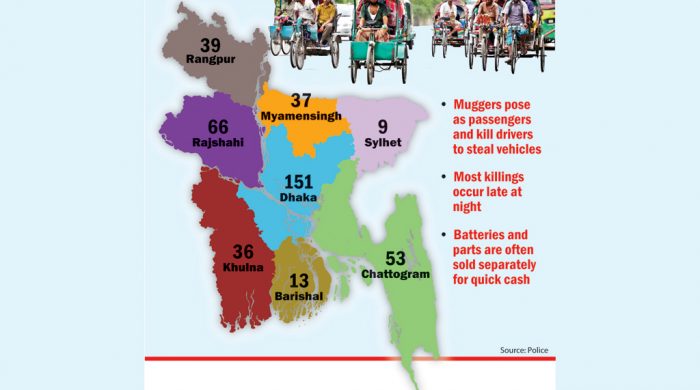
A total of 404 battery-powered rickshaw drivers were killed by muggers across the country between 2020 and October 20, 2026, with Dhaka recording the highest number, according to a New Age review of data obtained from various law enforcement sources.
No official police statistics are available on the number of drivers murdered for their auto-rickshaws.
New Age compiled a database from documents and information obtained from metropolitan and district police units, the Criminal Investigation Department and the Police Bureau of Investigation. But police say the actual toll could be higher.
A year-wise breakdown shows that 64 drivers were killed in 2021, the highest annual figure during the period. The number stood at 62 in 2020, 51 in 2022, 58 in 2023, 60 in 2024, 57 in 2025 and 52 up to October 20, 2026.
Information obtained from muggers arrested by law enforcement agencies suggests that stolen auto-rickshaws have a ready market across the country, making such robberies a recurring crime.
An analysis of the killings shows that perpetrators often pose as passengers, take drivers to isolated locations, kill them and steal their vehicles.
Most incidents occur late at night, with organised groups trading in stolen vehicles and batteries operating behind the crimes.
The pattern emerged in two killings in Amulia Model Town, Demra, in March 2023. Two auto-rickshaw drivers, Miraj Hossain and Swapn Islam, were killed there within 21 days of each other. Investigations found that both were murdered by muggers late at night for their vehicles.
Madhusudan Das, then assistant commissioner of police for the Demra zone and now an additional superintendent of police at the Armed Police Battalion, told New Age that a gang of six to seven members had been stealing auto-rickshaws in Demra, Jatrabari, Sabujbagh and Khilgaon.
The gang members were involved in both killings. After midnight, they would pose as passengers, take drivers to isolated locations, strangle them with towels, locally known as gamchha and steal their vehicles.
Madhusudan said the muggers sold stolen auto-rickshaws for as little as Tk 10,000. Police also arrested a buyer who ran a garage at Mala Market in Demra, where the colour of a stolen vehicle would be changed within 10 minutes of its arrival.
The market for stolen auto-rickshaws is thriving, as reflected in the killing of Ataur Rahman, a 60-year-old battery-powered rickshaw driver, at Mirzanagar in Kapasia, Gazipur, on August 20 this year. Police arrested three people in connection with the killing, but by then, the auto-rickshaw had already been sold for Tk 42,000.
Dhaka sees highest killings
A district-wise breakdown shows that Dhaka topped the list, with 47 auto-rickshaw drivers killed during the period. Of them, 26 were killed within Dhaka city and 21 outside the metropolitan area.
Pallabi, Demra, Sabujbagh, Gandaria and Badda are among the hotspots in Dhaka city. Drivers have also been killed and their vehicles stolen in isolated areas of Keraniganj, Savar and Ashulia.
Neighbouring Gazipur and Narayanganj reported 24 killings each, while Munshiganj and Narsingdi recorded eight and seven respectively. Together, the five districts of Dhaka, Gazipur, Narayanganj, Munshiganj and Narsingdi accounted for 110 killings.
After Dhaka, Mymensingh had the second-highest toll, with 25 drivers killed. Bogura reported 18 killings, Dinajpur 13, Sirajganj 12, and Chattogram and Kishoreganj 11 each. Cumilla, Pabna, Faridpur and Jashore reported 10 each.
However, New Age found no police records containing any reports of drivers being killed for their auto-rickshaws in Panchagarh, Rangamati and Shariatpur.
A ready market for stolen rickshaws
On November 2, 2025, the body of auto-rickshaw driver Humayun Kabir was recovered from the Bangshi River in Savar.
A subsequent police investigation found that gang members had killed seven people in Dhaka, Savar and Gazipur over the preceding two years to steal their auto-rickshaws.
The gang had stolen more than 100 auto-rickshaws during that period and sold them to five garages in Bauniabadh, Pallabi, in Mirpur, for Tk 35,000- 40,000 each.
Police have found evidence of organised groups trading stolen vehicles in cases involving the killing of auto-rickshaw drivers in Dhaka and neighbouring districts.
In February 2026, river police arrested five members of one such gang.
Mahfujur Rahman, additional superintendent of police for the Dhaka region of the river police, told New Age that stolen auto-rickshaws could be sold quickly in Dhaka and surrounding areas, making drivers frequent targets of robbery and murder.
Police officials said the vehicles were not always sold intact. In some cases, their batteries and other parts were removed and sold separately, allowing muggers to obtain cash quickly because buyers were readily available.
Used-battery markets operate in Keraniganj, Savar, Mirpur, Pallabi, Uttara, Jatrabari, Demra, Gandaria, Sabujbagh, Mugda, Bangshal and Dayaganj in Dhaka. Batteries from auto-rickshaws stolen in districts surrounding the capital are brought there for sale.
Auto-rickshaw factories and markets are also located in Gazipur, Narayanganj, Narsingdi and Munshiganj.
Auto-rickshaws are like ‘liquid money’
Over the past few years, the Police Bureau of Investigation has solved more than 100 cases involving drivers killed during auto-rickshaw robberies.
PBI officials described auto-rickshaws as ‘liquid money’ because they were unregistered and whoever possessed one effectively became its owner. Stolen vehicles could be taken to another area and driven or dismantled to sell their batteries and other parts. The lack of registration and number plates also made them difficult to identify.
PBI officials said the sector’s informal structure, inadequate oversight and proliferation of unauthorised garages had made trading stolen vehicles easier.
They argued that regulations should have been introduced when the number of auto-rickshaws was smaller. With many livelihoods now dependent on the sector, they said, effective regulation must balance drivers’ livelihoods with public safety.
PBI chief and additional inspector general of Police Md Mustafa Kamal told New Age that preventing the killings and thefts required standardised vehicle designs, mandatory registration and number plates, and driver permits.
He said that if the vehicles were allowed to operate, they must be regulated. Any decision to stop their operation, however, should be implemented gradually, taking into account manufacturing plants, parts supply chains and related factors.
Crime experts said investigating individual killings of drivers would not be enough. Authorities needed to identify where stolen vehicles were sold, who bought their batteries and parts, and who financed the criminal activities.
Md Omar Faruk, a professor of criminology and police science at Mawlana Bhashani Science and Technology University, said law enforcement agencies lacked systematic strategies to prevent such crimes.
He said coordinated data collection and analysis on the causes, perpetrators and hotspots, alongside stronger surveillance, could help bring the situation under control.
A killing, a family in crisis
Losing an auto-rickshaw means losing a family’s source of income. When a driver is murdered, the consequences extend beyond financial hardship.
The 404 killings of auto-rickshaw drivers represent hundreds of families left struggling to survive.
Humayun Kabir, who was killed in Savar, was his family’s sole breadwinner. His wife, Golapi Begum, said Humayun had borrowed Tk 200,000 to buy an auto-rickshaw but was killed by muggers within a month of purchasing it.
‘After my husband’s death, I was left struggling to support my two children and pay household expenses and loan instalments,’ she said. With no other option, she has taken a job at a garment factory.