Nation remembers Language Movement heroes

- Update Time : Saturday, February 21, 2026
- 50 Time

Thousands of barefoot mourners streamed towards the Shaheed Minars across Bangladesh just after midnight on Friday, as the nation commemorated Amar Ekushey with solemn tribute to the martyrs of the 1952 Language Movement.
People from all walks of life started pouring into Shaheed Minars across the country one-minute past midnight to pay tribute to language heroes, known and unknown, who made the supreme sacrifice to establish Bangla as a state language, by placing flowers and wreaths at the alters of the minars.
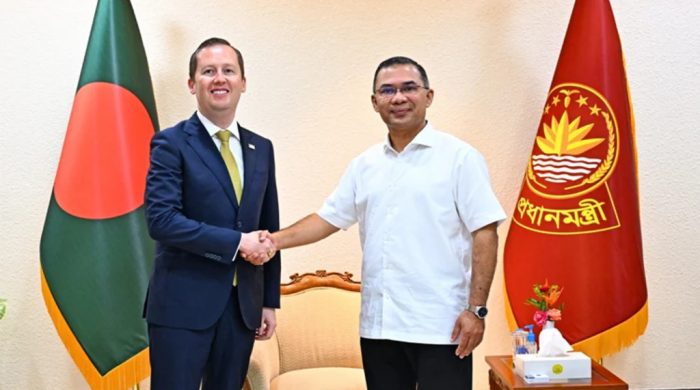
At the Central Shaheed Minar in Dhaka, president Mohammed Shahabuddin was the first to lay a wreath on behalf of the nation followed by prime minister Tarique Rahman and his cabinet members.
After the prime minister laid the wreath at the Central Shaheed Minar, special prayers were offered for the eternal peace of the martyrs who sacrificed their lives during the 1952 Language Movement, the 1971 War of Independence, and the mass uprisings of 1990 and 2024.
Following the prayers Tarique Rahman paid tribute on behalf of Bangladesh Nationalist Party.
Among those paying homage were Chief of Army Staff General Waker-Uz-Zaman, Chief of Naval Staff Admiral M Nazmul Hassan and Chief of Air Staff Air Chief Marshal Hasan Mahmood Khan.
Political parties, including the main opposition Bangladesh Jamaat-e-Islami, National Citizen party, paid tributes at the Central Shaheed Minar.
In a significant departure from its long-held political stance, the Jamaat-e-Islami paid tribute to the Language Movement martyrs at the Central Shaheed Minar shortly after midnight on Friday.
The tribute was led by party amir Shafiqur Rahman accompanied by senior leaders.
Leaders and newly elected Members of Parliament from the 11-party alliance also joined the ceremony.
Following the ceremony, Jamaat-led alliance leaders visited the graves of the Language Movement martyrs at the Azimpur Graveyard and offered prayers seeking eternal peace for their departed souls.
The Central Shaheed Minar was opened to the public at approximately 12:20am, after which chief election commissioner AMM Nasir Uddin, diplomats from different forgien offices, political parties, educational institutions and socio-cultural organisations placed wreaths in succession.
Throughout the night and into the morning, crowds continued to arrive, their quiet procession underscoring the enduring emotional weight of the day.
National flags have been flown at half-mast and black flags hoisted according to specified rules, colours and measurements at all government, semi-government, autonomous, and private organisations.
Bangladesh missions aboard have also been asked to chalk out various programmes engaging the expatriate Bangladeshis to mark the day.
President Shahabuddin and prime minister Tarique have issued separate messages on the occasion of Amar Ekushey, which is also observed as International Mother Language Day, designated by the United Nations.
Expressing respects to the language movement martyrs, the president, in his message, expressed his greetings and congratulations to the people and ethnic communities of Bangladesh and to speakers of diverse languages around the world.
‘As Bangla has been achieved as a state language by way of immeasurable sacrifice and the sacred blood of Martyrs’, we must be ever more mindful in its proper practice and in preserving its quality and dignity,’ he said in the message on the eve of the day.
Paying tribute to the language martyrs of 1952, prime minister Tarique, in his message, said, ‘Ekushey February stands as an indelible chapter in our national history. On this day in 1952, Abul Barkat, Abdus Salam, Rafiq Uddin Ahmed, Abdul Jabbar, and many others embraced martyrdom in their struggle to uphold the honour of Bangla.’
The core ideals of Ekushey were the establishment of democratic values, the protection of people’s rights, and the affirmation of equality, said the prime minister, adding, ‘The present government remains firmly committed to consolidating and advancing this democratic journey.’
On the eve of the day, he called upon all concerned to work collectively to uphold and protect the dignity of languages worldwide.
‘Let us preserve the linguistic diversity within our country, safeguard our unique culture and heritage, and ensure the proper use and culture of Bangla at all levels,’ said Tarique.
Ekushey February, also known as Shaheed Dibas or Martyrs’ Day, has come to be observed as International Mother Language Day since February 2000 following a UNESCO announcement in November 1999.
Political parties, including the ruling Bangladesh Nationalist Party and the main opposition Bangladesh Jamaat-e-Islami, socio-cultural and professional organisations and educational institutions have undertaken numerous events to observe the day.
Communist Party of Bangladesh president Kazi Sazzad Zahir Chandan and general secretary Abdullah Kafee Ratan in a joint statement on Friday said that the dreams of the martyrs who sacrificed their lives in the Language Movement had not been realised in the country yet.
The lesson of Amar Ekushey is to build resistance to all forms of aggression against language, culture and ethnicity, and against imperialist-hegemonic forces, they said.
Islami Andolan Bangladesh amir Syed Muhammad Rezaul Karim in a statement on Friday called upon the authorities concerned to take initiatives to ensure the use of Bangla language in
higher education and high courts and to protect mother languages of ethnic communities.
Different government institutions, including Bangla Academy, Bangladesh Shishu Academy, Bangladesh National Museum, Department of Public Libraries, Ministry of Cultural Affairs have taken elaborate programmes marking the day, reported Bangladesh Sangbad Sangstha.
State-run and private television and radio channels are airing special programmes on the occasion.
Newspapers published supplements highlighting the significance of the day.
Like previous years, Dhaka University is supervising the Amar Ekushey observance at the Central Shaheed Minar.
The university’s fine arts faculty students decorated the Central Shaheed Minar compound by drawing various designs.
Public access to the university area has been restricted from 7:00pm on Friday for security reasons while law enforcers have taken tight security measures in and around the Central Shaheed Minar.
Inspecting the overall preparations at the Central Shaheed Minar, Dhaka Metropolitan Police commissioner SM Sazzat Ali and Rapid Action Battalion director general AKM Shahidur Rahman on Friday morning said that multi-tier security measures had been taken in the area.
About 15,000 police personnel and 300 RAB members would have been deployed at the Central Shaheed Minar and surrounding areas to ensure security while the entire area had been brought under CCTV surveillance, they said, reassuring that there was no security threat regarding the observance programmes.
The prescribed routes to the Shaheed Minar include Palashi and Jagannath Hall crossings while the exit route is the Doel Chattar and Chankharpul crossings, said Sazzat.
‘No other routes will be allowed. This must be followed for the sake of discipline and security,’ he stated at night.
DMP additional commissioner (traffic) Md Anisur Rahman said that diversions would be in place at seven places, including Shahbagh, Nilkhet, Shahidullah Hall, High Court, Chankharpul, Palashi and Bakshibazar crossings.
The commemoration traces its origins to February 21, 1952, corresponding to 8 Phalgun 1359 in the Bangla calendar.
At the time, the authorities of the then Pakistan government had banned protests against the declaration of Urdu as the sole state language, despite Bangla being spoken by the majority of the population.
Defying the ban, students organised a procession demanding that Bangla also be recognised as a state language.
Police opened fire, killing several demonstrators, including Salam, Jabbar, Rafiq and Barkat.
Their deaths became a defining moment in the struggle for linguistic and cultural rights.
The Language Movement is widely regarded as a catalyst to subsequent political milestones, including the the Mass Uprising of 1969, events that ultimately paved the way for the 1971 War of Independence and the birth of Bangladesh as a sovereign nation.