Islami Bank, Janata hold 30pc of total NPLs

- Update Time : Sunday, June 7, 2026
- 30 Time
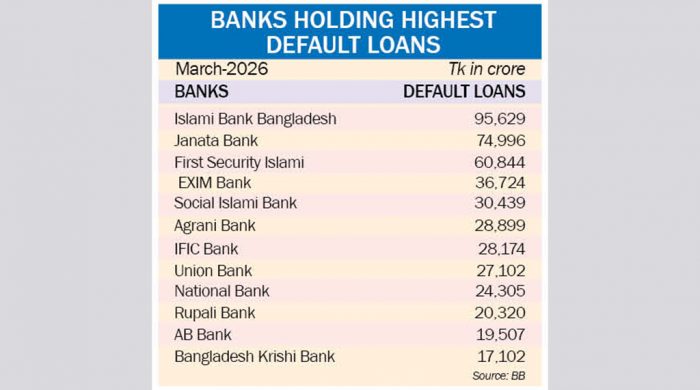
Only two banks — Islami Bank Bangladesh and Janata Bank — accounted for Tk 1,70,625 crore in classified loans by March 2026, representing nearly 30 per cent of the banking sector’s total defaulted loans, according to Bangladesh Bank data.
Bangladesh Bank data showed that the country’s total classified loans rose to around Tk 5.89 lakh crore at the end of March 2026, with the bulk of the bad assets concentrated in a handful of banks.
Ten banks alone carried Tk 4,27,433 crore in classified loans, accounting for about 72.6 per cent of the sector’s total non-performing loans.
Islami Bank Bangladesh remained the largest holder of defaulted loans, followed by Janata Bank, highlighting the scale of asset quality deterioration in some of the country’s biggest lenders.
Default loans at Islami Bank reached Tk 95,629 crore in March 2026, up from Tk 92,115 crore in December 2025 and from Tk 47,618 crore in March 2025.
Its classified loan ratio has risen from 27.38 per cent to 50.88 per cent over twelve months.
Islami Bank also carries the largest provision shortfall of Tk 71,839 crore.
Among banks outside the five Shariah-based banks currently undergoing merger and resolution processes, state-owned Janata Bank carried the second-largest stock of classified loans after Islami Bank Bangladesh.
Its defaulted loans rose to Tk 74,996 crore in March 2026 from Tk 70,846 crore a year earlier, accounting for 73.94 per cent of its outstanding loans.
The bank also reported a provision shortfall of Tk 50,131 crore, one of the largest in the sector.
Default loans at Agrani Bank stood at Tk 28,899 crore in March 2026, representing 40 per cent of its total loans.
Default loans of IFIC Bank increased to Tk 28,174 crore in March 2026, which is 63.36 per cent of total loans portfolio.
AB Bank recorded one of the sharpest deteriorations among long-established private banks.
Its classified loans more than doubled over the year to Tk 19,507 crore in March 2026 from Tk 8,841 crore in March 2025.
The classified loan ratio surged from 26.32 per cent to 54.09 per cent.
Bangladesh Krishi Bank also featured among the largest defaulters, with classified loans reaching Tk 17,102 crore and a classified loan ratio of 46.79 per cent.
Premier Bank’s classified loans rose to Tk 11,874 crore from Tk 9,817 crore a year earlier, while its classified ratio increased to 35.62 per cent.
Standard Bank’s classified loans jumped to Tk 4,663 crore from Tk 1,958 crore over the same period. Its classified loan ratio climbed from 9.65 per cent to 22.80 per cent, more than doubling within a year.
Bankers and analysts attributed the surge partly to years of weak governance, aggressive lending, inadequate risk management and large-scale loan irregularities.
They also noted that Bangladesh Bank’s stricter supervision and efforts to force banks to recognise previously unreported and rescheduled defaulted loans contributed to the sharp increase in classified loans during the past year.
In contrast, some major private banks maintained relatively healthy asset quality.
BRAC Bank’s classified loan ratio stood at 2.31 per cent in March 2026, Pubali Bank at 2.46 per cent, City Bank 2.89 per cent, Eastern Bank at 2.82 per cent, Prime Bank’s at 3.23 per cent, Jamuna Bank at 3.86 per cent, NCC Bank at 4.29 per cent, Trust Bank at 4.94 per cent, Dhaka Bank at 5 per cent and Dutch-Bangla Bank’s at 5.54 per cent.