Inclusive budget without inclusive foundations

- Update Time : Sunday, June 14, 2026
- 33 Time
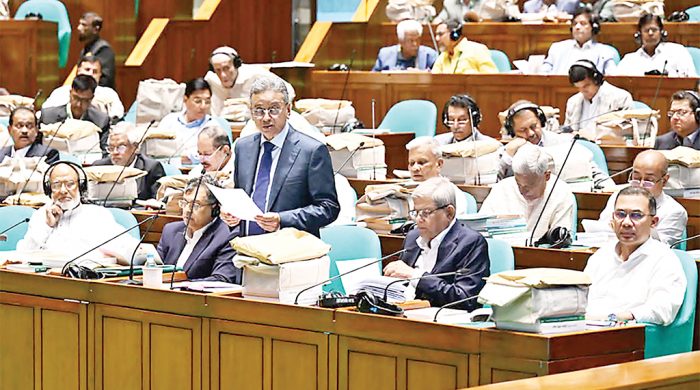
THE national budget for the 2026–27 financial year is proposed as a journey towards a ‘democratic, humane and inclusive economy.’ It is an appealing narrative at a time when millions struggle with declining purchasing power, stagnant income, weak employment opportunities and growing uncertainty. Yet, budgets should be judged not by their aspirations but by their capacity to address the structural constraints that stand in the way of those aspirations. By that standard, the budget proposal raises an uncomfortable question: can an economy become inclusive when the institutions needed to deliver inclusiveness remain weak, un-reformed and, in some cases, compromised?
With Tk 9.38 lakh crore, the outlay is the largest in Bangladesh’s history. It targets GDP growth of 6.5 per cent and inflation of 7.5 per cent while setting a revenue collection goal of Tk 6.95 lakh crore and a fiscal deficit of Tk 2.43 lakh crore. The government deserves credit for increasing allocations for health, education and social protection and for introducing measures aimed at reducing the burden on lower-income groups. Expanding social safety net programmes, increasing welfare allowances, lowering taxes on essential commodities and supporting women’s participation in the work force are all positive initiatives.
However, the central weakness of the budget lies in its assumption that increased allocations and ambitious targets will automatically translate into inclusive outcomes. Development challenges today are not merely one of resource allocation. It is fundamentally a crisis of implementation, governance and institutional effectiveness.
The most evident disconnect is inflation. The government has set an inflation target of 7.5 per cent, yet inflation remains the single greatest threat to economic inclusion. For nearly four years, high prices have acted as a regressive tax on ordinary citizens, disproportionately affecting low-income households. Food inflation, in particular, continues to erode real incomes and deepen vulnerability. While the budget offers tax reduction on selected essential commodities, it largely avoids confronting the structural drivers of inflation: weak market oversight, supply chain distortion, inadequate competition, hoarding and the influence of powerful market actors. Inflation is no longer simply the result of global shocks. It is increasingly a symptom of governance failures. Without strong market regulation and institutional accountability, the inflation target risks becoming an exercise in optimism rather than a credible policy objective.
The budget’s revenue strategy presents another significant contradiction. The government expects to collect Tk 6.95 lakh crore in revenue despite its repeated failures to meet the revenue target in recent years. The ambition is not the problem; the absence of a convincing strategy is. Bangladesh continues to have one of the lowest tax-to-GDP ratios among comparable economies. Tax evasion, exemption, administrative inefficiencies and a narrow tax base remain largely unaddressed. The budget relies heavily on optimistic assumptions while avoiding difficult political decisions regarding tax reform. An inclusive state cannot be built on a weak fiscal foundation. Without substantial improvement in revenue mobilisation, the burden of financing development will increasingly fall on borrowing rather than productive domestic resource mobilisation.
Equally troubling is the continued reliance on the banking system to finance fiscal deficits. The government plans to borrow heavily from domestic sources at a time when private sector investment remains sluggish. This approach risks crowding out productive investment and further constraining employment generation. More fundamentally, it reflects a broad failure to address the deep crisis within the financial sector.
The banking sector remains one of the most serious threats to economic future. Rising non-performing loans, weak governance, regulatory failures and declining public confidence have undermined the sector’s ability to support productive investment. Yet, the budget offers little evidence of the bold reforms needed to restore credibility. The repeated recapitalisation of weak banks with public resources has become an increasingly expensive substitute for genuine reform. Tax-payers are effectively being asked to absorb the costs of governance failures while powerful defaulters continue to evade accountability. An economy cannot become inclusive when financial resources are systematically diverted from productive uses to sustain inefficient and poorly governed institutions.
The contradiction becomes even more apparent in the decision to continue providing opportunities to legalise undisclosed wealth. At a time when the government calls for greater compliance and sacrifice from ordinary taxpayers, allowing the whitening of black money sends out precisely the wrong message. It rewards non-compliance, undermines tax morality and weakens public confidence in the fairness of the economic system. Inclusiveness requires trust in institutions. Policies that appear to favour those who evade rules over those who follow them inevitably erode that trust.
The budget also places a considerable emphasis on investment, production and employment generation. Yet, private investment cannot be revived through fiscal incentives alone. Investors continue to face high energy costs, policy uncertainty, bureaucratic complexity, weak contract enforcement and persistent governance challenges. The cost of doing business remains high while regulatory unpredictability discourages long-term investment decisions. Until these constraints are addressed, investment targets are unlikely to translate into meaningful employment growth. The danger is that economic growth, even if achieved, may remain concentrated to a relatively small segment of society rather than generating broad-based opportunities.
Perhaps, the most overlooked issue in the budget is the state’s implementation deficit. The substantial increase in allocations for health and education is encouraging, but Bangladesh has for long struggled to convert public spending into quality outcomes. Delayed projects, procurement inefficiencies, weak oversight and corruption continue to undermine development effectiveness. The annual development programme has repeatedly suffered from poor implementation performance, raising serious questions about whether larger allocations alone can improve service delivery. The challenge is not spending more; it is spending better.
The budget’s broad vision of a democratic and humane economy ultimately depends on the quality of governance. Yet, governance reforms occupy a surprisingly limited space in the policy framework. Corruption, political influence, weak regulatory institutions and limited accountability continue to impose significant economic costs. These are not peripheral issues; they are major obstacles to inclusive growth. Without confronting them directly, even well-intentioned social spending programmes will struggle to achieve their objectives.
The budget is, therefore, best understood not as a budget of transformation but as a budget of opportunity. It provides the new government with an opportunity to demonstrate that it is willing to move beyond rhetoric and undertake the difficult reforms necessary to rebuild confidence in public institutions and markets. To make inclusiveness more than a slogan, the government must prioritise inflation control through market reforms, strengthen revenue administration, undertake comprehensive banking sector restructuring, end preferential treatment for illicit wealth, improve development project implementation, reduce political influence in economic decision-making and create a more predictable environment for private investment.
The test of this budget will not be whether expenditure increases or growth targets are achieved on paper. It will be whether the government is prepared to address the governance failures and structural distortions that continue to prevent economic opportunities from reaching the majority of citizens. Without such reforms, the promise of a democratic, humane and inclusive economy risks remaining only a promise.
Amith Kumar Malaker is a human rights activist.