Fuel oil crisis persists across country

- Update Time : Tuesday, March 17, 2026
- 36 Time
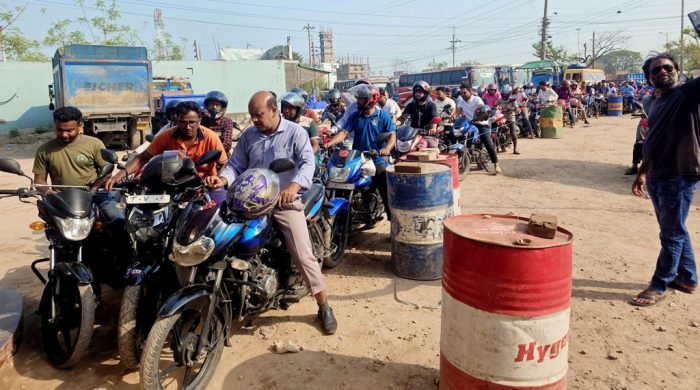
Consumers across the country are still suffering from shortage of fuel oils at filling stations one day after the government lifted the rationing.
Filling station operators blamed agencies under the Bangladesh Petroleum Corporation for supplying less than the required amount demanded by the operators.
They said that the unwanted situation was persisting though the government on Sunday stopped the fuel oil rationing after continuing it for the past nine days in the wake of escalating conflicts in the Gulf region.
Officials at the depot at Fatulla under the Jamuna Oil Company Limited, a subsidiary of the BPC, said that they had been providing fuel oils in compliance with the directive from the energy power and mineral resources ministry.
A requirement stipulated in the directive is limiting the scope of hoarding, said the officials.
The depot officials said that they had provided 15 lakh litres of diesel on Monday, while the amount was 12 lakh litres on Sunday.
They said that the average daily demand for diesel was around 12 lakh litres during March in the past calendar year.
The Fatulla depot along with Godnail in Narayanganj is responsible for supplying fuel oils to Dhaka, Gazipur, Manikganj, Munshiganj, Narayanganj, Narsingdi, Jamalpur, Sherpur, Mymensingh, Tangail, Netrakona and partly Kishoreganj.
Petroleum oils are sent from the Fatulla depo to the Baghabari and Chilmari depots by shallow draft tanker.
Former general secretary Md Mizanur Rahman of the Bangladesh Petrol Pump Owners Association said that there was no improvement on the supply end.
Half of the demand has been supplied, he said.
He said that they had already withdrawn the call for a strike made in the past week.
New Age staff correspondent in Chattogram reported that the situation at the pumps had returned to almost the normal position following the withdrawal of rationing.
‘But almost all consumers want full tanks,’ said Bangladesh Petroleum Dealer, Distributor, Agent and Petrol Pump Owners Association general secretary Moin Uddin.
Calling it a problematic feature, he said that the amount of fuel oils supplied from the government side would not be enough if everyone took the full tank.
For example, a filling station has 10,000 litres of octane for a day, but the demand from ‘thirsty’ consumers is much higher, he said, hoping that the demand would drop from Thursday or Friday.
New Age staff correspondent in Rajshahi reported that motorcyclists in different parts of Rajshahi city struggled to secure fuel oils as many filling stations either remained closed or had long queues.
A motorcyclist said that he had joined a queue of several hundred consumers at a filling station after crossing four dry pumps.
Another motorcyclist said that had he managed to buy petrol worth Tk 200 in the morning while most other filling stations were closed.
Monimul Haque, president of the Rajshahi district petrol pump owners’ association, said that the current shortage was largely caused by irregular supply from the depot.
He said that although some fuel had arrived at night and was distributed among filling stations, most outlets exhausted their stock by the morning.
‘If a pump requires two tanker-loads of fuel, it is not receiving that amount. Because of the quota system, pumps are getting only a limited supply, which is creating the shortage in the market,’ he said.
He also said that by late morning on the day, depot authorities had not yet informed pump owners about the next allocation of fuel.
‘As of around 11:00am to 12:00pm, we still had no update from the depots about new allocations. We are basically waiting to see whether more fuel arrives later in the night,’ he added.