Child labour elimination target missed

- Update Time : Monday, June 29, 2026
- 0 Time
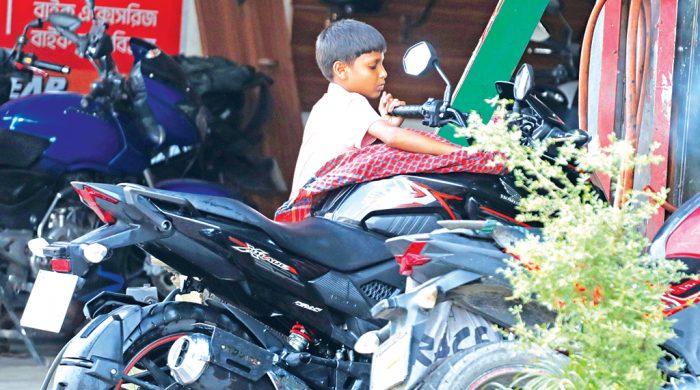
Over 10 lakh children in Bangladesh continue to work in dangerous conditions with minimal government oversight, exposing the nation’s future to abuse, torture, and severe physical harms.
Facing severe dangers at their workplaces, children have now come to dominate national crime statistics, many of them ending up on the list of dead or rape victims.
Yet, many of the perilous sectors they are engaged in are still not officially recognised on the government list of hazardous jobs, said Bangladesh Institute of Labour Studies executive director Syed Sultan Uddin Ahmed, who is also head of the Labour Reform Commission.
‘Child domestic worker has not been included in the list of hazardous jobs because they don’t have a voice,’ further said Sultan Uddin.
While Bangladesh has substantially reduced child labour in export-oriented industries like garments, leather, ceramics, and shipbreaking due to global oversight, this pressure has largely relocated the problem.
Many children have simply shifted into less regulated, invisible, and unmonitored informal sectors. Consequently, Bangladesh missed its targets of eliminating the worst forms of child labour by 2021 and all forms of child labour by 2025.
According to the Bangladesh Bureau of Statistics National Child Labour Survey 2022, published in 2024, about 17.8 lakh children aged 5-17 are engaged in child labour, up from 17 lakh in 2013.
Among them, 10.7 lakh children are engaged in hazardous work, according to the survey.
The government currently recognises 43 occupations as hazardous for children after expanding the list from 38 sectors in 2022.
The hazardous sectors, however, do not include occupations such as domestic work and recycling as hazardous though the sectors expose children to serious physical, psychological, and chemical hazards.
As Bangladesh observes World Day Against Child Labour today, although the day is globally observed on June 12, campaigners questioned why these rapidly growing sectors remain outside official recognition.
Child victims of brutal domestic torture, sometimes with graphic description of physical abuse like being scalded in the kitchen or pushed out of their workplace in multistoried apartment buildings, often become the subject of national news.
The suspected perpetrators range from high-level government officers to slum dwellers.
The International Labour Organisation recognises hazardous domestic work as one of the worst forms of child labour under Convention No. 182 and Recommendation No. 190.
A 2024 study by the Association for Social Development, conducted among 352 child domestic workers in Dhaka, found that almost half of them had experienced abuse.
The survey showed that 31.45 per cent were subjected to excessive workloads, 18.47 per cent suffered physical injuries, 8.23 per cent were beaten, 20.74 per cent faced verbal abuse, while 1.7 per cent experienced sexual abuse.
Electronic waste is a massive, unlisted hazard.
A 2025 study by Transparency International Bangladesh found that 97 per cent of e-waste is processed in the informal sector, where safety standards are non-existent.
Large numbers of children dismantle e-waste, plastics, batteries, and scrap metal without protective gear.
Safety and Rights Society executive director Sekender Ali Mina noted that these children regularly handle hazardous chemicals and inhale toxic fumes.
‘They inhale toxic fumes, handle hazardous chemicals and suffer injuries, yet the sector is still not officially recognised as hazardous for children,’ he said.
Meanwhile, the government has declared eight industries — export-oriented garments, leather goods, tannery, ceramics, glass, silk, shrimp processing, and shipbreaking — free of child labour since 2021 following years of domestic and international pressure.
Experts said that while progress in formal industries was encouraging, the absence of effective monitoring in informal sectors has simply relocated child labour rather than eliminating it.
Although the government has spent about Tk 352 crore on child labour elimination programmes over the past 13 years, child labour has increased instead of declining, they said.
The labour ministry is now preparing a new National Plan of Action for 2026-2030 after missing the previous targets and has proposed another project worth about Tk 2,500 crore.
Labour ministry joint secretary Mohammad Mozammel Haque attributed the increase partly to the economic impacts of the Covid-19 pandemic.
He said that the new action plan would involve all relevant ministries and government agencies.
Bangladesh Labour Foundation executive director AKM Ashraf Uddin said that although Bangladesh had demonstrated strong commitment internationally, implementation remained weak.
‘The government response has not been holistic. Child labour must become a cross-cutting national priority involving education, social protection, poverty reduction, and labour inspection,’ he said.
He also called for establishing an independent ‘Child Labour Elimination Authority’ to strengthen accountability.
INCIDIN Bangladesh executive director AKM Masud Ali said that poverty remained the principal driver of the existence of child labour.
‘Unless vulnerable families receive adequate economic support, children will continue to enter the labour market,’ he said, urging the government to include domestic work, recycling, and other hazardous occupations in the official hazardous child labour list.
According to the BBS survey, working children earn an average monthly income of Tk 6,675 and work nearly 9.4 hours a day, often at the cost of their education, health, and childhood.
Experts emphasise that addressing child labour requires a deeper understanding of the social and economic factors that drive it.
Many children become the primary earners for their families due to difficult circumstances, such as the abandonment of households by fathers, leaving mothers to care for several children with limited financial support.
Others are orphaned or abandoned altogether, making them especially vulnerable.
They also point out that weak enforcement of existing child protection laws together with insufficient government action has failed to adequately safeguard children.
As a result, many remain exposed to exploitation, abuse, and hazardous forms of labour, they observed.