Caretaker govt system to take effect after 13th parliament: SC

- Update Time : Monday, March 16, 2026
- 38 Time
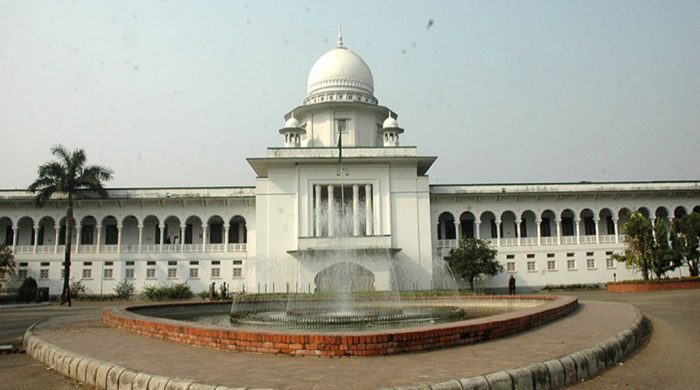
The Appellate Division of the Supreme Court has ruled that the non-party caretaker government system will come into effect only after the 13th parliament completes its tenure or is dissolved earlier.
The Appellate Division said this in its 74-page full judgement of an earlier short order on its verdict linked to the caretaker government system. The full judgement was released on the Supreme Court website on Sunday.
In November 2025, the Appellate Division, in a short order, scrapped its 2011 verdict that had canceled the caretaker government system, and said that the full judgment would provide detailed reasons.
In the full judgement released on Sunday, the Appellate Division said that the caretaker government provisions stand automatically restored in the constitution but will remain dormant for now.
The seven-judge Appellate Division bench made the observation in a judgement written by former chief justice Syed Refaat Ahmed.
Five judges — incumbent chief justice Zubayer Rahman Chowdhury, Md Rezaul Haque, SM Emdadul Hoque, AKM Asaduzzaman and Farah Mahbub — agreed with justice Syed Refaat Ahmed, while senior judge Md Ashfaqul Islam also concurred with the decision but added his own observations.
The court observed that the caretaker government mechanism can be activated only after the dissolution of a sitting parliament, as required under articles 58B to 58E of the constitution.
Since the current transitional political arrangement began without invoking those provisions, the court said that the restored system cannot be applied retrospectively.
According to the judgement, the earliest possible application of the caretaker government mechanism will fall under the authority of the 13th parliament.
The court said that the caretaker government will come into operation only after the 13th parliament completes its tenure or is dissolved earlier in line with article 58C of the constitution.
During the hearing, held in 2025, lawyers presented different views on the consequences of restoring the system.
Senior lawyer Sharif Bhuiyan argued that if the earlier judgment was set aside, the caretaker government provisions introduced through the Thirteenth Amendment to the Constitution of Bangladesh would automatically revive, similar to the restoration of the Supreme Judicial Council in earlier constitutional cases.
However, senior advocates Mohammad Shishir Manir and Imran Abdullah Siddiq urged caution, warning that immediate restoration could create institutional conflict as an interim government was already preparing to hold elections.
The court agreed that the restored provisions should remain dormant for now to avoid disrupting the current political transition.
The judgment also observed that the caretaker government system reflected the sovereign will of the people and was rooted in the constitutional principle expressed in the preamble — ‘We, the People’.
According to the court, the system emerged in the 1990s from a national demand for credible elections and was later introduced through the Thirteenth Amendment after broad political consensus.
In a separate observation, Justice Md Ashfaqul Islam said that the amendment had been enacted in good faith and did not destroy the basic structure of the constitution.
He also said in his observation that there was an ‘error apparent on the record’ because of a discrepancy between the short order and the full judgment in the earlier ruling that had scrapped the caretaker government system.
Both Justice Syed Refaat Ahmed and Justice Md Ashfaqul Islam emphasised that the constitution represents a living covenant between the state and its citizens and that the people’s will remains the ultimate source of constitutional authority.
Based on these findings, the Appellate Division overturned its 2011 judgment by former chief justice ABM Khairul Haque, which had abolished the caretaker government provisions.
Justice Khairul Haque is currently detained in five cases, including three related to alleged fraud in his verdict that scrapped the caretaker system.
The court noted that, in the short order, the government had been advised to uphold the caretaker system, but he had removed this observation in his written judgment, which the court deemed unlawful.
The 2011 verdict had paved the way for the then Awami League regime to abolish the election-time caretaker system through the Fifteenth Amendment to the Constitution of Bangladesh and hold parliamentary elections under a political government.
In its November 2025 short order, the Appellate Division scrapped the 2011 verdict and allowed separate appeals filed by Mirza Fakhrul Islam Alamgir and Badiul Alam Majumder challenging the 2011 verdict.
Mia Golam Parwar and several others also filed review petitions against the judgment.
The petitions were filed after the fall of the Sheikh Hasina-led Awami League regime on August 5, 2024, amid a mass uprising.
Attorney general Md Asaduzzaman, now law minister, represented the Muhammad Yunus-led interim government.