Cancellation of trade deal with US demanded

- Update Time : Saturday, March 14, 2026
- 41 Time
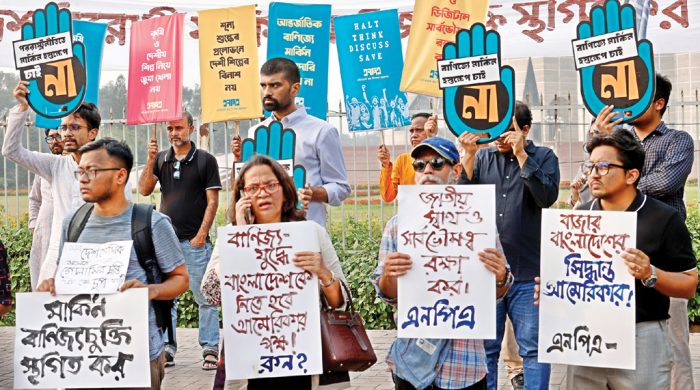
Economist Anu Muhammad on Friday said that the interim government should be tried as people’s enemy for signing the Agreement on Reciprocal Trade with the United States on February 9 ignoring Bangladesh’s interest.
He made the statement while presiding over a seminar titled ‘Why trade agreement with the US is dangerous for Bangladesh?’ at the Economic Reporters Forum auditorium in the capital, Anu Muhammad, also former Jahangirnagar University economics professor, said that the interim government left the country in captivity and handcuffed by signing the unequal agreement.
‘They should be tried as people’s enemy,’ said Anu Muhammad, demanding the elected government to review and scrap the agreement, signed three days ahead of the 13th national parliamentary elections.
Noting that Bangladesh’s rural economy would be severely damaged, unemployment would rise, unnecessary aircraft and defence items would be mandatorily purchased, agricultural items would be imported at high prices, while relations with foreign countries would be controlled through the agreement.
‘This agreement will not allow Bangladesh even that much autonomy a colony is given under a colonial system,’ said Anu Muhammad, while saying that even phrases like ‘agreement of slavery’ could not sufficiently describe its potentially harmful impact on Bangladesh.
‘We have to satisfy the arms dealer. Whereever in the world they (the US) will carry out war and aggression, we have to support them. And we cannot keep our relations with them (the countries) who oppose those,’ said the professor.
He also expressed worry over appointing Khalilur Rahman foreign minister as he was a part of the interim government and played role in signing the agreement.
Referring to Khalilur’s comment after the elections that the agreement was good and the Bangladesh Nationalist Party and Jamaat-e-Islami were aware about the agreement, Anu Muhammad said that the parties, particularly the ruling BNP should take clear and strong stand against the agreement to prove Khalilur’s statement wrong.
Prime minister Tarique Rahman had begun a fresh journey with the slogan ‘Bangladesh first’, but activities centring the agreement showed his ‘US first’ focus in actuality, the economist remarked.
‘No agreement should be signed without ensuring the interest of the nation, interest of the people and people’s consent. Without these, the slogan will be meaningless,’ Anu Muhammad further said.
Lawyer Jyotirmoy Barua said that interim government did not have any legal authority to sign the agreement, which would affect the country’s sovereignty and economy in the long term.
He said that the agreement did not come into effect yet and the elected government had the option to review it and discuss it in the parliament.
International University of Business Agriculture and Technology economics professor Golam Rasul said that through the agreement the US had unilaterally imposed many conditions on Bangladesh that undermine public interest, would put its agro-industrial sector at risk, and result in soaring food prices.
The unequal agreement will would also harm Bangladesh geopolitically shrinking its power to make agreements independently, jeopardising the country’s sovereignty, he observed.
Researcher Maha Mirza said that the country’s potential agricultural and industrial sectors, including poultry, dairy and pharmaceuticals, would face unequal competition and severe damage due to the agreement as US products would enjoy customs duty exemptions in the Bangladeshi market.