‘Black Gold’ bringing Faridpur farmers from rags to reaches

- Update Time : Thursday, March 5, 2026
- 81 Time
Across the flat, fertile plains of the Padma basin in Faridpur, a quiet but consequential shift is underway.
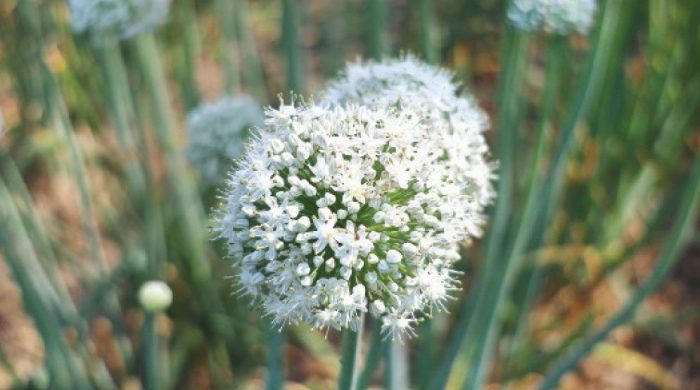
Fields that once grew rice and other staple grains are now thick with flowering onion plants, their white spherical blooms swaying in the winter air. The tiny black seeds hidden within those flowers have earned a striking nickname among the farmers who tend them “Black Gold”.

Onion seed cultivation has, over the past several years, emerged as the most lucrative cash crop in parts of Faridpur district, drawing smallholders away from lower-margin grains with the promise of returns that few other winter crops in Bangladesh can match. A kilogram of onion seed fetches between Tk3,500 and Tk4,000 on the national market, enough for a farming family to repay debts, build a brick home or send a child to university.
A kilogram of seed is sufficient to cultivate one bigha of land, which in turn yields between 90 and 120 maunds of onions. Production costs this season have fallen to an estimated Tk25 per kilogram, slightly lower than last year owing to favourable weather conditions.
Faridpur’s onion seeds do not merely serve local demand. According to the district’s agriculture office, the surplus is supplied to roughly 15 other districts across the country, making the region a quiet but significant node in Bangladesh’s broader onion supply chain.
Boktar Hossain, a farmer from Ambikapur who is well regarded in the area, welcomed the favourable weather but raised a concern that was spreading quietly among growers.
Onion prices in the market have fallen sharply this year, he said, and if they remain at current levels, farmers risk being unable to recover even their labour costs, let alone the broader investment in seed and land preparation.
Anwar Hossain, agriculture officer for Faridpur Sadar upazila, said the area devoted to onion seed cultivation in his upazila has dipped modestly this year, from 330 hectares to 310 hectares.
Cultivation has, however, expanded in Ambikapur union, and the overall district figures show an additional 390 to 410 hectares brought under onion cultivation this season, he added.
The crop demands as much care as it does investment. Unlike hardier cereals, onion seeds are vulnerable during the pollination and drying stages, a single spell of unseasonal rain can destroy an entire season’s worth of work by washing away the pollen before it sets.
The Department of Agricultural Extension has been working with farmers to introduce polythene shielding over flowering plants and better post-harvest storage methods, the official said, adding that the government also distributed 142 air-flow machines across the district, each capable of preserving up to 250 maunds of onions, to reduce post-harvest losses.
Among those who have built a reputation on this crop is Shahida Begum, a farmer from Gobindapur village in Faridpur Municipality, who was honoured as an Agriculturally Important Person by the Ministry of Agriculture in 2021.
“We desire that we no longer have to remain dependent on any other country for onions,” she said. “The production of these seeds and successful cultivation should spread across the entire country.”
It is a sentiment that captures the mood of a farming community whose fortunes have been transformed by something no larger than a speck of black pepper, and who now watch the sky and the market with equal and anxious attention.
The reporter can be reached at: