Beximco sukuk faces repayment risk

- Update Time : Thursday, July 23, 2026
- 10 Time
Bangladesh’s first private-sector Shariah-based corporate sukuk, worth Tk 3,000 crore, faces the risk of failing to repay investors on time after the Investment Corporation of Bangladesh, acting as trustee, sought regulatory approval to extend its maturity by six years.
The move came after Beximco said it would be unable to repay the full amount due this December.
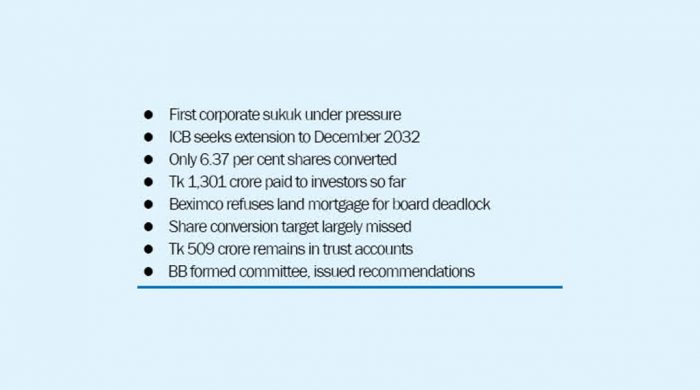
In a proposal submitted to the Bangladesh Securities and Exchange Commission on June 30, ICB warned that Bangladesh Export Import Company PLC (Beximco), the originator of the sukuk, was unlikely to repay investors at the scheduled maturity in December 2026 because of its prolonged financial crisis, the closure of most of its textile factories and weak repayment capacity.
Instead of repaying the principal this year, ICB proposed extending the repayment deadline to December 2032.
It also recommended changing the formula used to calculate investors’ profit by linking it to the yield on the government’s five-year treasury bond, replacing the existing mechanism tied to Beximco’s dividend performance.
The proposal now awaits approval from the BSEC.
It will also require consent from Beximco’s board, the trustee, the Shariah supervisory board and the special purpose vehicle governing board before any restructuring can take effect.
Beximco managing director Osman Kaiser Chowdhury could not be reached over phone for comment on the matter.
ICB chairman Abu Ahmed told New Age that the proposal had been sent to the securities regulator considering investors’ interests and the continued operation of the sukuk-backed assets.
He said that Beximco’s current financial condition made full repayment this year unrealistic, while partial repayment from retained earnings would not adequately protect investors.
He added that the Teesta solar project, the sukuk’s main income-generating asset, remained profitable and continued to generate regular cash flows, allowing investors to receive periodic profit payments.
However, the Korotoa solar project could not be implemented after local people attacked the project following the August 5, 2024, political changeover, and the project has now been abandoned.
Bankers said that Salman F Rahman, vice-chairman of the Beximco Group and former private industry and investment adviser to ousted prime minister Sheikh Hasina, was arrested on August 13, 2024, and later sent to jail. He has since faced multiple allegations, including corruption, large-scale loan irregularities and stock market manipulation, which remain subject to legal proceedings.
The sukuk, approved by the BSEC in December 2021, raised Tk 3,000 crore from investors to finance two solar power projects and an environmental compliance expansion at Beximco Textiles.
According to ICB, Tk 2,155 crore was invested in the Teesta solar project and Tk 806 crore in Beximco Textiles.
However, only Tk 39 crore of the Tk 308.31 crore allocated for the Korotoa solar project was spent before work stopped.
The repayment risk has significant implications for Bangladesh’s capital market because institutional investors hold almost the entire sukuk.
Data from the Central Depository Bangladesh Limited show that 4,839 investors currently own the instrument.
Institutional investors hold 97.72 per cent, or Tk 2,745.10 crore, while 4,591 individual investors own the remaining 2.28 per cent.
Major investors include IFIC Bank, Janata Bank, Rupali Bank, Agrani Bank, City Bank, Dutch-Bangla Bank, Southeast Bank, Social Islami Bank, Shahjalal Islami Bank, First Security Islami Bank, AB Bank and several non-bank financial institutions.
Any delay in repayment would therefore mainly affect banks and institutional investors that have invested large amounts of depositors’ money in the sukuk.
Although investors have continued to receive their scheduled six-monthly profit payments, returns have steadily declined from 11.60 per cent in the first year to 4.59 per cent in the first half of 2026 because the payout formula depends on Beximco’s dividend performance.
Between January 2023 and June 2026, the sukuk generated Tk 2,175.87 crore, mainly from electricity sales by the Teesta solar project to the Bangladesh Power Development Board.
During the period, Tk 1,666.77 crore was distributed to investors, leaving Tk 509.10 crore in the sinking fund and trust accounts.
A sinking fund is money set aside gradually to repay investors when the investment matures.
Another weakness highlighted by ICB is the failure of the sukuk’s share conversion feature.
The structure allowed investors to convert up to 20 per cent of the sukuk into Beximco shares each year, reducing the amount requiring cash repayment at maturity.
The expectation was that Tk 1,800 crore would be converted by 2024. Instead, only Tk 190.75 crore, or 6.37 per cent of the issue, was converted, leaving most of the principal to be repaid in cash.
A Bangladesh Bank committee recommended that Beximco mortgage land belonging to the Teesta and Korotoya projects in favour of ICB to provide additional security for investors.
However, Beximco refused, arguing that the existing trust deed does not permit such a mortgage and that any change would require amendments that its board is currently unable to approve because of ongoing legal disputes over its composition.