Road to catastrophe

- Update Time : Tuesday, August 25, 2026
- 0 Time
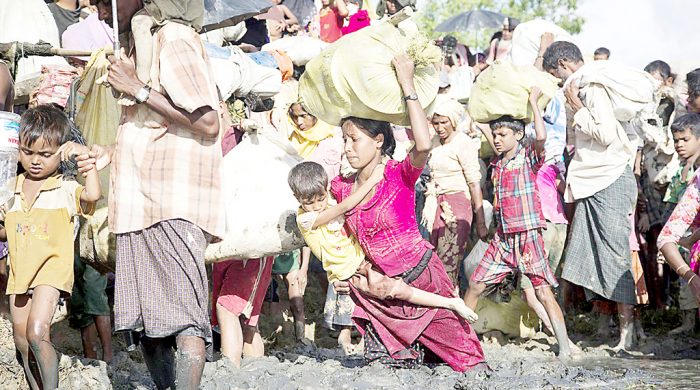
AUGUST 25 marks the tenth anniversary of the day the Tatmadaw unleashed its genocidal ‘clearance operations’ against the Rohingyas in Myanmar’s Rakhine State. The exodus of more than 700,000 Rohingyas into Bangladesh that followed was not a spontaneous eruption of violence but the culmination of decades of systematic persecution, political manipulation and military planning. Understanding how Myanmar arrived at this precipice requires examining the military and political developments that transformed Rakhine State into a theatre of atrocity.
As we mark this grim anniversary, the story of the Rohingyas is not merely a tale of Myanmar’s internal conflicts but a damning indictment of an international order where strategic calculation consistently triumphs over human rights and where the Rohingyas have been reduced to pawns in a great game of influence in the Bay of Bengal and beyond.
Historical grievance
RAKHINE State, historically known as Arakan, was an independent kingdom ruled by 234 Arakanese kings before the Burmese king annexed it in 1784. The British annexed Arakan to Burma in 1826 as war reparation after the first Anglo-Burmese war, sowing the seeds of permanent trouble in western Burma. The colonial period deepened the communal divide. During World War II, Rakhine Buddhists supported the advancing Japanese army while Rohingya Muslims supported British forces to resist the Japanese advance. Weapons at the hands of both communities resulted in riots that inflicted much damage and loss of life.
Before the partition of the subcontinent and Burma’s independence, Rohingya Muslims in western Burma had ambitions to merge their region into East Pakistan. Muslim leaders from Arakan addressed themselves to Jinnah, asking his assistance in joining the Mayu region to Pakistan. The proposal was reportedly turned down by Jinnah and the British annexed Arakan to Burma. This desire entrenched distrust among the majority Bamar and Rakhine Buddhist communities, who entrenched the perception that the Rohingyas, given the opportunity, will separate Rakhine from Myanmar.
Citizenship stripped
THE Rohingyas had been Burmese citizens for centuries. After Burma’s independence, they exercised voting rights, filed candidature in national and state elections, represented people in the parliament and were employed in government jobs. The military-drafted marshal Citizenship Act 1982 changed everything. The marshal citizenship law did not include Rohingya ethnicity, rendering them stateless. No other ethnicity lost citizenship under this law.
After revoking citizenship, successive military regimes issued policies of persecution and institutionalised torment against the Rohingyas. Hate speech and narratives from both central and local governments successfully embedded hatred in the Buddhist majority population. A report on the ‘Policies of Persecution’ published by Fortify Rights in 2014 detailed restrictions on movement, marriage, childbirth, home repairs and construction of houses of worship. Confidential enforcement guidelines empowered security forces to use abusive methods to implement these ‘population control measures.’
Cycles of violence
POST-INDEPENDENCE Burma/Myanmar evicted the Rohingyas from their ancestral abode in cycles of violence in 1978, 1992, 2012 and 2017. In 1978, military junta Ne Win’s Operation King Dragon drove 200,000 Rohingyas into Bangladesh. In 1992, general Saw Maung’s military government evicted and pushed 250,000 Rohingyas into Bangladesh. In 2012, about 70,000 Rohingyas took refuge, escaping communal riot instigated by local political rumor.
Each crisis was met with temporary, reactive international responses focused solely on humanitarian aid and short-term, ineffective repatriation deals. Diplomacy consistently failed to address the root cause: the state’s institutionalised denial of citizenship and fundamental rights to the Rohingya.
To find a solution to the persistent communal problem, Aung San Suu Kyi’s government established the Rakhine advisory commission on September 5, 2016, chaired by former UN secretary general Kofi Annan. The commission’s mandate was to develop recommendations within five thematic areas: conflict prevention, humanitarian assistance, reconciliation, institution building and development. It submitted its final report on August 24, 2017.
But, the commander-in-chief senior general Min Aung Hlaing rejected the report before it was submitted to the government. He told Kofi Annan on August 24, 2017 that the commission report had ‘factual flaws and deficiencies’ and advised a re-examination. He emphasised that ‘acceptance of local Rakhine ethnics over the commission’s report is important.’ The military viewed the progress of implementing the commission’s recommendations as ‘an attempt to place Rohingyas into the mainstream of the population,’ a prospect the senior general could not tolerate.
ARSA ‘drama’
ALMOST a year before the August 2017 attacks, three police posts in northern Rakhine were attacked on October 9, 2016, leaving nine police officers dead. The incident followed military operations that killed eight attackers. But, unlike the events of 2017, the military and Rakhine Buddhists did not plunder Rohingya villages.
On the night of August 25, 2017, a militant group calling itself the Arakan Rohingya Salvation Army allegedly attacked 30 police posts, villages and an army camp in northern Rakhine. The attack prompted security forces to launch the massive Clearance Operations. The coordinated attacks coincided with the release of the final report of the advisory commission on Rakhine.
The story of ‘several thousand ARSA fighters’ presented in the International Court of Justice by Aung San Suu Kyi was never convincing. If several thousand ARSA fighters had taken part in the attack, its actual force strength should have been far more and it should have been a well-organised insurgent group like those on Myanmar’s eastern and northeastern borders. Such a large insurgent group would not ‘bob up and disappear’ overnight. What Suu Kyi could not tell the court was that the ARSA drama was an enactment of the Tatmadaw to prevent communal reconciliation in Rakhine.
In July 2017, Rakhine State’s chief minister urged the commander-in-chief to deploy military forces for the security of Rakhine population. Myanmar media reported force build-up beginning on August 11, 2017. The United Nations rang the alarm bell at reports of military build-up in northern Rakhine.
On September 1, 2017, the senior general Min Aung Hlaing, referring to the 1942 riot between Rakhine Buddhists and the Rohingyas, commented that the Rakhine problem was ‘a long-standing one which has become an unfinished job’ despite the efforts of previous military governments to solve (finish) it. The senior general vowed to finish the unfinished job. According to Myanmar No, the senior general was the ‘chief architect and perpetrator of a genocidal campaign of mass murder, rape, arson and forced displacement against the Rohingya in Rakhine State in 2017.’
The military’s plan was to evict the Rohingyas en masse and subsequently make the Rohingya repatriation virtually impossible. Inside Myanmar, the military bulldozed Rohingya homes and land, rendering homesteads untraceable. The government confiscated their land and changed ownership. The objective of the Clearance Operation was to clear Rakhine of the Rohingyas.
Today, as the world marks the 10 year of Rohingya Genocide, the situation has only become more complex. The Arakan Army, formed in 2009, now controls more territory than any other non-state armed group in Myanmar. On December 8, 2024, the Arakan Army completed its capture of Maungdaw and assumed full control of northern Rakhine State’s border with Bangladesh. The Arakan Army now controls 14 of 17 townships in Rakhine State and Paletwa district in Chin States. The military junta, in retreat, has behaved with brutality and desperation, including the conscription of Rohingya Muslims in a bid to cause communal division.
The Rohingyas today face two oppressors instead of one. The Arakan Army has established a parallel proto-state with its own administrative, judicial and security structures. Yet, it has no legal power to grant citizenship or issue recognised identity documents, leaving the Rohingya under Arakan Army rule entirely undocumented and outside any formal system of legal personhood. The Arakan Army also reproduces identity-based exclusion by rejecting Rohingyas as a recognised ethnic group.
The road to catastrophe was paved by decades of military planning, political manipulation and international indifference. Bangladesh, always bearing the burden of repeated refugee crises though, consistently viewed each exodus as a temporary inconvenience and responded reactively with the benefits of hindsight but without foresight. Today, on the tenth year of the 1.2 million-strong refugee crisis, Bangladesh is caught in a diplomatic trap, its leverage exhausted, demanding not just remembrance but accountability.
To be continued.
Mohammad Abdur Razzak ([email protected]), a retired commodore of the Bangladesh navy, is a geopolitical analyst.