The last ‘Mughal’ who redefined playback singing with unmatched versatility

- Update Time : Tuesday, April 14, 2026
- 42 Time

The passing of legendary singer Asha Bhosle on Sunday marks the end of an era that shaped both the golden age and the evolving landscape of Indian cinema. With a career spanning more than eight decades, her voice was not merely an instrument-it was a living archive of the subcontinent’s cinematic and cultural transformation. From classical melodies to cabaret numbers, from ghazals to pop experiments, Bhosle’s unmatched versatility made her one of the most enduring and influential figures in Indian film music.
On the eve of her 90th birth anniversary in 2023, Indian news agency ANI shared a video that now feels deeply poignant. Reflecting on her extraordinary journey, she said, “Only I know the history of the film industry… There are so many stories that it will take me three-four days if I start talking about it. I have not forgotten anything. I’m the last Mughal of this film line.” Far from exaggeration, her words captured a rare truth-she was among the last living links to the formative years of Indian cinema.
Asha Bhosle captivated audience with her remarkable range-effortlessly energising listeners with songs like “Aaja, Aaja” while evoking deep emotion in melodies such as “Chain Se Ham Ko Kabhi.” Alongside her sister Lata Mangeshkar, she dominated Hindi playback singing for nearly seven decades, their voices becoming synonymous with Bollywood’s leading heroines.
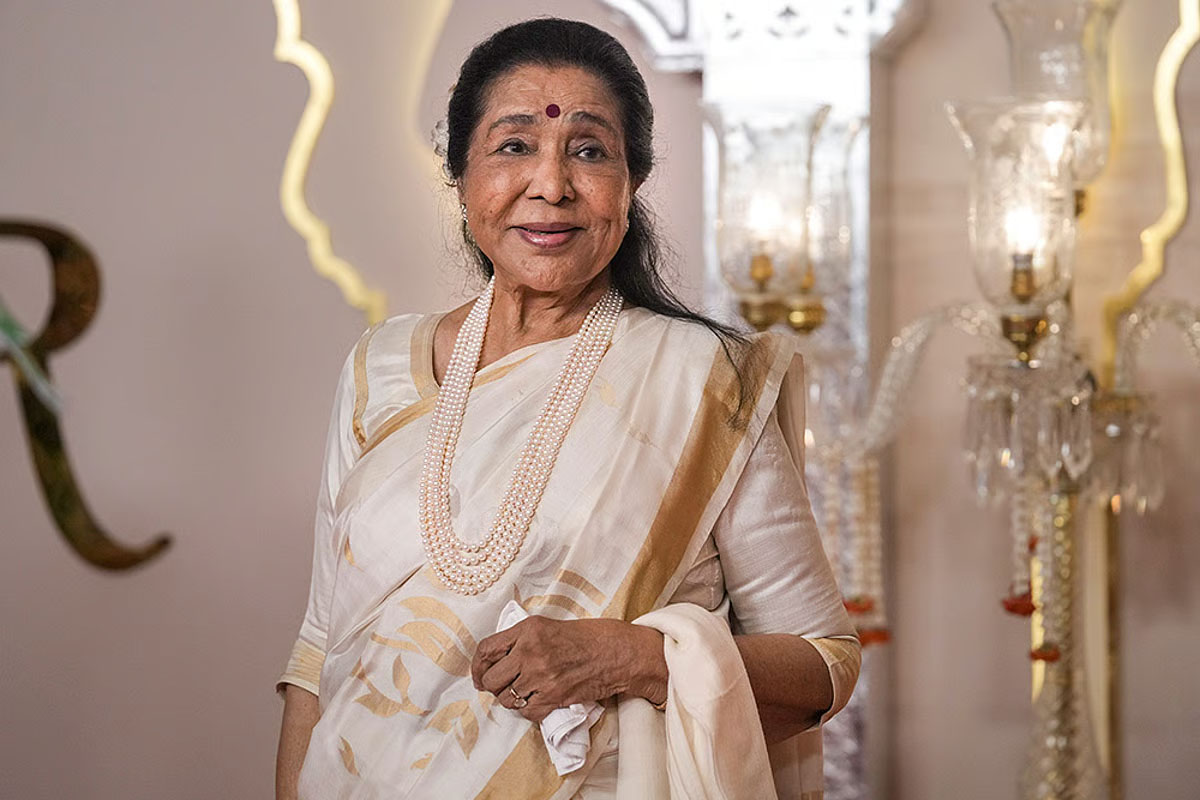
Over her prolific career, Bhosle recorded more than 12,000 songs. She began singing at the age of 10, with her first recording for the Marathi film “Majha Bal” in 1943, and continued performing into the late 2010s-making her one of the longest-performing singers in global music history. Unlike many of her contemporaries, her voice retained its clarity and vibrancy even in later years.
While Lata Mangeshkar was often the preferred voice of composer Madan Mohan for ghazals and soulful compositions, Asha carved her own distinct space in the genre.
Her repertoire included some of the most iconic songs in Indian cinema, including “Abhi Na Jao Chhod Kar,” “Piya Tu Ab To Aaja,” “Duniya Mein Logon Ko,” and “Zara Sa Jhoom Loon Main.” Her ability to adapt to changing musical styles-from classical and folk to disco and pop-kept her relevant across generations.
Bhosle lent her voice to a wide range of leading actresses-from Meena Kumari and Madhubala to Zeenat Aman, Kajol, and Urmila Matondkar, as well as southern icons like Padmini and Vyjayanthimala.
Born on 8 September 1935 in Sangli, she was introduced to music by her father, Dinanath Mangeshkar. Music ran deep in the family-her siblings, including Lata Mangeshkar and Usha Mangeshkar, also became accomplished musicians, while Hridaynath Mangeshkar gained recognition as a composer.
A recipient of numerous honours, Asha Bhosle was awarded the Dadasaheb Phalke Award, the Padma Vibhushan, and multiple National Film Awards. Beyond music, she also found success as an entrepreneur with her “Asha’s” restaurant chain in Dubai and the UK.
Her legacy is not merely one of songs, but stories of studios, musicians, lyricists, and moments that shaped the cultural identity of a nation. In an ever-changing industry, Asha Bhosle remains a symbol of timeless artistry and resilience.
As audience continue to celebrate her music, her words carry deeper resonance. The “last Mughal” is not just a title-it is a tribute to a life lived at the heart of an empire of melody, memory, and magnificence.