41 killed in 2 weeks: Police data

- Update Time : Thursday, March 5, 2026
- 42 Time
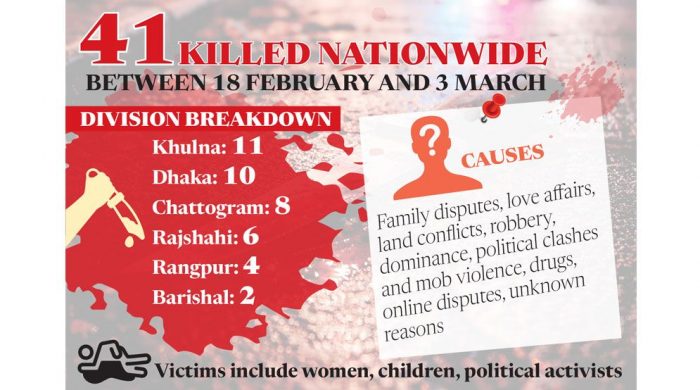
At least 41 people were killed across the country in the last 14 days, from 18 February to 3 March, according to data compiled by Police Headquarters.
The figures were drawn from field-level reports submitted by district police units and analysed at the central crime management wing.
On 28 February, police recovered the bodies of a woman and her teenage granddaughter from Ishwardi upazila in Pabna.
The 65-year-old grandmother’s bloodied body was found in the courtyard of her home, while her 15-year-old granddaughter’s body was discovered in a nearby mustard field.
Police suspect the teenage girl was killed after being raped, while the elderly woman was murdered as she attempted to resist the attackers.
In Narsingdi, the quest for justice ended in tragedy for a 15-year-old girl who was allegedly abducted and murdered days after her family sought accountability for her reported rape.
The body of Amena Akhter, daughter of Ashraf Hossain, was recovered on 26 February from a mustard field in Darikandi village of Madhabdi upazila.
According to the family, a group of 5-6 men, led by Nur Mohammad Hossain alias Nura, 30, had abducted and gang-raped the girl 15 days earlier.
On 25 February, Ashraf was taking his daughter to her aunt’s house when Nura and several accomplices allegedly abducted her in front of him in the Baraitala area.
The following morning, locals found her body in a mustard field with a veil wrapped around her neck.
These incidents form part of a broader pattern of violence recorded nationwide.
On 26 February, former Union Parishad member Amir Hossain of Banshgari in Raipura, Narsingdi, was hacked and beaten to death. He was reportedly abducted from a boat while travelling to his ancestral home in Charamdhuya and later thrown into a river.
On the same day, five more people were killed in separate incidents in Chattogram, Brahmanbaria, Khulna and Narsingdi.
Of the 41 victims, nine were women. Khulna and Chattogram divisions recorded the highest number of killings.
Among the deceased were three BNP workers, one Jubo Dal leader, one Chhatra Dal worker and one Jamaat supporter.
Eight victims were stabbed to death, three were shot dead, several were killed in mob violence or strangulation, and seven were murdered by unidentified assailants.
11 murders in Khulna division
Data analysis shows that 11 people were killed in Khulna division during the period.
Four deaths occurred in dominance-related conflicts. Two victims were stabbed by rivals, two were killed for unknown reasons, one died in a BNP-Jamaat clash and one was killed over past enmity.
On 27 February, Md Murad Khan, senior joint convener of Senhati Union Jubo Dal in Dighalia upazila, was hacked to death.
A day earlier, businessman Sheikh Sohel, 41, was shot dead inside a motorcycle garage adjacent to the Afilgate petrol pump under Khanjahan Ali Police Station in Khulna city.
8 murders in Chattogram
Police statistics show that eight people were murdered in Chattogram over the last two weeks.
The motives included online gambling disputes, land conflicts, robbery, past enmity and family violence, while several cases remain without confirmed motives.
On 25 February, Jubo Dal activist Muhammad Abdul Majid was shot dead in Raozan while returning home from the market.
Since the fall of the Awami League government on 5 August 2024, 21 murders have been recorded in Raozan upazila, 15 of which are claimed to be politically related.
10 murders in Dhaka
At least 10 people were killed in Dhaka division during the 14-day period.
The motives ranged from love affairs and criminal rivalry to disputes over drugs, land and dominance. Two victims were killed by unidentified assailants and two for unknown reasons.
On 25 February, eighth-grade student Shahriar Sharmin was killed in front of Hazaribagh Police Station, reportedly over a relationship dispute.
The accused, Siam Hossain alias Emon, 19, later gave a confessional statement in court.
On the same day, the body of six-year-old Tahedi Akhtar was recovered from West Ulan in Hatirjheel.
On 28 February, a young man named Obaidullah was murdered and dismembered. Police recovered body parts from Kamalapur, Demra, Baitul Mukarram and Savar.
12 murders in three other divisions
Six people were killed in Rajshahi division. Two died in clashes between the BNP and the Awami League, one was killed over a dispute involving guest appointments at a waz mahfil, two were murdered by unidentified assailants and one was killed by a cousin.
Rangpur division recorded four killings – one during a football altercation, two in mob beatings and one for unknown reasons.
In Barishal division, two people were killed. In Kalapara of Patuakhali, Idris Khan was beaten to death by local Jubo Dal leaders and activists following a dispute reportedly triggered by a Facebook post.
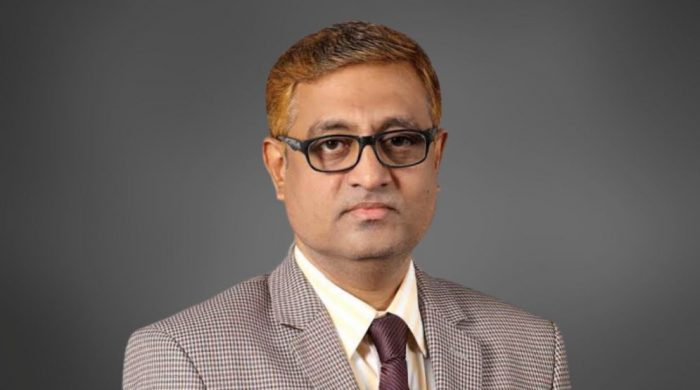
Crime analyst Dr Md Tawohidul Haque told the Daily Sun that the rise in murders and violent crimes reflects weaknesses in the enforcement of the rule of law.
“When laws are not effectively implemented, criminals exploit the gaps,” he said. “Many offenders believe they are unlikely to face punishment. That perception emboldens them to commit crimes.”
Tawohidul, however, noted that the present government is relatively new and should not be blamed outright for the current situation.
“But the government must ensure that investigations are conducted swiftly and professionally so that offenders are brought to justice,” he added.
The crime analyst stressed that the authorities must guarantee accountability in every case. “No one should be able to walk free after committing any kind of crime,” he said.
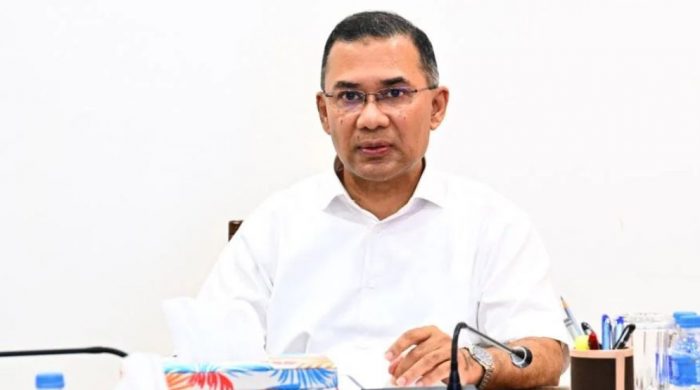
Assistant Inspector General of Police AHM Shahadat Hossain told the Daily Sun that law enforcement agencies respond to crimes primarily through a reactive policing system, while also taking preventive measures.
“We practise proactive policing as well,” he said. “However, certain incidents stem from deep-rooted family and social conflicts. When crimes occur within families, it becomes extremely difficult for police to prevent them in advance.”
He emphasised that tackling crime is not the responsibility of law enforcement alone.
“Combating crime requires collective responsibility. Society as a whole must play its part,” he said.