Stitching prosperity, struggling to survive

- Update Time : Tuesday, November 3, 2026
- 86 Time

Bangladesh routinely describes its readymade garment industry as the backbone of the economy. Yet the workers who keep that industry running often struggle to afford even the basic necessities of life.
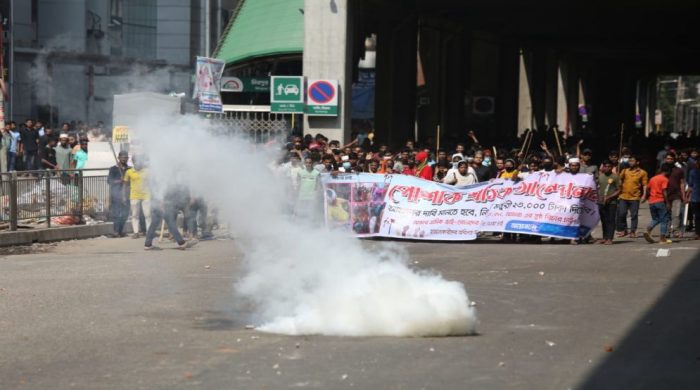
The latest protests by garment workers, demanding a minimum monthly wage of Tk 30,000, have once again exposed the gap between the industry’s economic success and the lives of the people who sustain it.
On the same day, the government formed a minimum wage board. But the numbers behind the demand tell only part of the story. To understand what a wage means to a garment worker, it is worth looking at how one of them spends it.
On November 1, I spoke to Shilpi, who works at a medium-sized garment factory in Dhaka. She earns around Tk 13,500 a month. Her father is dead, while her mother and younger brother live in Sirajganj.
She came to Dhaka for work and sends Tk 7,000 home every month to support her family and pay for her younger brother’s education at a local madrassah.
Shilpi lives in a four-storey building on a plot measuring roughly one and a half to two kathas, where almost everyone is a garment worker.
Each floor has two rooms, with cooking arrangements beside the staircase. The room she shares with another female colleague has one light, one fan and, fortunately, a window barely large enough for a small backpack. The bathroom is outside and shared by the residents.
Her share of the rent is Tk 3,500, including utilities. Once the rent and the money sent home are deducted from her salary, she is left with Tk 3,000 for the month.
Consider what that means for food. Even at Tk 50 a meal, three meals a day would cost Tk 4,500 a month. That is already Tk 1,500 more than she has available, without accounting for transport, medicine, mobile phone expenses or other necessities.
Even the morning tea and a piece of bread that many workers might take for granted have to be considered against this narrow budget.
Her kitchen offers a glimpse of the compromises she makes.
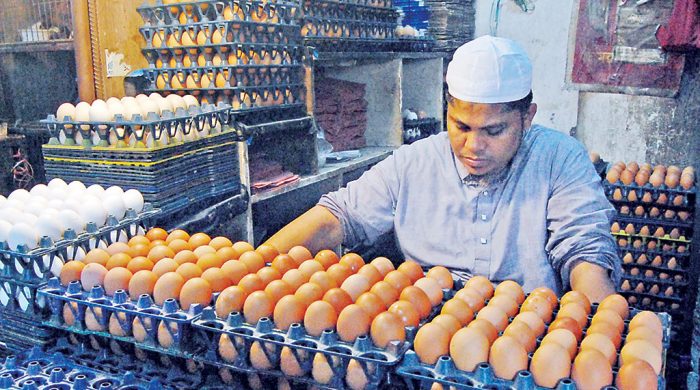
‘At night, most days I fry potatoes or sometimes an egg and eat them with rice and fried chillies. I cook extra and take the rest to work in a box the next morning,’ she said.
There is little room in her budget for eating out or buying snacks.
After work, as groups of workers hurry home, roadside markets come alive under yellow lights hanging from makeshift electrical wires.
Fish are laid out in rows, and vendors repeatedly splash water over them while calling out prices. Workers like Shilpi look at the fish but rarely have enough money to buy them.
In the morning, she takes a leguna because she has to reach the factory in time to mark her attendance. On her way home, however, she and her colleagues often walk to save on transport fares.
Illness is another expense she cannot comfortably afford.
‘When I fall ill, I often do not go to a doctor out of fear because buying medicine costs money too,’ she said.
There is something particularly unsettling about how ordinary these circumstances have become for her.
Shilpi does not describe them as an exceptional hardship. Her colleagues live in similar conditions. As almost everyone around her makes the same compromises, deprivation may gradually become part of the routine.
And Shilpi is not the only kind of worker the wage debate needs to account for.
Many garment workers live in Dhaka with their spouses and children. Their wages must support several people under one roof, covering rent, food, children’s education, transport and health care.
For a family living on one main factory salary, even a modest increase in the price of rice, vegetables or cooking oil can mean cutting back elsewhere.
An analysis by Bangladesh Policy Laboratory of the Bangladesh Bureau of Statistics’ 2022 Household Income and Expenditure Survey offers an indication of these pressures.
Among 144 sampled garment-worker households in urban Dhaka division, food accounted for 48.9 per cent of household expenditure, compared with 43.5 per cent among all urban households in the division.
Half of the garment households lived in a single room, compared with 32 per cent of other urban households. About 64 per cent shared toilets with other households.
The survey dates back to 2022, and its garment-household sample is relatively small, so it should not be mistaken for a current nationwide estimate.
Still, the findings suggest how little financial room these families have. The same analysis found that garment households had an average of 1.91 income earners, compared with 1.40 among all urban households.
In other words, more family members are working to sustain households that, on average, spent considerably less.
The nutritional implications deserve attention. When nearly half a household’s expenditure goes towards food, the question is not merely whether there is rice on the table, but whether the family can afford a varied diet.
Fish, meat, eggs, milk and other protein-rich foods can become occasional purchases rather than regular parts of meals.
Rice and inexpensive vegetables may fill stomachs, but a full stomach is not necessarily a nutritious one. The household survey does not diagnose malnutrition, but it shows the budgetary constraints that can undermine dietary diversity.
For workers who have to spend nine hours or more in factories, overtime often becomes a means of bridging the gap.
Some stay back to pay for a younger sibling’s education, support their parents or meet medical expenses at home. What is commonly described as an opportunity to earn extra money can become a necessity when regular wages are insufficient.
The wage-price gap
The demand for Tk 30,000 did not emerge overnight. The history of minimum wage revisions in Bangladesh’s garment industry is marked by periodic increases, followed by renewed pressure from workers as the cost of living rises.
The first wage structure was gazetted in December 1984, setting the entry-level monthly wage at Tk 627, effective from 1985. Subsequent revisions raised the minimum to Tk 930 in 1994, Tk 1,662.50 in 2006, Tk 3,000 in 2010, Tk 5,300 in 2013, Tk 8,000 in 2018 and Tk 12,500 in 2023.
The newly formed board is therefore the eighth wage-setting exercise since the process began. The 2023 revision raised the lowest-grade minimum wage from Tk 8,000 to Tk 12,500, effective from December 1 that year.
In nominal terms, the minimum wage has increased nearly twentyfold since the first structure. But nominal increases do not necessarily translate into better living standards.
A worker’s purchasing power depends on what their salary can buy, not simply how many times its numerical value has increased.
When food inflation stood at 10.76 per cent in November 2023, according to the BBS, the previous wage structure was being implemented. By September 2026, food inflation had moderated to 7.22 per cent, up from 7.02 per cent in August. Overall inflation stood at 8.34 per cent.
The lower rate should not be confused with falling food prices. Inflation measures how quickly prices rise, not whether they have returned to an affordable level. Years of price increases remain embedded in the cost of everyday necessities.
Bangladesh Bank’s July-September 2026 inflation report found that food inflation averaged 7.13 per cent during the quarter.
Protein-based foods, including fish, eggs, meat, milk and pulses, accounted for 51.1 per cent of food inflation’s contribution.
The report also found that national wage growth slowed to around 7.9 per cent in September, below headline inflation of 8.34 per cent. This is a national wage measure, not a garment-sector-specific figure, but it illustrates the continuing pressure on the purchasing power of workers like Shilpi.
Economic stakes
Bangladesh earned $38.70 billion from garment exports in FY2025-26, accounting for 80.62 per cent of the country’s total exports of $48 billion, according to BGMEA’s export-performance data.
The sector employs around four million people, generates more than 80 per cent of export earnings and contributes approximately 10 per cent of GDP, according to Reuters.
According to a BGMEA situation report, labour unrest disrupted production at 529 factories across Dhaka, Gazipur, Mymensingh and Savar-Ashulia on November 1, involving 987,190 workers who left their workplaces.
Gazipur and Mymensingh were the worst affected, with 276 factories reporting disruptions involving 645,360 workers.
Prolonged disruption could delay shipments, jeopardise commitments to international buyers and hold up payments from overseas customers.
In a competitive global market, buyers may look elsewhere if production and delivery schedules become unreliable. Such a shift would hurt manufacturers, the country’s export earnings and, ultimately, workers who depend on regular wages and overtime.
BGMEA president Mahmud Hasan Khan Babu, who was the BNP-nominated candidate for the Chuadanga-2 constituency in the 2026 national elections, said on November 1 that owners hoped normal production would resume the following day after the formation of the wage board.
‘If workers still do not return to work, it will be difficult to keep factories open day after day.’
The concerns of manufacturers about rising production costs, energy shortages, tight margins and competition from other apparel-producing countries cannot simply be dismissed.
A wage structure that makes factories uncompetitive could threaten employment. But neither can competitiveness rest indefinitely on wages that fail to meet workers’ basic needs.
The garment industry’s success is usually measured in export earnings, market share and the number of factories operating.
Those measures matter. But there is another measure that deserves equal attention: whether the people who produce those exports can afford to live decently.
The workers are the heart of the garment industry, just as the garment industry is the backbone of Bangladesh’s economy.
The sustainability of that economic success will depend, in no small measure, on whether workers can share in the prosperity their labour helps create.
Julfekar Dehan is a sub-editor at New Age.