Why is Bangladesh a death trap for children today?

- Update Time : Monday, May 25, 2026
- 31 Time
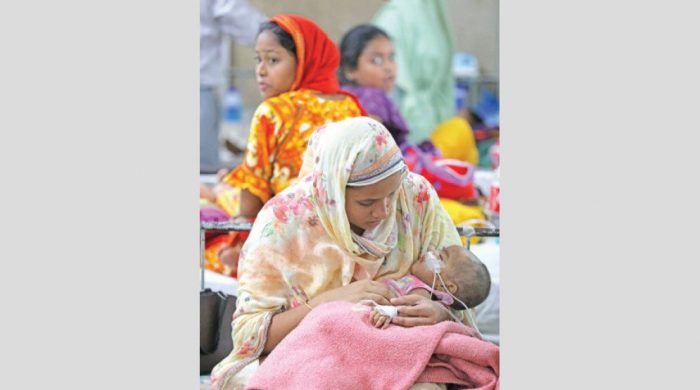
Have we completely forgotten these lines from poet Sukanta Bhattacharya’s poem Chharpatra (The Clearance)? In this country now, children are the most unprotected and unsafe. On one hand, the procession of child deaths from measles is growing longer and longer. According to data from the Directorate General of Health Services (DGHS), more than 500 children have died this year from measles and related symptoms until yesterday. This is currently the highest number of measles deaths in the world this year.
During the same period, the second-highest number of deaths from measles and its symptoms occurred in civil war-torn Sudan, where 371 children died. Yet, until March, Sudan was two steps ahead of Bangladesh in terms of the number of infections. Pakistan ranks third in the world for measles deaths this year, with at least 71 children dying from the disease. The occurrence of child deaths from measles is not merely a health issue; it is a stark example of the limitless negligence of the previous interim government.
In a recent UNICEF press conference, UNICEF Representative Rana Flowers stated that UNICEF had warned the Ministry of Health under the interim government in at least five letters regarding a potential vaccine crisis. They also conveyed the same message to government officials during 10 meetings. UNICEF believes that because the interim government altered the vaccine procurement process, the vaccines did not arrive in the country on time. This proves that these children were effectively killed—a killing for which the Chief Adviser of the interim government andhis Health Adviser bear responsibility. The people of the country demand the formation of an inquiry commission for this incident. People from various walks of life have demanded that those responsible for these child deaths be brought to justice. The government should immediately investigate the causes of this disaster, identify the culprits, and bring them under the law. If this does not happen, similar incidents will occur in the future. It is precisely because of this culture of impunity and lack of justice that child abuse has taken on an epidemic proportion in the country.
On one hand, the deaths of children infected with measles are breaking all records, while on the other, the entire nation is stunned by consecutive incidents of child rape and murder. Yet, despite this, it feels as though we are becoming progressively numb. It seems our emotions have rusted, and our humanitarian values are disappearing. Recently, incidents of rape and subsequent murder of girl children have increased in various parts of the country. This is raising anxieties and questions regarding the safety of children.
Data from Ain o Salish Kendra (ASK) shows that from 1 January to 20 May, 118 children fell victim to rape, and 46 children faced attempted rape. Following rape, 14 children were murdered, and three children were killed after failed attempts of rape. Two child victims of rape committed suicide. Furthermore, 115 children were murdered in various incidents from January to April.
An analysis of five recent incidents of rape and murder reveals that in all cases, the children fell victim to neighbors, relatives, or close acquaintances. Behind these incidents lies not just individual criminal tendencies, but a deep-seated social and cultural degradation. The spread of drug addiction, the easy availability of perverted online content, the lack of moral education in families and the education system, and the tendency to get away with crimes have made this situation even more horrific.
Because the judicial process for child abuse and murder cases is prolonged, victim families often fear being deprived of justice.
The question arises: why are such incidents suddenly increasing? Why are some people in society becoming so monstrous? The people of Bangladesh are historically peace-loving. The people of this country love children. Child abuse or child murder is not a part of our culture. In the past, social hatred would brew against those who committed such acts in isolated instances. But now, we are all somehow numb and emotionless. We even seem afraid to protest after such incidents.
In my view, there are three primary reasons for this. First, the culture of impunity. Second, the dominance of social media. Third, the sense of insecurity among people caused by mob culture.
During the one-and-a-half-year rule of the Yunus government, the culture of impunity seems to have institutionalized. A certain class has emerged in society under state patronage that considers itself above the law and justice. They loot police stations and kill police officers, yet there is no trial. They create anarchy in educational institutions, and everyone suffers silently. They attack and loot business establishments, and not even a case is filed against them. They publicly assault women, and no one stops them. They attack shrines (mazars) and force garlands of shoes around the necks of senior citizens, while the government provides silent support to these actions. The Yunus government took no action against this lawlessness. As a result, some miscreants have become unstoppable in society. They believe that no matter what they do, they will not face trial. The source of today’s horrifying child abuse lies exactly here. These monsters believe that whatever they do, they will not be judged; they are beyond reach. This culture of impunity is the primary reason for these atrocities across the country today.
Currently, the biggest source of panic in Bangladesh is social media. Social media has now become the primary platform for bullying, obscenity, and blackmail. A literal competition of violence and filth against women and children is taking place here. Gambling and pornography enjoy an unrestricted, roaring fair on social media today. The main task of some human-shaped beasts is to harass women and spread obscenity on social media. There is no law against cyber terrorism.
After the fall of Awami League government on 5 August 2024, the demand to repeal the Cyber Security Act came to the forefront. At that time, the then Law Adviser, Asif Nazrul, announced the abolition of the Digital Security Act without any proper planning. Without reviewing the reality and without taking feedback from stakeholders, the Digital Security Act was repealed in 2025. Instead of the Digital Security Act, Asif Nazrul issued the Cyber Security Act Ordinance.
The gazette stated that the Cyber Security Act of 2023 had been repealed; however, sections 17, 18, 19, 20, 22, 23, 30, 32, and 35 of that act would remain in force. But later, the law was amended. In the Cyber Protection Ordinance, sections 21, 24, 25, 26, 27, 28, 29, 31, and 34 of the Cyber Security Act were dropped. The ordinance stated that any pending cases, proceedings, or investigations under the aforementioned sections would be canceled, and no further action could be taken. Furthermore, sentences and fines imposed by courts or tribunals under these sections would be voided.
The sixth chapter of the law (sections 17 to 30) identified various cyber crimes and their punishments. Illegal access or hacking into critical information infrastructure; illegal access to computers, digital devices, computer systems, etc.; damage caused to physical infrastructure of computers, computer systems, and cyber space; gambling, forgery, fraud, terrorist activities, sexual harassment, blackmailing, publishing obscene videos, religious provocation, and spreading ethnic hatred and malice in cyberspace were considered offenses. However, issues like personal attacks, false propaganda, spreading fake information, and violating the right to personal privacy were ignored in this law.
Upon coming to power, the BNP government made some changes to the Cyber Security Ordinance during the first session of the National Parliament and enacted the Cyber Protection Act, which has already been passed in Parliament. This law, too, is incapable of providing protection to citizens. Cyber experts state that under this law, there is no punishment for relentlessly cyberbullying an individual. If someone uses AI to superimpose someone’s face onto another photo to assassinate their character, there is no legal remedy against it. The law does not mention the protection of children and women in cyberspace. There is no law to control unchecked pornography. Without understanding or knowing the depth of the issue, Asif Nazrul has left the general public in severe cyber vulnerability. He has held ordinary citizens hostage to cybercriminals.
Various mob forces have emerged during the tenure of the Yunus government. If one observes closely, those who are currently abusing and killing children have been inspired by seeing these mobs. It is evident in various places that law enforcement agencies face resistance from mob groups when trying to take action against child abusers. All small and large mob groups that emerged during the Yunus regime must be eradicated.
If we want to build a livable country for children, we must break out of this culture of impunity. Whoever the criminal is, they must be brought under the law. Strict measures must be taken against whoever is responsible for child deaths from measles. Exemplary, swift punishments must be ensured for those currently involved in child murder, and the rule of law must be established. A zero-tolerance policy against mob violence must be enforced immediately. Actions must be taken against those who engaged in mob activities in the past.
Only the establishment of the rule of law can provide protection to our children.
Audite Karim is a writer and playwright. Email: [email protected]