Eid rush to face familiar strains

- Update Time : Wednesday, May 20, 2026
- 29 Time
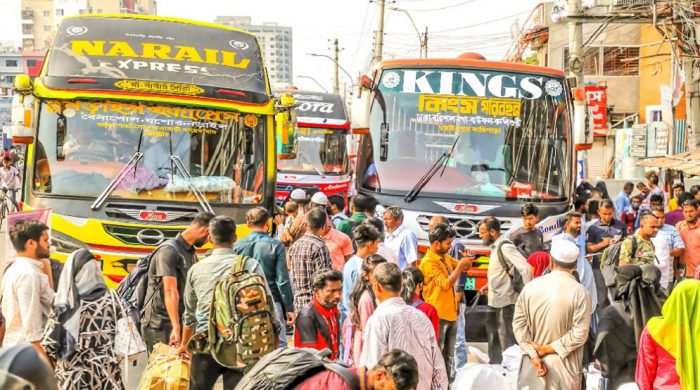
Transport shortages, traffic congestion, roadside cattle markets and ongoing road construction works may disrupt travel during the Eid-ul-Azha exodus with authorities identifying 94 traffic-jam-prone locations on highways across the country.
According to Highway Police, construction work, illegal roadside stands and markets, and poor road maintenance are among the main causes behind recurring congestion on key national highways.
Police have identified seven congestion-prone points each on the Dhaka-Aricha and Dhaka-Mymensingh highways, 25 each on the Dhaka-Rangpur route and the Dhaka-Chattogram highway, 21 on the Dhaka-Sylhet highway, eight on the Chattogram-Cox’s Bazar highway and one on the Dhaka-Barishal route.
On the Dhaka-Sylhet highway, authorities warned of possible delays near the western side of Kanchan Bridge and near Green University because of ongoing road construction. Traffic disruptions are also feared near Itakhola Bus Stand, where flyover construction under the Dhaka-Sylhet highway widening project and a narrow diversion road could slow vehicle movement.
The police report also noted that manual toll collection at Meghna toll plaza may hamper traffic flow on the Dhaka-Chattogram highway.
Additional Deputy Inspector General of Bangladesh Highway Police Muntasirul Islam said authorities had prepared a detailed operational plan to prevent congestion from escalating.
“We have received 1,000 additional personnel from headquarters and they will be deployed on highways from May 20,” he said, adding that CCTV cameras had been installed at key intersections, including Chandra, while senior officers would remain in the field throughout the holiday period.
Alongside congestion concerns, passengers, police officials and transport planners warned of a persistent shortage of public transport during Eid travel, forcing many travellers to rely on unsafe or unfit vehicles. A senior highway police official, speaking on condition of anonymity, said transport shortages become acute during every Eid season.
He recalled seeing garment workers travelling home in trucks during the previous Eid holiday because they had no alternative.
“There were women and children inside the trucks,” he said. “It became difficult to enforce the law when people were taking risks because they had no other way to reach home.”
Rafiqul Islam, a private-sector employee in Dhaka, said he had previously travelled to his home in Shariatpur on a city minibus operating between Sadarghat and Jatrabari because regular intercity services were unavailable.
“I had no option,” he said, adding that many buses on his route had shifted elsewhere in search of higher profits. Adil Mohammed Khan, a professor of Urban and Regional Planning at Jahangirnagar University and former president of the Bangladesh Institute of Planners, said rapid urban migration had created a complex transport situation in which existing systems struggled to cope with Eid demand.
“During Eid, transport demand rises several times over,” he said. “That is why people risk travelling in unfit buses, microbuses and even Lagunas.”
He also called for stronger action against illegal and unfit vehicles carrying passengers during the festive travel period.