Notice ::
Yunus’s wealth, deception and fraud

Audite Karim
- Update Time : Tuesday, May 19, 2026
- 94 Time
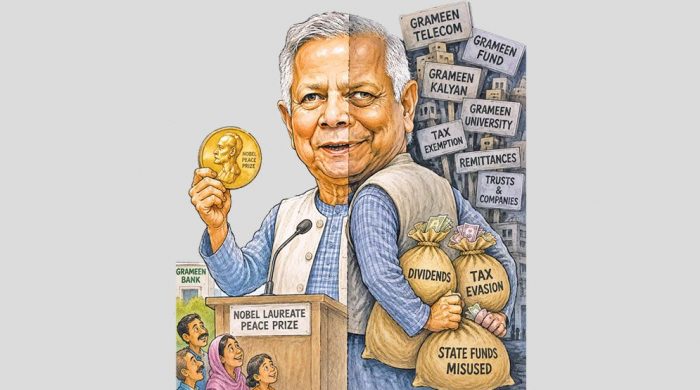
Prof Muhammad Yunus is a Nobel Peace Prize laureate. He has served as the chief adviser to the interim government for a year and a half.
Yet, overshadowing everything else, he may ultimately be remembered as a self-centred, selfish and greedy individual. Whether or not Prof Yunus achieved anything for the country while leading the interim government, he undoubtedly secured various privileges and benefits for himself.
An examination of Yunus’s life suggests that, just as he allegedly abused state power during his eighteen-month tenure as chief adviser to secure financial gains, he has spent much of his life building immense wealth through ventures financed by state resources.
Under the guise of poverty alleviation, he established non-profit organisations and became wealthy by using state assets.
This is Muhammad Yunus. He remains silent regarding the country’s problems. He is absent during times of national crisis and celebration alike, yet he is highly vocal abroad when it comes to his personal interests. He shows no remorse over the deaths of children caused by hunger.
However, he was deeply grieved by the death of Ted Turner and sent a message of condolence. Yunus once declared that he would send poverty to the museum through microcredit.
Poverty, however, did not end up in the museum; instead, he displayed what many would describe as a remarkable spectacle of wealth and luxury.
Today, under the banner of “Social Business”, he delivers lectures across the globe. Whether social business succeeds or not, his own wealth has continued to expand.
From being a university teacher, he has become a billionaire. According to his critics, this wealth has been accumulated through the exploitation of the poor, the evasion of government taxes and the misuse of state resources.
Although an economist by profession, Prof Yunus received the Nobel Prize for Peace. He began researching microcredit operations in Jobra village and later approached the Government of Bangladesh with the claim that he could help make the poor self-reliant. Following his proposal, the government of Hussain Muhammad Ershad established Grameen Bank, where Prof Yunus became Managing Director. In 1983, the bank formally began operating as an independent institution. The government established Grameen Bank through legislation and appointed Prof Muhammad Yunus as its Managing Director. On 4 September 1983, the government issued the Grameen Bank Ordinance (Ordinance No. 46). At the time, Grameen Bank began with a capital of only Tk3 crore. Of this amount, Tk1.8 crore came from the government, while Tk1.2 crore came from borrowers. Prof Yunus himself invested none of his own money in the bank. Yet, according to his critics, he used Grameen Bank as the foundation for his vast personal success. On paper, the owners of Grameen Bank are the government and its borrowers. However, critics allege that Prof Yunus used his influence to divert state and public funds for personal benefit. Through Grameen Bank, Prof Muhammad Yunus established 28 institutions under his control and allegedly became the owner of wealth worth thousands of crores of taka through the misuse of state and institutional funds.
Since the inception of Grameen Bank, donor groups have provided grants and loans to the institution. Critics argue that if all grant money had gone directly to the state and the people, Prof Yunus would not have personally benefited. Consequently, using donor grant money, he established the Social Venture Capital Fund (SVCF). On 7 October 1992, a decision was made to create a separate entity using this fund. In 1994, a limited company called “Grameen Fund” was established, and Tk49.10 crore was transferred to it. Critics claim that attempts to divert foreign funds through the image of Grameen Bank existed from the very beginning. Although Grameen Bank was a state-backed institution, Prof Yunus reportedly made decisions single-handedly as managing director. The board of directors, according to critics, was structured in such a way that no one would challenge him.
On 19 December 1993, the 34th board meeting of Grameen Bank took place. During that meeting, a decision was made to establish the Social Advancement Fund (SAF) using grants and loans from donor agencies. However, donor groups objected to the diversion of funds from Grameen Bank, stating that such transfers amounted to fraud. Prof Yunus then reportedly adopted a different strategy. Through a formal letter, he claimed the decision had been made in error and promised to exercise greater caution in future. Later, on 25 April 1996, he presented a proposal at a Grameen Bank board meeting to establish “Grameen Kalyan”.
The proposal stated that “Grameen Kalyan” had been established under the Companies Act 1994 for the welfare of Grameen Bank’s members and employees. The board approved the proposal, and the institution became an affiliate of Grameen Bank. Its status as a subsidiary was reflected in the manner in which its capital was formed. Grameen Kalyan received Tk69 crore from Grameen Bank’s Social Advancement Fund. The Memorandum of Articles of Grameen Kalyan also demonstrated its close connection to Grameen Bank. According to the memorandum, two of the nine members of its governing body would be nominated representatives of Grameen Bank, while the Chair of Grameen Kalyan would likewise be nominated by the bank. Prof Yunus subsequently became Chairman of Grameen Kalyan as Grameen Bank’s nominee.
Critics argue that Grameen Kalyan later became Prof Yunus’s “golden goose”. Through Grameen Kalyan, he established numerous institutions, including Grameen Telecom Ltd., Grameen Distribution Ltd., Grameen Shiksha, Grameen Knitwear Ltd., Grameen Byabosha Bikash, Grameen IT Park, Grameen Capital Management, Grameen Solutions Ltd., Grameen Danone Foods Ltd., Grameen Healthcare Services Ltd., Grameen Star Education Ltd., Grameen Fabrics and Fashion Ltd., and the Grameen Krishi Foundation.
Similarly, through Grameen Fund, which was modelled on Grameen Kalyan, several additional institutions were established. These included Grameen Capital Management Ltd., Grameen Solutions Ltd., Grameen Udyog, Grameen Itech Ltd., Grameen Cybernet Ltd., Grameen Knitwear Ltd., Grameen IT Park, Tulip Dairy and Products Ltd., Globe Kids Digital Ltd., Grameen Biotech Ltd., Grameen Cyber Net Ltd., Grameen Star Education Ltd., Rafiq Auto Vano Manufacturer Ltd., Grameen Information Highway Ltd., Grameen Byabosha Seva Ltd., and Grameen Samogree.
Critics point out that both Grameen Kalyan and Grameen Fund were created using Grameen Bank’s funds and through decisions taken at its board meetings. Consequently, the institutions established through these entities are effectively component units of Grameen Bank. However, while representatives of Grameen Bank sat on the boards of Grameen Fund and Grameen Kalyan until 2020, no such representatives have served there since 2021. According to decisions taken by the Grameen Bank Board of Directors, the Chair of these organisations should be nominated by Grameen Bank. Nevertheless, Prof Muhammad Yunus still remains Chairman of both Grameen Kalyan and Grameen Fund. Critics describe this as a striking example of privately controlled institutions being built using public wealth.
Among the 28 institutions established through Grameen Kalyan and Grameen Fund, all except Grameen Telecom are reportedly loss-making ventures. Grameen Telecom owns a 34.2% stake in Grameenphone, the country’s largest mobile network operator. In 2022, Grameenphone reportedly made a net profit of Tk3,009.16 crre after paying taxes and VAT. This means Grameen Telecom receives more than Tk1,000 crore annually in net profit from Grameenphone. Critics argue that Grameen Telecom has little operational function beyond managing and distributing dividends from Grameenphone. Prof Yunus remains Chairman of the institutions created through Grameen Kalyan, while Managing Directors are reportedly appointed from among his close associates and loyalists. Critics allege that one of the principal aims of these institutions is the diversion of Grameen Telecom’s profits and the evasion of taxes.
According to these allegations, Grameen Telecom distributed 42.6% of its dividend income from Grameenphone Limited to Grameen Kalyan in violation of Sections 28 and 29 of the Companies Act 1994, despite the fact that Grameen Kalyan is not a shareholder in Grameenphone Limited. Under the law, critics argue, the entire dividend income of Grameen Telecom should have been treated as its own revenue and taxed accordingly at the applicable corporate rate. However, audited accounts allegedly show that nearly half of Grameen Telecom’s dividend income was transferred to Grameen Kalyan, while only advance income tax was paid at a rate of 10%-20%. During the relevant periods, the corporate tax rate allegedly ranged between 35% and 37.5%. Critics therefore claim that this discrepancy amounted to tax evasion.
If all allegedly evaded taxes are aggregated, critics estimate the amount at nearly Tk1,000 crore for Grameen Telecom alone. Similar allegations of tax evasion have also been levelled against other institutions controlled by Prof Yunus, as well as his personal tax filings. Lawsuits were reportedly filed regarding these matters, and the High Court directed Yunus to pay approximately an additional Tk1,200 crore in outstanding taxes. At the time, Yunus reportedly stated that he would comply with the court’s order, maintaining that he had not evaded taxes but had merely sought judicial clarification. Critics allege, however, that following the political transition of 5 August, Prof Yunus used his authority to have those cases withdrawn.
During the 28 years of Grameen Telecom’s operations, critics claim that nearly Tk1,000 crore in taxes was evaded. According to these allegations, Prof Yunus consistently underpaid taxes each year. From 1997 to 2005, when the applicable tax rate was 35%, only 10% was allegedly paid. From 2006 to 2008, the institution allegedly paid 15% instead of 35%. From 2009 to 2022, critics allege that Grameen Telecom paid only 20% despite a tax rate of 35%. Critics further claim that Prof Yunus filed multiple lawsuits and writ petitions in an effort to avoid legal accountability regarding these tax matters. They argue that investigations by state and regulatory authorities documented repeated instances of tax evasion by both Prof Yunus and the institutions under his control. During his eighteen months in office, critics allege that Yunus halted all ongoing NBR cases and investigations against him.
Prof Muhammad Yunus reportedly maintains three bank accounts: one with Southeast Bank, one with Standard Chartered, and one with Rupali Bank. Critics identify the Southeast Bank account, opened in 2000, as his principal personal account. Between 2000 and 2023, remittances totalling Tk118,27,76,368 were reportedly deposited into this account. The largest portion – Tk47,89,96,652 – allegedly arrived during the tenure of the military-backed caretaker government. It was during that same period that Prof Muhammad Yunus attempted to form a political party. Critics therefore raise the question of whether foreign funds entered the country to support depoliticisation efforts during the 1/11 period.
According to an analysis of Prof Muhammad Yunus’s tax records, he reportedly declared remittances totalling Tk97,04,61,191 in his tax file for the 2005-06 assessment year. However, critics claim that the actual remittance received in his Southeast Bank account during the same period was Tk115,98,96,024. They therefore allege that he concealed remittance information worth Tk18,94,34,835 in order to evade taxes. Critics further claim that these concealed funds were transferred to other accounts at Southeast Bank, including accounts associated with Travel International Ltd. Such transfers, they argue, are indicative of money laundering practices.
Similar allegations are raised regarding subsequent assessment years. Critics claim that Prof Yunus repeatedly concealed significant portions of remittance income in his tax filings in order to reduce his tax liabilities. According to these allegations, discrepancies amounting to several crores of taka appeared year after year between the remittances deposited into his accounts and the amounts declared in his tax returns.
Critics further allege that, in the 2020-21 fiscal year, Prof Yunus withdrew most of the funds from his personal account in order to establish the “Yunus Trust”, whose income is exempt from taxation. They claim he adopted this strategy to avoid taxes while failing to pay the required 15% tax applicable to such transfers. A lawsuit was reportedly filed over this matter, and critics claim that he lost the case. According to them, the trust engages in little genuine social welfare activity and primarily covers the personal expenses of Prof Yunus and his family.
Critics argue that throughout his life Yunus used state-backed institutions to advance his personal interests, and that he acted similarly once in power. According to these allegations, after Prof Yunus assumed office as chief adviser, various Grameen-affiliated institutions began receiving government approvals, registrations and tax exemptions. These included approval for a private university named “Grameen University” in Dhaka, a manpower export licence for Grameen Employment Services, and permission for Grameen Telecom to launch a digital wallet service. In addition, Grameen Bank reportedly received tax waivers, while the government’s ownership stake in the bank was reduced from 25% to 10%.
Critics also question the rapid dismissal of labour law violation and money laundering cases involving Prof Yunus and his associates. Grameen University, which will operate under the Grameen Trust, reportedly received approval within three months of its application being submitted on 17 December 2024, making it the first private university approved under the interim government. In January 2025, Grameen Employment Services Limited reportedly secured a manpower export licence from the BMET and, in April, gained membership of the Bangladesh Association of International Recruiting Agencies (BAIRA). Shortly after Prof Yunus assumed office as chief adviser, “Samadhan Services Limited”, a subsidiary of Grameen Telecom, reportedly received approval on 2 September 2024 to operate as a Payment Service Provider after obtaining a No Objection Certificate from Bangladesh Bank.
On 17 April 2025, the interim government reportedly decided to issue a new ordinance for Grameen Bank reducing the government’s ownership from 25% to 10%. The meeting was chaired by Chief Adviser Muhammad Yunus himself. Under the proposed ordinance, borrowers’ ownership would rise from 75% to 90%, while the government’s role in appointing the Chair of the Board would be abolished.
On 10 October 2024, two months after Prof Yunus became chief adviser, the National Board of Revenue reportedly granted Grameen Bank a five-year tax exemption valid until 2029. In addition, only three days after Prof Yunus assumed office on 8 August, a Dhaka court acquitted him in a money laundering case. The day before he took the oath of office, Yunus and other directors of Grameen Telecom were also acquitted in a labour law violation case in which they had previously been sentenced to six months’ imprisonment.
Critics conclude that, whenever Yunus found an opportunity, he expanded his wealth through deception and manipulation. Upon receiving the Nobel Prize in 2006, Yunus famously declared that poverty would one day be confined to a museum. Yet, according to his detractors, poverty in Bangladesh has continued to rise over the past 26 years, with the number of poor people increasing significantly during his administration. Meanwhile, they argue, Yunus himself became even wealthier. In their view, his immense fortune was not built through hard work alone, but through the accumulation of wealth made possible by deception and misuse of public resources.
Audite Karim is a writer and playwright. Email: [email protected]
More News of This Category