1,600 drug kingpins active across 162 entry points

- Update Time : Monday, May 18, 2026
- 27 Time
Anti-drug operations launched nationwide following the government’s announcement have so far failed to significantly curb drug trafficking activities. Even after 17 days of the crackdown, there has been little visible impact, and top-level drug kingpins remain beyond the reach of law enforcement. While several major drug consignments were seized at the beginning, the momentum of the operation has gradually slowed.
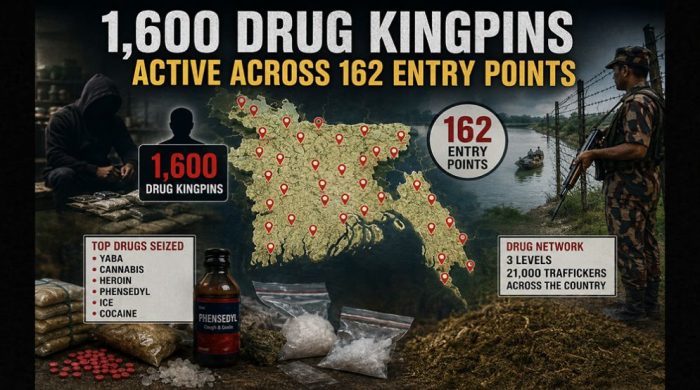
Officials and analysts say that law enforcement activity was nearly absent during the previous interim administration, creating an opportunity for traffickers to expand operations. As a result, the situation remains largely uncontrolled. Despite ongoing operations, drugs continue to enter the country through 162 points across 29 border districts. Narcotics are also reaching remote areas, with rising supplies of yaba, cannabis, heroin, and phensedyl.
Police and the Department of Narcotics Control (DNC) said plans are underway to intensify the special operation. Police headquarters have sent special directives to drug “red-zone” districts, while the Ministry of Home Affairs has instructed the Border Guard Bangladesh to maintain strict border surveillance.
According to intelligence reports, at least 1,600 drug kingpins are active nationwide. The trafficking network operates in three layers and involves at least 21,000 traffickers. The highest concentration of dealers is reportedly in Dhaka, Chattogram, Rajshahi, and Khulna.
Sources say traffickers are now using increasingly sophisticated methods and disguises. A DNC official noted that their tactics have become so advanced that many are difficult to detect unless internal conflicts expose them.
Crime analyst and Dhaka University Associate Professor Touhidul Haque said that without a coordinated approach and a genuine zero-tolerance policy, drug control efforts will never succeed. He stressed the need for greater use of technology at border areas and stronger monitoring of whether any officials are involved in trafficking networks.
DNC Director (Operations) Md. Bashir Ahmed said that special anti-drug operations are being conducted nationwide following the government’s declaration, and many arrests and drug seizures have already taken place. He added that authorities are working to implement a strict zero-tolerance policy.
Police headquarters Assistant Inspector General (Media) A.H.M. Shahadat Hossain stated that many street-level dealers and carriers have already been arrested and are being questioned to identify major kingpins.
Statistics show that the flow of drugs has increased sharply. In 2024, authorities seized 22.85 million yaba tablets nationwide; last year the figure rose to 43.56 million. Authorities also seized 166 kilograms of heroin, 14.5 kilograms of cocaine, more than 96,000 kilograms of cannabis, and over 319,000 bottles plus 81 liters of phensedyl.
DNC data further showed the seizure of crystal meth (“ice”), shisha products, ketamine, cannabis kush, and more than 120,000 tapentadol tablets—substances that had little presence in the country just a few years ago. Western-origin drugs have also reportedly become increasingly popular among wealthy youth.
Officials say almost every border district is now being used for drug smuggling. Traffickers from neighboring India and Myanmar continue supplying drugs through porous border routes, with long-standing allegations of Rohingya involvement in some trafficking activities.
Source : Bangladesh Paratidin