International Women’s Day today

- Update Time : Sunday, March 8, 2026
- 41 Time
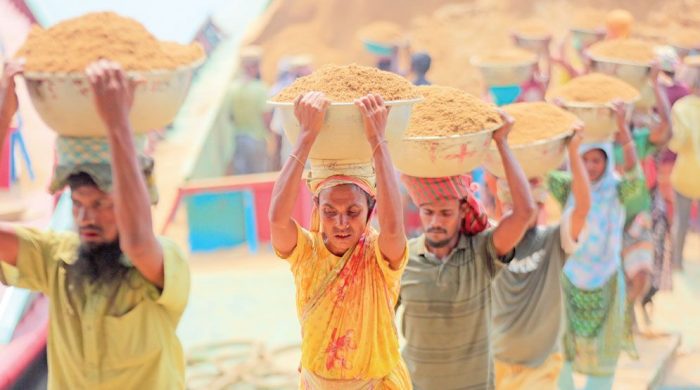
International Women’s Day is being observed today across the country as elsewhere in the world with the theme “Rights. Justice. Action. For ALL Women and Girls”.
President Mohammed Shahabuddin and Prime Minister Tarique Rahman have issued separate messages marking the day.
Prime Minister Tarique Rahman, in his message on Saturday, said his government is giving top priority to ensuring women’s safety with taking a strict stance to stop cyber-bullying and online harassment against women.
Extending his sincere greetings and congratulations to all women around the world on the occasion, PM Tarique said, “A country’s development can only be sustainable when women’s rights, education, health, safety, and participation are ensured.
In this context, this year’s theme – “Rights. Justice. Action. For ALL Women and Girls,” is very meaningful and timely.”
“Women make up nearly half of the world’s population. No country can achieve real development if women are kept outside the mainstream of government, politics, and decision-making. In particular, without women’s economic empowerment, it is not possible to achieve balanced development both at home and in society.”
Tarique went on to say, “The Proclaimer of Independence, Shaheed President Ziaur Rahman, and the Mother of Democracy Begum Khaleda Zia played groundbreaking roles in empowering women politically and economically. During President Zia’s tenure, a Women’s Affairs Division was established in 1976 under the President’s Secretariat. Later, in 1978, the Ministry of Women’s Affairs was formed, and in 1994, during the government of Begum Khaleda Zia, it was transformed into the Ministry of Women and Children’s Affairs.”
To strengthen women’s socio-economic empowerment, Begum Khaleda Zia introduced free education for girls up to the 12th grade, he noted, adding, “This was a revolutionary step in empowering women in Bangladesh. Continuing that legacy, the current government has introduced the Family Card, which will be issued in the name of the female head of the family to promote women’s economic empowerment. The government is committed to ensuring women’s active and meaningful participation in education, the economy, health, politics, and all areas of national life.
“As part of our election commitments, our goal is to gradually introduce free education up to the postgraduate level, increase women’s participation in higher education, provide free school uniforms for girls, expand digital learning opportunities, and strengthen a modern education system.”
The government is also giving the highest priority to ensuring women’s safety, he further said, adding, “We have taken a strong stance against cyberbullying and online harassment targeting women.
“We want to build a Bangladesh where women and men enjoy equal rights and opportunities – a Bangladesh where women can work with dignity, respect, and safety in their families, communities, and the nation. Let equality be our commitment, dignity our reality, and empowerment the foundation of our development.”
The United Nations has been observing the day as International Women’s Day since 1975. The theme of day this year is- “Rights, Justice and Opportunities for All Women.”
The day will be celebrated worldwide through various programmes to highlight the need for immediate action, not just discussions, regarding women’s rights and dignity, and celebrate women’s economic, political and social achievements.
The objective of the theme is to encourage everyone to contribute to establishing gender equality in society. It also aims to promote women’s empowerment through cooperation, support and sharing of resources, conveying the message that the development of women equally benefits society and the economy.
The observance of the day has its roots in the historical struggle of women workers to secure their rights. In 1857, women workers from textile factories took to the streets in New York in the United States to protest wage discrimination, demand fixed working hours and oppose inhumane working conditions. The procession faced repression by government forces.
On 28 February 1909, the first international women’s conference was organised at a women’s rally arranged by the Social Democratic women’s organisation in New York under the leadership of German socialist leader Clara Zetkin.
Clara, a German politician and one of the architects of the German Communist Party, later proposed at the second International Women’s Conference held in Copenhagen, Denmark in 1910 that March 8 be observed annually as International Women’s Day.
Around 100 women representatives from 17 countries attended that conference and decided that the day would be observed from 1911 as a day for women’s equal rights. Socialists from different countries came forward to observe the day, and from 1914, March 8 began to be celebrated in several countries.
United Nations formally recognised March 8 as International Women’s Day in 1975 and called upon countries to observe it. Since then, the day has been celebrated across the globe with due importance, with a specific theme announced every year.
In Bangladesh, various programmes have been taken at the national level under the auspices of the Ministry of Women and Children Affairs to observe the day. Different offices and organisations have also undertaken diverse initiatives to mark the day.