Energy, banking, jobs crucial tasks for new govt

- Update Time : Monday, February 16, 2026
- 22 Time

Energy security, aligning fiscal and monetary policies, and strengthening banking reform will be most critical economic issues for the new government to be formed by the Bangladesh Nationalist Party, said economists.
BNP swept the 13th Jatiya Sangsad elections of February 12 and is set to form government again after a gap of almost two decades.
Economists said that an effective communication strategy would also be no less critical for the upcoming government to convince people satisfactorily on how to implement its electoral pledges such as family card to protect low-income households, farmer card for fair prices, subsidies, credit access, recruitment of one lakh healthcare workers and creation of one crore jobs.
‘People want the implementation of the electrical pledges overnight,’ said former World Bank Dhaka office chief economist Zahid Hussain while highlighting the importance of an effective communication strategy to make comprehensible to the general people how the electoral pledges would be implemented and to prevent criticisms in this connection.
According to him, the traditional announcement of the national budget for the financial year of 2026-27 in the first week of June should be utilised by the new government to communicate the strategy to implement its pledges.
Economists viewed that preparing an implementable budget would be an immediate challenge for the new government in addition to addressing inherent problems in energy and banking sectors.
Without addressing those issues, the economy will continue to suffer from falling growth, growing poverty and unemployment, low private investment, and elevated inflation.
Economic growth fell from 7.17 per cent in FY 2021-22 to 3.9 per cent in FY 20024-25 while a World Bank report released in November 2025 said that nearly 6.2 crore people — about one-third of the country’s population — remained vulnerable to falling back into poverty in addition to the four crore people already living below the poverty line.
According to Bangladesh Institute of Development Studies director general AK Enamul Haque, poverty is bound to rise if economic growth fell below 4 per cent in Bangladesh.
Expecting the new political government to streamline economic rules and regulations to attract domestic investment, he said that job generation was crucial.
The rate of unemployed graduates stood at 13.5 per cent, which more than doubled over the past eight years, according to the Labour Force Survey 2024.
The BIDS DG said that only a rules-based society with transparency in all kind of economic activities could address the challenges hampering the economic potential of the country over the past decade.
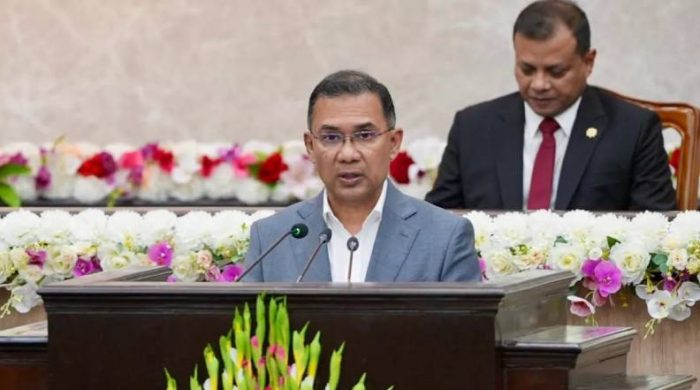
At a press conference in the capital on Saturday, BNP chairman Tarique Rahman identified the maintenance of law and order and reviving the economy, among others, as the main challenges for the new government.
Inheriting a fragile economy — caused by economic mismanagement, corruption, ruination of institutions and the patronisation of oligarchs by the AL regime — the outgoing interim government managed to check the dollar shortage and increase the foreign currency reserves.
The AL regime was ousted in August 2024 amid a mass uprising.
The maladies in the energy sector because of the presence of controversial power plants like the Adani Godda Thermal Power Plant in Jharkhand, India and around two dozen fuel oil-based rental power plants have continued to pressurise the economy’s fiscal side amid a low revenue generation.
The shortage of natural gas on the back of a high demand by industrialists should get special attention, said Masrur Reaz, chairman and chief executive officer of Policy Exchange Bangladesh.
Last but not the least, logistics for smooth exports and imports are highly important as the country’s transition from the LDC bloc largely hinges on the operation of congestion-free ports.
On November 24, the country will leave the LDC bloc to face greater competition in the global trade as the country’s promotion to the higher level will dry up the benefits it is enjoying as an LDC.
The country’s main sea port in Chattogram often faces congestion because of inefficiency in management by the port authority and wildcat strikes.
Enhancing port efficiency has become an automatic imperative, observed Masrur Reaz.
The new government has to decide whether the deal negotiated by the interim administration on leasing out the New Mooring Container Terminal at the port to United Arab Emirates-based DP World would be finalised or not.
Three ports under Chittagong Port Authority have already been leased to foreign operators.
Despite challenges, the new government is likely to get relief from the falling commodity prices in the global market.
The World Bank’s Commodity Markets Outlook, released in October 2025, projected a continued decline in global commodity prices in 2026, falling by about 7 per cent for the fourth consecutive year, reaching a six-year low due to weak global growth, oil surplus, and trade tensions.
As an import-dependent country, Bangladesh will benefit from falling prices, said Zahid Hussain.
The pressure on fiscal side for importing primary energy such as fuel oils at less than $70 dollar per barrel is sustainable, observed economists.